Print Story
X




How floating wetlands are reviving Pakistan’s water ecosystems
| P |
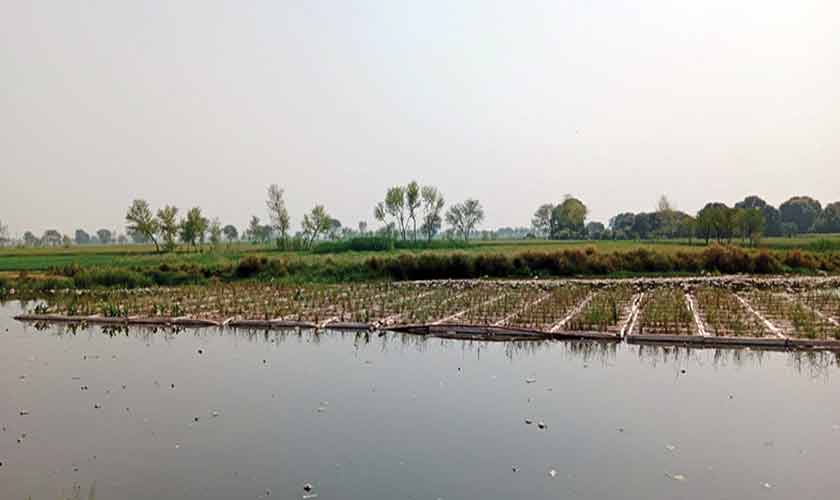
akistan’s per capita water availability has declined dramatically from around 5,600 cubic metres in 1947 to nearly 930 cubic metres today, placing the country well below the international water scarcity threshold of 1,000 cubic metres per person per year. Against the backdrop of this deepening water crisis, a quiet transformation is unfolding across wastewater ponds in communities, industrial zones and university campuses in the Punjab. Where stagnant wastewater once collected, clusters of lush green plants now float gently on the surface. Birds perch along the edges of the vegetation; fish weave through the intricate network of roots below. For nearby communities that once avoided these polluted water bodies, the change is visible and surprising. To the casual observer, these floating islands of plants may appear decorative. In reality, they are part of a carefully designed ecological system that is gradually cleaning polluted water while restoring life to it.
These floating islands are known as floating treatment wetlands, a nature-based solution that the WWF-Pakistan has been piloting and scaling since 2019 across 15 locations in the Punjab. The installations can now be found in diverse settings, including Faisalabad’s Chokera industrial zone, community ponds in Khushab, Multan, Lahore and Gujranwala, and some ponds within university campuses and botanical gardens.
Each site tells a similar story: water bodies once overwhelmed by untreated wastewater are slowly regaining ecological balance.
A growing water pollution challenge
Pakistan’s freshwater ecosystems are under increasing pressure. Rapid urban expansion, industrial growth and limited wastewater treatment infrastructure mean that many urban drains, ponds and canals receive untreated or partially treated wastewater.
The consequences are visible across the country: deteriorating water quality, nutrient pollution and the disappearance of aquatic biodiversity.
For many municipalities, industries and communities, installing large-scale wastewater treatment plants remains financially and technically challenging. Recognising this gap, WWF-Pakistan’s freshwater programme began exploring practical and scalable solutions that could work within Pakistan’s environmental and economic realities. Resultantly, floating wetlands emerged as one such opportunity.
“WWF-Pakistan has been working on nature-based solutions for wastewater treatment; floating wetlands is one such NbS,” says Sohail Ali Naqvi, WWF-Pakistan’s Freshwater Programme director.
“WWF has been working on this technology in collaboration with the National Institute for Biotechnology and Genetic Engineering for nearly 8 years and have installed 15 floating wetlands in five cities in Pakistan.”
“That treated water can be used for agriculture and horticulture purposes. We look forward to taking it to a more advanced level to make a clear business case.”
How do floating wetlands work?
Floating treatment wetlands draw on a simple but powerful scientific principle: aquatic plants and microorganisms can naturally remove pollutants from water. However, translating this principle into functioning systems requires careful design.
WWF-Pakistan began piloting floating wetlands in different types of water bodies in collaboration with research institutions like the NIBGE, and universities like the University of Engineering and Technology, Kala Shah Kaku, and Bahauddin Zakariya University, Multan, along with the private sector.
Floating treatment wetlands draw on a simple but powerful scientific principle: aquatic plants and microorganisms can naturally remove pollutants from water.
Each intervention is installed while adapting to local conditions such as water depth, pollution levels and water flow patterns. Floating mats are planted with aquatic species capable of thriving in nutrient-rich environments. These wetlands typically include plants such as phragmites (common reed), canna indica, water lily and other aquatic species known for their pollutant filtering abilities.
Once installed, the plants’ roots extend beneath the floating platforms into the water column. Over time, they form dense biological networks where beneficial microorganisms colonise and begin breaking down pollutants. Nutrients are absorbed by plants, suspended particles settle within root systems and microbial activity helps degrade contaminants.
Science backed by evidence
While floating wetlands are visually striking, their true impact lies in the data. Water quality monitoring conducted before and after installation of the floating mats has shown measurable improvements in key indicators such as biological oxygen demand (BOD), chemical oxygen demand (COD), total dissolved solids (TDS) and total suspended solids (TSS). Equally important is the ecological recovery that follows.
Water bodies that once appeared lifeless gradually begin to attract birds, insects, fish, turtles, snakes, dragonflies, slugs and frogs (as reported by locals). The floating vegetation provides shelter, breeding grounds and feeding habitats, turning degraded water surfaces into functioning ecological spaces.
For nearby communities, these changes are both environmental and practical. The treated water is reused for irrigation, horticulture, groundwater recharge, aquaculture, livestock watering and other agricultural purposes.
Bridging science, practice and policy
Floating wetlands also offer valuable insights for Pakistan’s evolving water governance landscape. As the country grapples with water pollution and climate impacts, nature-based solutions are gaining increasing attention within national policy frameworks. Floating wetlands align with priorities outlined in the National Water Policy, which calls for improved water quality management, and the Pakistan Climate Change Policy, which encourages ecosystem-based approaches for environmental restoration. At the global level, such interventions contribute directly to Sustainable Development Goals, particularly SDG 6 (clean water and sanitation) and SDG 13 (climate action).
A solution for Pakistan’s water future
Pakistan’s water crisis is complex and will require a mix of engineering infrastructure, stronger governance and behavioural change. Floating wetlands are not a replacement for conventional wastewater treatment plants but they offer a powerful complementary approach that is adaptable, cost-effective and ecologically restorative.
The writer is a water stewardship and sustainability professional with experience in water-positive solutions, groundwater governance and cross-sector collaboration in water-stressed regions. She has an MSc in water science, policy and management from the University of Oxford.