Print Story
X




Art has never captured time; it has always reshaped it
| B |
efore the invention of photography, painting and other visual arts were the only means of stopping time. An artist observes human beings, beasts, birds, plants, the sky, clouds, sunshine, the sea, lightning and other natural phenomena and depicts them on two-dimensional surfaces or in three-dimensional forms. Oil paintings, stone statues and pastel drawings, among other techniques, have often been considered inherently naturalistic, as they possess the potential for accurate resemblance. For this reason, they have been preferred by art enthusiasts and appreciated by the general public. Art students, teachers, critics and historians have furthered this fallacy by classifying works produced in these mediums as ‘realistic.’
This overlooks the fact that reality is not frozen in a nanosecond. A model posing for a picture breathes, shifts and blinks during the time their image is being portrayed. Sculpting in any material involves multiple sittings, with intervals in which the model must resume the same position. Similarly, when a painter renders a landscape, they are aware of its fleeting nature. Leaves stir, cows graze, crows fly, water ripples, light shifts in intensity and shadows change in tone, direction and width. It is, therefore, impossible to record a single moment. Any claim to capture an instant, if presented as such, is inherently misleading.
Impressionist painters are often said to have pursued this aim: a paradoxical task, if only for practical reasons. The time required to construct the image of an ‘instant’ inevitably exceeds the lifespan of that instant. Even setting aside the properties of oil paint, which requires hours to dry before another layer can be applied, the problem persists in watercolour. Though considered a quicker medium, it still demands time for the mixing and application of pigments, creating a mismatch between the duration of the image and the moment it seeks to capture.
Has this question of time been taken seriously? Perhaps not. It has remained a marginal concern, often concealed within broader discussions of art. It was the camera that initiated the process of capturing a moment, although in its early use, with long exposure times, that moment was itself extended, sometimes with devices used to hold a sitter’s head still in individual or group portraits.
When one compares works produced before and after photography, a shift in the depiction of human action becomes apparent. Earlier images, a father presenting swords to his sons (Oath of the Horatii), Christ about to break bread with his disciples (The Last Supper), God reaching towards the first human in the Creation of Adam, now appear stylised, composed and still. The sense of action in these works is akin to stagecraft, where movement is carefully arranged so that it can be clearly registered by an audience.
Photography, and later film, altered this condition. Movement was no longer bound by such constraints. One could now see a banker falling from a skyscraper, a swimmer racing a hundred metres, a trainee leaping from a helicopter, or a crowd scattering after an explosion. These were movements that had always been observed, but had not been captured with such immediacy or precision.
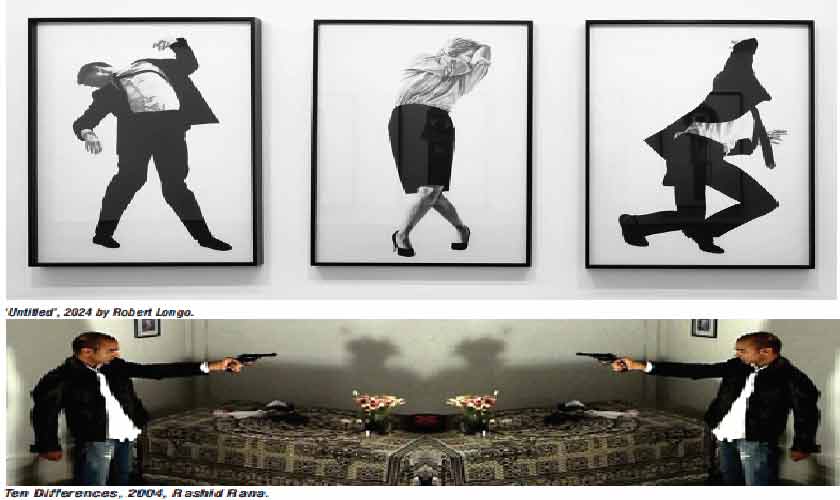
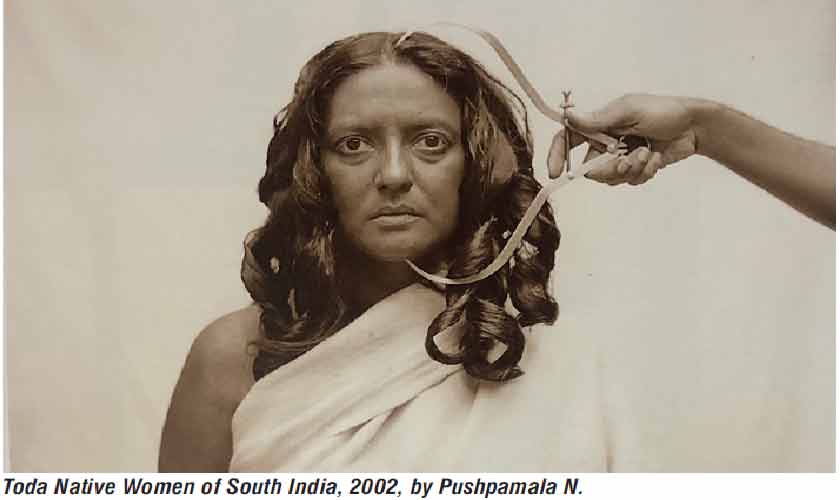
Most contemporary art now draws, in one way or another, on photography and cinema. Robert Longo’s charcoal and graphite series Men in the Cities, for instance, would have been inconceivable before the camera, much like the work of artists such as Andy Warhol, Cindy Sherman, Rashid Rana, Pushpamala N and Bani Abidi. The camera introduced the possibility of capturing the body in motion with a speed and precision that earlier mediums could not match.
Yet, even as image-making has accelerated, certain art forms that demand time continue to hold value. Traditional miniature painting is one such example. The making of a miniature requires prolonged and meticulous engagement — not unlike other forms of labour from earlier periods. The construction of monuments such as the Red Fort, the Taj Mahal or the Badshahi Masjid took years to complete. Similarly, handcrafted objects, pottery, metalwork and tapestries were produced over weeks and months.
Today, building technologies can complete structures in a matter of days. In much the same way, miniature painting, once defined by the time it required, has also adapted. Contemporary artists trained in the discipline often work at a faster pace, compressing processes that once unfolded over long durations.
Despite this shift, the idea of miniature painting continues to carry a certain appeal, particularly among collectors and curators in the Western art world. A practice rooted in slowness, in a world governed by speed and instant delivery, acquires the aura of the exotic. It is valued not only for its form, but for the time it appears to embody.
At the same time, many artists, especially those from the first generation trained at the National College of Arts, have moved beyond these expectations. They have stepped away from the conventional framework of miniature painting, engaging instead with installation, digital print, site-specific work and performance.
The question of time is not confined to shifts in artistic methods or modes of production. It is also bound up with individual sensibility. We may exist physically in a given moment, the Twenty-first Century, for instance, yet our beliefs, habits and creative impulses often belong to different periods. One encounters people unfamiliar with tools such as ChatGPT or unable to navigate a mobile app, alongside others adapting to online banking, ordering meals, booking rides or reading digital newspapers. We live in one year, say, 2026, but in practice inhabit at once multiple moments, stretching across decades.
A similar condition can be observed among artists. Within the same country, practitioners often operate across distinct temporal registers. Some remain anchored in the Nineteenth Century; others draw from early Twentieth-Century forms; some follow the trajectories shaped after World War II. Many engage directly with the present; a few attempt to anticipate what lies ahead. There are also those who consciously bring together fragments of different eras, using this layering of time to reflect on contemporary realities.
This interplay with time is an inherent feature of art. Art, like dreams, unsettles the ordinary sense of duration. Jorge Luis Borges observed that within a dream lasting only minutes, one may experience an entire lifetime, believing fully in its reality until waking up. Art operates in a similar way. The moment depicted in The Last Supper appears brief, yet we recognise it as an illusion of duration. An artwork is not bound by the time it represents; it reshapes it.
Umberto Eco, in distinguishing between mainstream cinema and pornography, makes a related point. In film, time is constructed: a few minutes can be extended into hours, while an entire life may be compressed into a short sequence. He criticised pornographic films not for their content, but for their insistence on real time. For him, this lack of transformation, this refusal to manipulate time, was what made them vulgar.
The term itself, in its original sense, refers to the common or the ordinary. Art, by contrast, resists such fixity. It moves across durations, inhabiting multiple temporalities at once. In doing so, it frees itself from the constraints of linear time, allowing artists to work through memory, imagination and anticipation simultaneously.
The writer is a visual artist, an art critic, a curator and a professor at the School of Visual Arts and Design, Beaconhouse National University, Lahore. He can be contacted at [email protected].