Print Story
X




From a Valentine’s Day premiere in Berlin to a milestone announcement in Karachi, here’s what you need to know about the very best of Pakistan’s cultural moments.

Sarmad Khoosat’s latest film Lali, examines marriage from inside and outside
| O |
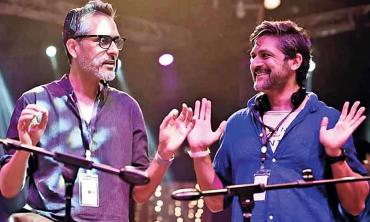
n February 14, while the world reached for roses and romance, Sarmad Sultan Khoosat arrived at the Berlin International Film Festival with some-thing harder to sit with. Lali premiered in the Panorama section and became the first all-Pakistani feature to screen at the Berlinale. It sets the tone immediately. Love, the film insists, is not a fairy tale. It is a battlefield.
The trailer offers little exposition and keeps viewers uneasy. Zeba, played by Mamya Shajaffar, marries Sajawal, played by Channan Hanif. She carries a strange reputation. Three former suitors died in unusual circumstances. Sajawal says he is stronger than the other men and will not die so easily. Around them, people whisper. Noor Jahan calls Zeba cursed. The neighbour Bholi watches closely with a morbid fascination. As the wedding rituals unfold, the tension intensifies. Is this superstition, black magic, fate or something far more sinister?

Lali isn’t just an examination of deeper societal views we carry. It is just as much about a filmmaker returning to his roots. Darker territory isn’t new for him. In Manto, he explored writer Saadat Hasan Manto’s inner world.
In Kamli, he used folklore as a metaphor for repression. In Zindagi Tamasha, he showed how society punishes individuals through public morality. With Lali, he turns to marriage and strips it down.
The film unfolds in Sahiwal’s shanty towns and what its synopsis describes as a “fever dream.” Produced by Khoo-sat Films in collaboration with Enso Films, long-time collaborator Khizer Idrees handles cinematography while Saim Sadiq (who directed Joyland) handles editing duties. The spaces feel tight and the silences heavy. At its core, the film looks at fear, shame and violence wrapped within relationships. Sajawal grows paranoid and even pretends to be possessed to control his wife. Superstition becomes a tool and masculinity feels fragile and exposed.
Speaking to Outlook India, Khoosat spoke openly about marriage and desire. “People use marriage to make sexual behaviour kosher or acceptable. It’s also weaponised as the biggest tool of abuse,” he said.
The women orbiting Zeba compli-cate the emotional landscape. Sohni Ammi, the mother-in-law, stands out. She is sharp, loud and layered. Khoosat admitted the character connects to his own history. “I’m obsessed with my mother,” he said. “Sohni Ammi isn’t exactly like my mother. I wish my mother were like her. It’s almost like writing an alternative personality for my mother.”
When it comes to global audiences, Khoosat keeps his focus clear. “I’d keep the global audience as my secondary audience,” he said. “Wherever stories originate, they need to be authentic and primarily communicate to that audi-ence.” The Berlinale selection gave him reassurance. “The Berlinale acceptance comforted me.” He remains candid about working in Pakistan’s film industry. “It has to take some insanity to make films,” he said. “I’ve never made money from my films. For that, I do my TV stints and commercials.”
Watching the trailer doesn’t offer any easy answers. The film keeps its distance and asks you to confront issues that are often connected to marriage and the stories people use to justify it. The release date in Pakistan has not been announced yet.
Karachi Biennale turns 10 and
announces KB27

| T |
he Karachi Biennale Trust has celebrated 10 years as it looks ahead. At a press conference held on February 13 at the Gulgee Museum, the Trust announced Karachi Biennale 2027. Noor Ahmed will curate the fifth edition under the theme Kal - Yesterday/Tomorrow. The city-wide exhibition is scheduled to run from January 16 to 31, 2027.
The event brought together media and key figures from the city’s art and corporate circles. Chairperson Atteqa Malik welcomed guests and presented highlights from past editions. The presentation served as a celebration and a reminder of how far the initiative has come in a city often described as struggling with infra-structural challenges.
Newly appointed Managing Trustee Shanaz Ramzi reflected on the journey. “At 10 years, the Karachi Biennale Trust stands as a testament to what sustained cultural collabo-ration can build for a city. As we look toward KB27, we reaffirm our commitment to making art publicly accessible while creating global conversations rooted in Karachi’s realities,” she said.
The press conference also formally introduced Noor Ahmed as curator of KB27. Bushra Hussain, artistic director of the upcoming edition, spoke about earlier editions and their impact across public spaces. Noor Ahmed then shared her vision for KB27. The theme gestures toward the elasticity of time embedded in the Urdu word Kal, which carries the dual meaning of both yesterday and tomorrow. The upcoming edition will explore memory and what lies ahead.

Founded in 2016, the Karachi Biennale Trust works as a non-profit platform to support creativity and critical discussion in the visual arts. The Biennale transforms heritage sites, parks and institutions into temporary museums. Entry remains free.
Ahmed brings significant experi-ence. She co-curated River Land-scapes, a transdisciplinary project between South Asia and Europe. In 2021, she was part of the curatorial team for the Pakistan Pavilion at Dubai Expo 2020, which won a silver award among 192 countries. She also served as project director and lead curator for the Digital Curation of Lahore and Taxila Museums and as an assistant curator of KB19. Her writings on contemporary art and culture have appeared in both local and international publications.
After the press conference, guests viewed an exclusive preview of Aaj Aur Kal, a one-day exhibition of performance, new media and installation curated by Amin Gulgee and Noor Ahmed at the Gulgee Museum. The exhibition marked the official countdown to KB27.
The 72 artists from 18 countries featured in Aaj Aur Kal included Salima Hashmi, RM Naeem, Raqs Media Collective, Meher Afroz, Heide Hatry, Natthaphon Chaiworawat, Richard Humann, Sohail Zuberi and Risham Syed, reflecting the Biennale’s growing international scope.
After the invite-only preview, the exhibition opened to the general public. As the Trust steps into its second decade, you can expect KB27 to build on what came before and push the conversation further.