Print Story
X




Women journalists take climate reporting to Pakistan’s frontlines
| I |
n Pakistan, climate change is not only an environmental crisis it is a social one as well. Women and girls bear its heaviest burden. From floods to water scarcity, their struggles are often invisible, compounded by a steep decline in the number of women journalists.
Women are becoming increasingly under-represented in Pakistan’s media. The trend driven by a range of factors, including social attitudes. The Global Media Monitoring Report 2025 indicates a sharp decline in the number of female reporters in Pakistan from to just four per cent as compared to 16 per cent in 2020.
This drop has serious implications, particularly for women, many of whom are already disproportionately affected by climate change. In conservative and traditional backgrounds, cultural barriers often prevent women from sharing their experiences and concerns with male journalists, which further marginalises their voices in media coverage.
The complexity of overlapping challenges from extreme weather to shrinking female media presence has left women and girls in one of the countries hardest hit by climate change, bearing the heaviest social, economic and health burdens.
Amid this challenge, a new initiative is helping women reclaim the story. Accountability Lab Pakistan and the women-led Green Media Initiative have joined forces to empower district-level women journalists. Their collaboration focuses on gender-focused, ethical, evidence-based reporting and digital climate storytelling, amplifying voices from communities affected by floods, ecological loss and water crises, particularly in Gilgit-Baltistan and Khyber Pakhtunkhwa, the regions hardest hit by last year’s monsoon.
For Kiran Qasim, a journalist based in Gilgit-Baltistan, reporting on climate disasters is fraught with personal and professional challenges. “Last year’s heavy rains and floods had a direct and severe impact on local communities, yet coverage of women was neglected. Journalists covering these events were also affected—road closures, power outages and disrupted communication made access extremely difficult,” she said.
Qasim says women often face disproportionate hardships during disasters: loss of shelter, lack of clean drinking water and healthcare, absence of childcare, psychological stress, and, in some cases, heightened insecurity. Cultural barriers frequently prevent them from speaking to journalists.
“Many women are unable to have their voices represented. This results in their concerns being sidelined,” she says.
Training provided by GMI has been crucial. It equipped women journalists with modern disaster reporting practices, gender-sensitive data collection methods and field safety skills. According to Qasim, such capacity-building not only strengthens professional skills but also enables reporters to amplify the voices of women in affected communities more effectively.
Khalida Niaz, reporting from Khyber Pakhtunkhwa’s Malakand division, describes similar hurdles. She says during floods in Buner, local traditions and security risks often prevented women from speaking with the media.

Women often face disproportionate hardship during disasters: loss of shelter, lack of clean drinking water and healthcare, absence of childcare, psychological stress, and, in some cases, heightened insecurity. Cultural barriers frequently prevent them from speaking to journalists.
“Women affected by disasters lack information about climate change. Their problems are not highlighted,” she says. Niaz welcomes GMI’s support, noting that the combination of training and grants is enhancing women’s reporting capacity and leadership in climate journalism.
Muhammad Abubakar, programme and communications manager at Accountability Lab Pakistan, emphasises the initiative’s wider purpose. “Climate change advocacy has become a strategic pillar of our work, approached as a governance challenge shaped by institutional gaps and social inequities,” he says.
The partnership with GMI merges governance expertise with grassroots journalism, producing women-centric stories on climate impacts on marginalised communities. The initiative allows journalists to document gender elements in climate governance and governance gaps, bringing local climate realities to mainstream attention.
The collaboration has also fostered women engagement and public dialogue. Building on this momentum, the fellowship supports district-level female journalists in producing digital video documentaries on local climate impacts, reinforcing women’s leadership in climate reporting and deepening public understanding of climate challenges.
The initiative is about more than individual training. “By investing in women journalists and supporting field-based, evidence-driven storytelling, we hope to contribute to a more informed and inclusive climate discourse in the country,” says Abubakar.
Shabina Faraz, the founder of GMI, says that despite Pakistan ranking among the world’s top three most climate-vulnerable countries for the past 15 years and moving to number one after the 2022 floods, mainstream media coverage continues to prioritise politics over climate reporting. She points out that climate change disproportionately affects vulnerable communities, particularly women in rural areas who are directly dependent on natural resources for water and livelihoods.
Faraz says that during droughts, women are forced to travel longer distances to fetch water when nearby wells dry up. Crop failures eliminate already fragile household incomes. She says that these realities often remain invisible in media coverage due to cultural barriers that limit male journalists’ access to women in conservative communities.
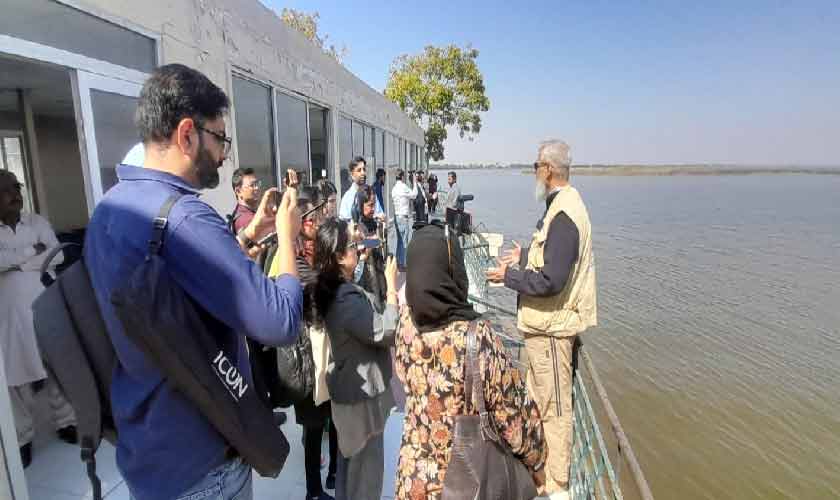
“This gap inspired the creation of Green Media Initiative and the Female Media Cohort on Climate Change,” says Faraz, adding that the cohort includes around 70 female reporters, bloggers and vloggers from across Pakistan, including remote areas such as Pasni, Turbat, Gwadar and Tharparkar. GMI organises field visits, workshops, seminars and regional exchange programmes to build journalists’ capacity and ensure responsible reporting from the front lines of climate change.
When the number of female journalists declines, the experiences of women on the front lines of climate disasters remain largely invisible. Empowering women reporters is not just a matter of representation, it is also essential for credible, inclusive and people-centric climate reporting that reflects the realities of those most affected.
The writer is a Karachi-based environment journalist and researcher, X handle @asifaidris