Print Story
X




The RLNG overcorrection is not a failure of coordination; it is a logical outcome of an energy regime shaped by crisis politics, class insulation and federal erasure
| C |
loser coordination between Power and Petroleum Divisions is the new emphasis by those wishing to explain away our LNG overshoot as a result of mismatch in preferences within the two sections of Ministry of Energy. The phrase and its underlying connotations, however, assume more than they resolve - at least on three counts. The coordination narrative treats RLNG as a neutral technological fix whose excesses could have been avoided through better planning. However, this framing hides the politics embedded in the emergence of LNG as Pakistan’s imagined energy future.
Nothing in terms of major decisions that historically shaped LNG value chain originates in either of the two divisions. At best, these institutions emerge and act as vessels materialising decisions hurled by messy geo-strategic and political entanglements that invite deeper attention. All LNG contracts are government-to-government (G2G), as are the enabling synergies of RLNG value chain. They implicate IFC and ADB financing and result from a particularly enabling political atmosphere.
After the 2008 general elections, the PPP-led government faced a rising circular debt (then Rs 72 billion). It decided not to finance it and leave it for the power sector to resolve. Caught by internal inefficiencies and a generation shortfall after 2008, the power sector looked to political leadership that firmly opposed new generation capacity, urged the DISCOs to improve recoveries and came up with rented power plants. The judicial demise and defeat of these plants unfolded in a particularly perverse throw-the-baby-with-bath-water way.
A novel idea to ensure power generation without owning large capacity in the long-run, was buried under the ‘revolutionary’ judicial roar promising the emergence of mother state. Courts proved hyper-interventionist in one case (RPPs) and deferential or procedural in another (LNG). Law itself thus became a political technology so that certain solutions were rendered illegitimate while others were normalised. The point here is not corruption vs legality, it is that certain infrastructural futures were allowed to survive juridical scrutiny.
The provincial government in the Punjab, vehemently opposed to the PPP, fanned the fire by joining street protests against load-shedding. Its chief minister, now prime minister, attracted thousands under Minar-i-Pakistan in daily mid-day fan yourself campaigns. A perspiring CM fanning himself along with other energy deficient Lahoris, became a potent political symbol establishing the PML-N as impacted by energy crisis and leading the crisis-ridden masses to a solution. Load-shedding can be not just a technical shortage but also a political crisis. RLNG emerged not as a neutral solution but as a crisis technology -- a solution whose legitimacy depended on the visibility of suffering rather than long-term system rationality.
Few could see that the same leadership was preparing a tariff inferno where electricity will be available but electrified cooling and heating unimaginable. This hard headed load shedding politics conveniently turned attention away from the focus on sectoral uplift and DISCO reform to a linear road of redemption: add more capacity.
Big industrial players were scarcely touched by the energy crisis.
Behind the scenes, meanwhile, a business clique was sharpening its teeth in the proverbial seize-the-crisis posture. One manifestation of this were the managers of the industries owned by many of these protesting leaders and those close to them rubbing shoulders in the NEPRA offices seeking licences to set up captive power plants. The Authority was virtually throwing permits to industries and repeating the pasted paragraph citing generation shortfalls to justify in-house industrial generation.
A strange assumption escorted these justifications: the captive plants would redeem the country’s generation shortfall. Captive power de-socialised electricity. Electricity thus ceased to be a public good. It became a private, firm-level risk management strategy.
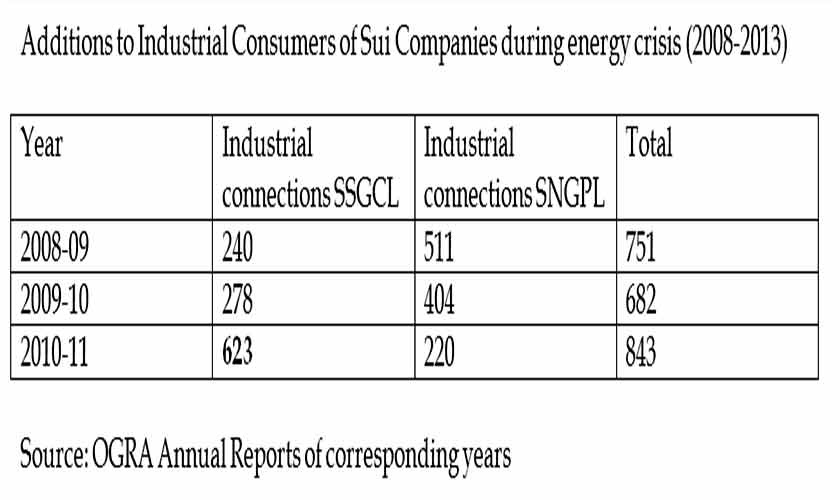
Disconnected from grid, guzzling subsidised gas, selling electricity at inflated prices to connected industries and the grid; these industrial players were scarcely touched by the energy crisis. This shift is evident in the figures.
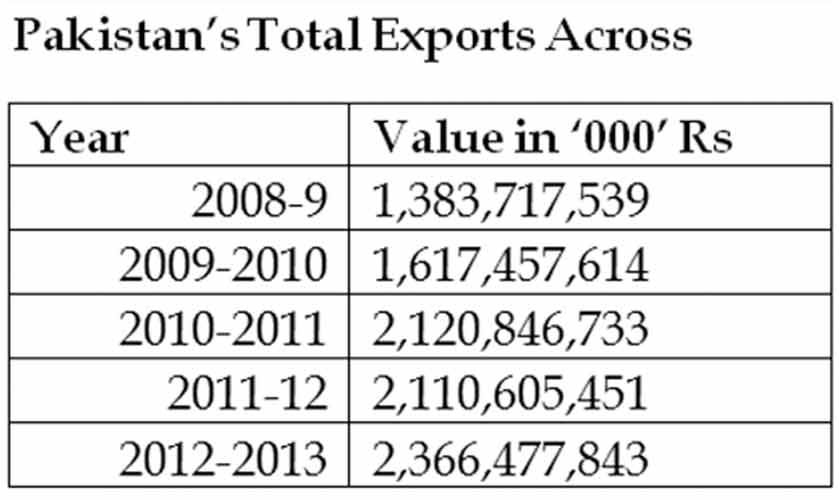
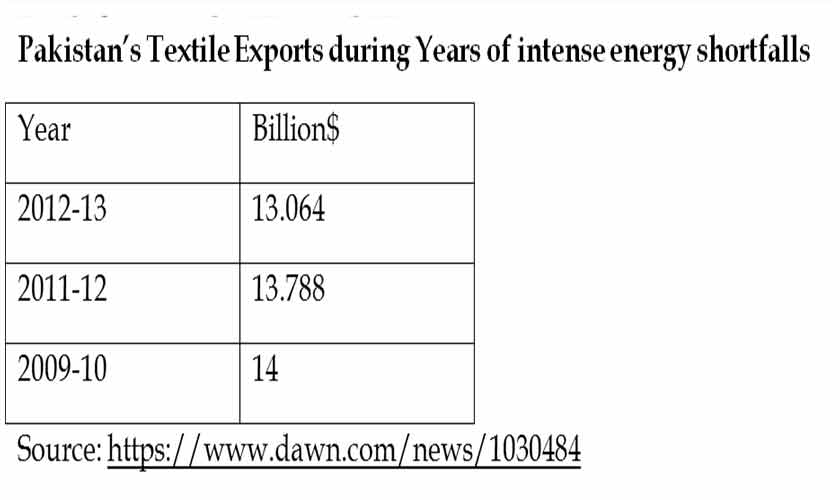
The Authority has not reported the sectoral break-up for additions for 2012 or 2013. However, a glance at Pakistan’s energy intensive exports for those years shows exactly this; an industrial elite isolated from the crisis and successfully shifting its power needs from electricity to the gas sector.
Source:https://www.pbs.gov.pk/
wpcontent/uploads/2020/07/5_exp_2008-09_to_2012-13.pdf
Pakistan’s Textile
Exports during Years of intense energy
shortfalls
Source:https://www.dawn.com/news/1030484
Here is evidence of unequal energy access and risk transfer. Resilience of export sector was not evidence of system recovery but its insulation form the crisis - in other words, successful energy arbitrage by elite industries. The country’s exporting industrial elites were feeding off subsidised natural resources through entrenched influence in Sui companies and regulators that enabled gas supplies.
Come the next general election, the political elite in power represented industrial interests more fully. This time it was also armed with a public acknowledgement of their discourse on energy crisis resolution. Thus resulted the hasty and profitable-for-some stamping of the RLNG value chain where SNGPL, according to a 2022 Auditor General of Pakistan report, never submitted its RLNG demand forecast. Rest of the story is more of the same. The licence debates and sectoral views merely state the federal stance on control over natural resources. Sindh government’s objections to gas swapping between Sui companies were ignored. The 18th Amendment-stipulated province-federation balance in resource sharing was undermined.
All else that followed - low utilisation of RLNG in the power sector, domestic diversion of expensive gas (Rs 211 billion only this year), consistently violated ISMO merit order, line-pack pressures - is a consequence of the politics that thumbed up RLNG discourse as a solution. The RLNG overshoot is not a failure of coordination but the logical outcome of an energy regime shaped by crisis politics, class insulation and federal erasure. These problems are too political to be resolved by coordinating divisions.
The writer works for the research section of Climate Action and Energy Access, a climate action dedicated institute at Islamabad