Print Story
X




Pakistan is adding two million young people a year to its working-age population
| M |
any Pakistani institutions today are preparing a generation of young people for jobs that do not exist. This is no exaggeration. It is a measurable economic failure that is shaping the country’s future in troubling ways. Every year, Pakistan produces more university graduates for whom the economy produces no matching opportunities. The result is growing unemployment, frustration and a steady outflow of talent.
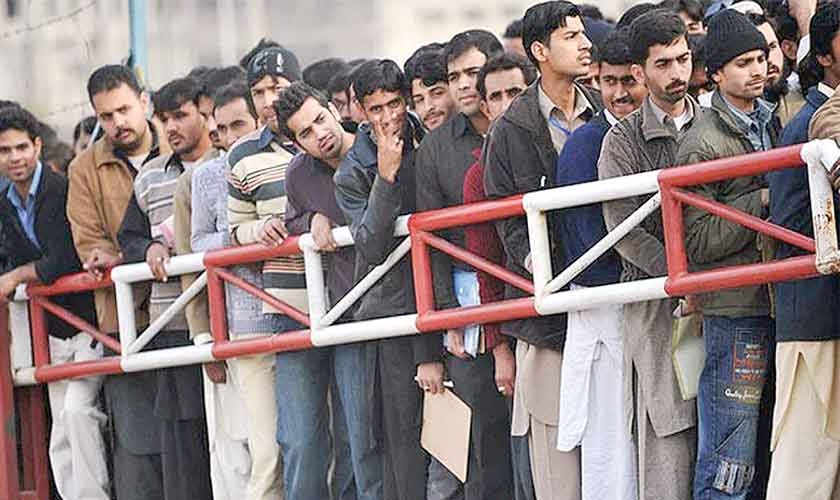
Pakistan adds more than two million young people to its working-age population every year. According to official figures, around 800,000 students graduate from universities and colleges annually. Meanwhile, the economy does not create even half that number of decent jobs. This gap is not closing. It is widening.
Over the last two decades, the higher education facilities have expanded rapidly. There are more universities, more enrollment and more degree options. Families have been investing heavily in education, believing that this will secure stable employment and social mobility. For many, that has not happened.
Unemployment among university graduates is higher than among those with lower levels of education. Degree holders in general disciplines struggle the most. Many accept jobs far below their qualifications; others remain unemployed for years. This is not because these graduates lack ambition. It is because the economy does not need the skills they are being taught.
Pakistan’s economy remains dominated by low-productivity sectors such as informal retail, small trading, agriculture and basic services. These sectors do not require university-level education. At the same time, sectors that typically absorb educated workers, such as manufacturing, technology, research and high-value services, remain small and underdeveloped. As a result, most graduates are trained for an economy that does not exist.
A major part of the problem lies in Pakistan’s long-standing dependence on public sector employment as the ideal outcome of education. For decades, students have been encouraged, directly or indirectly, to see government jobs as the ultimate goal. Competitive recruitment examinations have become the focus of entire academic careers.
The public sector now employs less than five percent of the workforce. It cannot absorb millions of graduates. Each year, thousands compete for a handful of government positions. When most fail, disappointment turns into frustration and resentment. Years of education end in uncertainty.
The private sector, meanwhile, often finds graduates unprepared for work. Employers repeatedly report that new graduates lack basic relevant skills. Many struggle with clear writing, problem-solving, teamwork and practical understanding of their field. This forces employers to spend time re-training and reduces their willingness to hire more graduates.
The education system focuses heavily on theory and memorisation. Practical training, internships and workplace exposure are limited. Many universities operate in isolation from industry. Curriculum updates are slow. As a result, graduates leave campuses with degrees but without usable skills.
Unemployment among university graduates is higher than among those with lower levels of education. Degree holders in general disciplines struggle the most.
At the same time, technical and vocational education remains neglected. Only a small share of young people are enrolled in formal skills training, despite strong demand for technicians, supervisors and skilled workers. Pakistan ends up with unemployed graduates and a shortage of skilled labour at the same time.
In recent years, freelancing and digital work have been promoted as solutions. While online work has helped some people earn income, it is not a replacement for a functioning job market. Freelancing offers no job security, no social protection and limited career growth for most workers. Incomes are uncertain and dependent on global demand.
Only a small number of freelancers earn stable, high incomes. For the majority, digital work is temporary and fragile. It cannot absorb the millions entering the workforce each year. Presenting freelancing as a national employment strategy avoids confronting the real issue: the economy is not generating enough productive jobs.
The consequences of this failure are already visible. Pakistan is witnessing one of the largest waves of outward migration in its history. Skilled and educated young people are leaving for the Gulf, Europe, North America and Australia. Many families now plan education with migration in mind rather than domestic employment.
This brain drain carries a heavy cost. Public resources are spent on education, but the returns benefit other economies. Innovation suffers. Productivity remains low. Institutions lose future leadership. Those left behind often feel disconnected and disillusioned.
Youth unemployment is not just an economic issue. It is a social and political one as well. Prolonged joblessness erodes trust in the system. It increases social tension and deepens political polarization. A generation that feels excluded is unlikely to contribute positively to long-term stability.
The solution does not lie in producing more university graduates of the same kind. Pakistan already has many degree-holders. What it lacks are jobs aligned with the education.
Economic policy must focus on sectors that generate employment at scale. Manufacturing, exports, logistics, renewable energy, technology services and value-added agriculture must become priorities. Without structural transformation, employment growth will remain weak.
Education reform must be linked directly to labour market needs. Universities must work with industry. Curriculum must reflect real demand. Internships and practical training should be mandatory, not optional.
Technical and vocational education must be treated as a national priority, not a second choice. Skills training delivers faster and more reliable employment outcomes than many academic degrees.
Finally, the public must be told the truth. The state cannot employ everyone. Education alone does not guarantee a job. Honest communication is better than false hope.
Pakistan’s youth are not the problem. They are educated, connected, and ambitious. The real failure lies in an economic model that cannot absorb them.
A country that educates its youth without creating opportunity is not building its future. It is quietly exporting it.
The writer is a chartered accountant and a business analyst.