Print Story
X




The Orange Train runs from the city’s northeast to its southwest
| L |
ahore is privileged; so are its denizens. One can travel across the metropolis sitting in red and green buses and, of course, the Orange Train. The gap between the advantages and comforts taken for granted by Lahoris and those living in other cities, even relatively large ones, becomes clear when one happens to travel elsewhere.
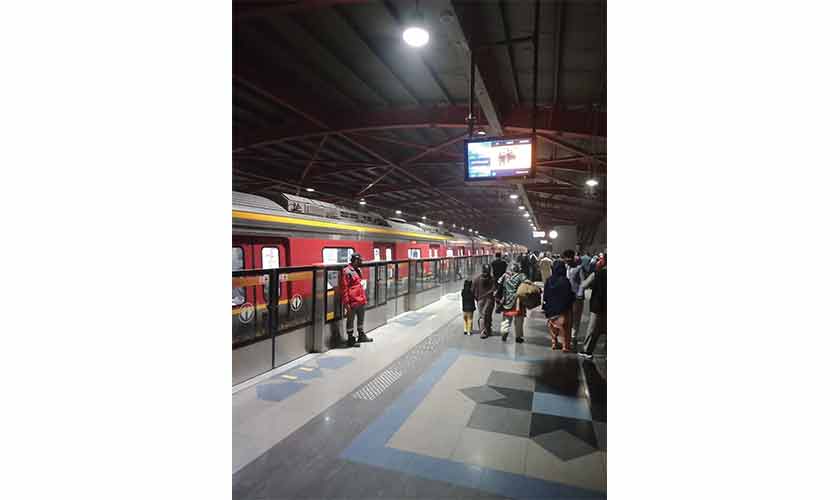
The Orange Train, which formally started operating on its above-and-below-the-ground rails in October 2020, runs from the city’s northeast to its southwest, covering a distance of twenty-seven kilometres. There are twenty-six stations where the train stops, allowing passengers to get on and get off. The distance between one station and the next is roughly one kilometre. Jain Mandir and the General Post Office are two locations either side of The Mall where the train moves underground to avoid the colonial-era buildings and the thoroughfare.
Whenever I am in Lahore, I travel by public transport to experience the diversity in people and the raw nature of the city. Nowhere other than in the Orange Train, which is one of its kind in Pakistan, do I get to see so many new faces. This time I had to travel to The Mall from Ali Town station, the Raiwind side terminal. After reaching the station, I swiped my user card on the pass-through machine. It showed an error. I realised that it had been long since I last recharged it. There were endless queues at the ticket booths and the recharging machines were accepting only ten-rupee notes. I waited for a while and then approached two boys wearing shalwar qamees. From their appearance, I assumed that they were locals. I was at a distance of five or six metres when I called out, “O sohne-o, meri gal sunde-o” (O beautiful people, could you please listen to me). They smiled a bit, listened to my request, and gave me the currency notes I needed. Grateful, I thanked and paid them, and proceeded to sit in the train.
Everything about the train and the travel experience is exquisite, except one. There is only one bogie or car reserved for women in every train. The male passengers can easily stay away from that bogie and allow their fellow female passengers to relax and indulge in lively gossip without worrying about prying eyes.
I relish the reactions of those travelling in the train for the first time. They gaze out of the windows in amazement, stand in the centre to have their picture taken by a friend, who obliges quickly to have his own picture taken in return. Some size up those sitting beside them and across them. During early hours in winter, the elderly are keen to find a seat where they can receive the sun’s warmth.
If by chance middle-aged people or those in their early 60s board the train from a midway station, they enter and look at the seated young men with beseeching eyes. They do not put their request into words, but their feelings are easily understood. Some oblige them by giving up their place; others remain indifferent.
Students in uniform are often seen cramming questions, turning the pages of their books or notes, half agitated and half resigned. University-going students, especially the male ones, rub their eyes, avoiding the slight sunlight that may pull them out of slumber altogether. There are also students so well-prepared they appear fit to attend a wedding reception: neatly ironed dress, polished shoes, fresh faces and carefully combed back hair.
Everything about the train and its travel experience is exquisite, except one. There is only one bogie or car reserved for female passengers in every train. The male passengers could easily stay away from that bogie and let their fellow female passengers relax and indulge in lively gossip without worrying about prying eyes. However, many passengers remain glued to the last bogie, making others uneasy. I wish they knew that many men witness this spectacle and resolve in their minds never to allow their daughters to attend universities and colleges.
Many passengers are absorbed in their smartphones, numb to what is happening around them. Someone reading a book is a rare sight. This is not in keeping with the cultural mores and heritage of Lahore.
It is heartening and beautiful that, irrespective of class or gender, anyone can travel on this train. The train offers first-time travellers a memory to cherish and regular commuters something to be grateful for.
The writer is a storyteller and literary critic. Email: [email protected].