Print Story
X


| I |
n a disturbingly short span of time, two cases of suicide at a local university in Lahore have jolted the public conscience and compelled a searching reflection on the invisible yet widening fissures between Generation Z and the institutions that shape their lives: family, academia and the state. These tragedies are not isolated pathologies of individual despair; rather, they are symptomatic of a deeper malaise rooted in structural neglect, cultural dissonance, and the erosion of meaning in contemporary life. As Émile Durkheim observed in Suicide (1897), self-destruction often arises not merely from personal suffering but from anomie - a breakdown of social norms and collective moral frameworks that once anchored individuals to a shared world.
At the heart of this crisis lies an elusive disconnect between the young and their elders: parents who remain imprisoned in outdated expectations, teachers constrained by rigid pedagogical systems and government institutions that increasingly rely on coercive instruments as technologies of control rather than mechanisms of care. Michel Foucault’s insight that modern power operates less through overt repression and more through subtle disciplinary regimes finds uncomfortable resonance here. Surveillance-driven governance, bureaucratic indifference and punitive academic cultures combine to produce what Foucault termed “docile bodies” — yet Generation Z, acutely conscious and digitally literate, resists docility while lacking viable channels for meaningful dissent.
Economic stress further compounds this sense of alienation. In Pakistan’s increasingly stratified society, young people confront shrinking employment opportunities, rampant inflation and a brutal competition that rewards conformity over creativity. Karl Marx’s notion of alienation — where individuals are estranged from their labour, their potential and ultimately themselves — has assumed new relevance in an era where education is reduced to credentialism and survival anxiety eclipses intellectual curiosity. The promise that education once held as a vehicle of emancipation now appears hollow to many students who experience it as an extension of market discipline rather than a space of self-realization.
Equally corrosive are the social ramifications of broken family structures, emotional absenteeism and growing mutual apathy. The family, traditionally a site of moral formation and emotional anchorage, has itself been destabilised by economic precarity and cultural transition. Zygmunt Bauman’s concept of “liquid modernity” aptly describes this condition: social bonds have become fragile, identities fluid and commitments provisional. Generation Z inhabits a world of constant flux, where digital connectivity masks profound loneliness and algorithmic affirmation substitutes for genuine recognition.
The crisis is exacerbated by an educational system that has drifted away from human concerns. Instructional methods increasingly privilege technical proficiency over ethical reflection, efficiency over empathy. Paulo Freire warned against such “banking models” of education, in which students are treated as passive repositories rather than active participants in the production of knowledge. When education ceases to engage with the lived social, political and cultural realities of learners, it forfeits its transformative potential. It becomes, at best, irrelevant; at worst, oppressive.
In this context, one possible way forward lies in a return to classical forms of knowledge — not as antiquarian indulgence, but as living traditions capable of being synthesised with modern needs and sensibilities. The classical humanities, from Aristotle’s Nicomachean Ethics to Ibn Khaldun’s Muqaddimah, were centrally concerned with questions of purpose, justice, community and the good life. They recognised that human beings cannot be reduced to economic units or data points; they are meaning-seeking creatures embedded in moral and historical worlds.
Such a reorientation is especially urgent in an age of rapid technological transformation. The advent of artificial intelligence, automation and digital mediation has accelerated social change to a velocity that outpaces human adaptability. As Hannah Arendt cautioned in The Human Condition, when technological progress is divorced from ethical and political judgment, it risks hollowing out the very capacities that make us human—thinking, judging and acting in concert. Fast-paced change, when unaccompanied by reflective spaces, destabilises identities and makes it nearly impossible for individuals or societies to achieve equilibrium.
Therefore, the humanities and social sciences must be accorded a far greater space within academia, particularly in the Pakistani milieu where questions of identity, power, faith and social justice remain intensely contested. These disciplines cultivate critical thinking, historical consciousness and moral imagination — capacities indispensable for navigating uncertainty and sustaining democratic life. As Martha Nussbaum has argued, societies that marginalise the humanities in favour of purely instrumental knowledge ultimately produce “technically trained people who lack the ability to criticise authority, to think for themselves and to see the humanity in others.”
The recent tragedies in Lahore should thus serve as more than moments of mourning; they should be catalysts for introspection and reform. Bridging the generational divide will require not only policy interventions and mental health resources, but also a deeper commitment to restoring meaning, dialogue and ethical reflection within our institutions. Without such a commitment, we risk raising a generation that is hyper-connected yet profoundly unheard—adept at navigating machines, yet abandoned by the very structures meant to nurture their humanity.
In confronting this crisis, the question is not merely how to prevent despair, but how to re-imagine education and governance as humane practices. For as Albert Camus reminded us, “The struggle itself is enough to fill a man’s heart.” Our task, then, is to ensure that this struggle is not waged in isolation, but sustained by institutions capable of listening, understanding and caring.
Before concluding this write-up, it is imperative to underscore the importance of sustained and collaborative engagement between universities and parents. While institutions of higher learning are conventionally regarded as spaces for autonomous adults, lived experience reveals that family-related challenges frequently constitute a significant undercurrent of stress and anxiety among students. The university, therefore, does not exist in isolation; rather, it functions as one shore of a river whose other bank is the family. When turbulence arises at home, its ripples are inevitably felt in the academic domain.
Contemporary students also navigate a digital landscape that is both enabling and perilous. Phenomena such as cyberbullying and the intrusion into private spaces represent invisible yet potent threats to psychological well-being. These challenges cannot be addressed through punitive measures alone. Instead, they call for concerted, ethically grounded efforts by university administrations, complemented by empathetic and persuasive engagement from academic staff. Faculty members, as intellectual mentors and moral exemplars, are uniquely positioned to cultivate a climate of trust, dignity and responsible digital citizenship.
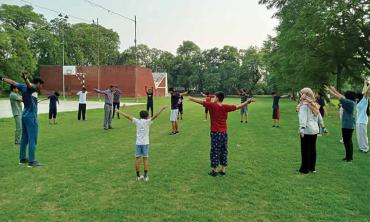
The role of extra-curricular and co-curricular engagements is equally significant in mitigating stress and anxiety. Such activities act as emotional safety valves, allowing students to release pressure, rediscover joy and reconnect with their intrinsic strengths. Participation in sports, cultural forums, community service and creative expression not only enriches the student experience but also reinforces the classical wisdom that a sound body nurtures a sound mind. Physical vitality and mental resilience are not parallel pursuits; they are intertwined strands of the same fabric.
Beyond structural interventions, universities must consciously foster environments that promote meaning, connection and hope. Accessible counseling services, peer-support networks, reflective practices and value-based education can serve as quiet but powerful anchors in moments of inner turmoil. When students are encouraged to cultivate gratitude, empathy and purpose, life begins to appear less like a burden to be endured and more like a gift to be carefully stewarded. In such an ecosystem, resilience is not merely taught — it is lived, and optimism emerges not as naïveté but as a disciplined act of faith in the possibility of growth.
When academic institutions attend not only to the intellect but also to the inner lives of students, education transcends the transfer of knowledge and becomes an act of human affirmation. In doing so, universities help young minds perceive life not as a weight that bends the spirit, but as a luminous, if demanding, journey — one that is worthy of engagement, perseverance and hope.
The writer is a professor in the Faculty of Liberal Arts at the Beaconhouse National University, Lahore.