Print Story
X




PPP’s cautious balance act during Afridi’s visit has sent subtle signals in every direction
| W |
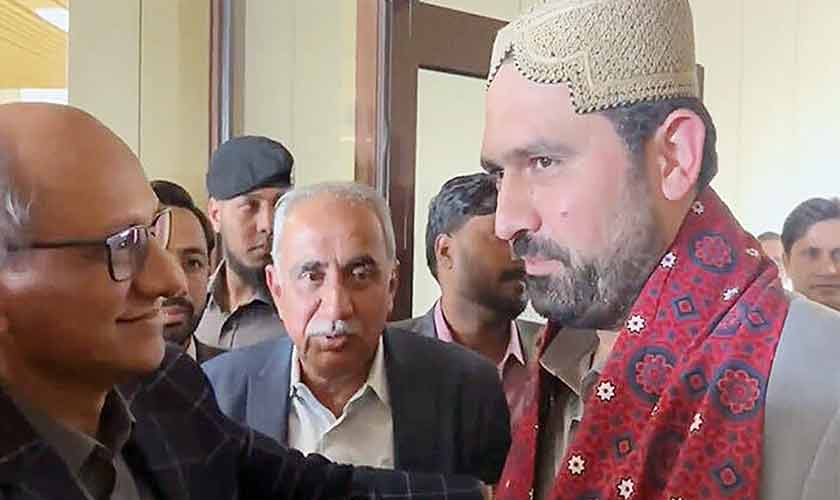
hen Chief Minister Sohail Afridi got off his plane in Karachi, his welcome included traditional gifts of an ajrak and a Sindhi topi presented by a Sindh minister. The gesture was seen by many as the extension of a political olive branch from the Pakistan Peoples Party to Pakistan Tehreek-i-Insaf. For nearly 24 hours, the media dwelt on a reception in stark contrast with the one he had experienced during his Lahore visit.
However, the warmth and the cordiality were short-lived. By the time the visiting chief minister reached Hyderabad, the streets were full of police pickets. Earlier still, the Jinnah Bagh jalsa of the Pakistan Tehreek-i-Insaf, meant to be a dress rehearsal for the February protest, had faced all kinds of hurdles. The organisers were hard put to arrange chairs, tents, loudspeakers and lights. The visit that seemed to have begun with what most analysts had read as a sign of political sophistication ended up in scenes reminiscent of the very tactics the PPP had sought to distance itself from.
Had it continued, the ‘warm reception’ and freedom to hold a public meeting where the federal government would be attacked could have opened strategic options. PPP chairman Bilawal Bhutto Zardari was apparently signaling that the PPP was willing to treat the PTI differently from the way the PML-N had done. The nuanced response appeared calculated to pacify the PTI supporters.
Unlike PML-N’s clearly hostile approach, the PPP’s strategy had introduced ambiguity. The warm welcome created room for the later restrictions to be explained as administrative necessity, rather than political persecution. While necessary permissions failed to materialise, provincial ministers could still claim that their approach to opposition was one of extending hospitality.
Subsequent obstruction of the PTI effort revealed the limits of how far the PPP could go. As the chief minister’s convoy moved through interior Sindh, the bid to control his engagement with the public became transparent. Police officers cited vague security concerns and missing permissions. PTI workers said they believed that left alone the attendance would have been at least twice as large. They said many potential participants, particularly families and middle-class supporters, had stayed away after witnessing the chaotic scenes on television. They said the heavy police presence and lack of appropriate lighting had deterred all but the most committed of activists.
Still, the participants’ number surprised the provincial government. PTI leaders said thousands of people had gathered in a spontaneous show of support. They also said the party had not arranged transportation for those in attendance or bribed them in any way.
The PTI leaders said the chief minister’s reception had shown that the PTI’s support base in Sindh is far deeper than acknowledged by the PPP and most analysts. Following the latest local government elections, the party’s strength was understood to have dissipated except in Karachi’s Pashtun dominated neighbourhoods. They said Afridi’s visit had shown that the PTI still enjoyed grassroots support in rural Sindh as well.
For Peoples Party, which sees Sindh as its secure home base, this may be a worrying sign.
Within the PTI, the visit may have raised Afridi’s stock and established him as the party founder’s closest deputy. His rapid transformation from a relatively obscure Provincial Assembly member into a national level politician commanding media attention and grassroots enthusiasm has been a rare feat.
Comparison with PTI’s earlier choices for regional leadership, such as former Punjab chief minister Usman Buzdar, could hardly be more pronounced. Afridi’s ability to draw crowds and his emergence as an articulate spokesperson should be a heartening sign for the party.
The vastly differing approaches of the PPP and the PML-N’ represent alternative solutions to the same problem: keeping an opposition party commanding grassroots support quiet. The difference may be explained in terms of their unique situation.
For the PML-N, the PTI represents an existential threat in the Punjab. Allowing the PTI to organise freely could threaten its core constituency. It has therefore had a zero-sum approach, just like the PTI.
The PPP, meanwhile, is operating under a different set of constraints. Its electoral dominance in rural Sindh is relatively secure. It sees the PTI as real but not immediately existential threat. It can therefore show selective tolerance for the PTI while preventing breakthrough mobilisation.
The PPP and the PTI share an interest in dislodging the PML-N from its positions in the federal government as well its dominance of the Punjab. PPP’s cautious balance act during Afridi’s visit has sent subtle signals in every direction. It has shown that it can be relied to manage PTI activity in the streets. It has also indicated to the PTI, once again, that it is able and willing to work as a coalition partner.
It seems that the way February protests called by the PTI will play out can be predicted already. The Punjab, with its concentration of security installations, industrial capacity and demographic weight, will likely remain no-go. This is where the PTI and its allies will face maximum resistance.
Sindh, ruled for decades by the PPP, has a different political calculus. While Karachi is the country’s financial capital and revenue engine, the rest of the province is not seen as immediately threatened. This allows the PPP to show considerable flexibility and keep future options open.
The December 27 gathering at Garhi Khuda Bakhsh, where both President Asif Ali Zardari and Bilawal Bhutto Zardari invoked Benazir Bhutto’s doctrine of national reconciliation, takes on new significance against the backdrop of Afridi’s reception. The PPP is apparently positioning itself as a potential bridge between the current political order and whatever political accommodation eventually emerges.
For the PTI, the strategic calculation is even clearer. If the current standoff proves unsustainable and accommodation become inevitable regardless of Imran Khan’s stated position, the PPP is more likely to emerge as a palatable partner.
A configuration in which different parties dominate various provinces and the centre is run by a coalition of necessity, will require precisely the kind of flexibility the PPP has signaled.
Yet the visit has raised more questions than it has answered. The PPP cannot indefinitely be both the democratic alternative to the PML-N and its reliable partner in containing the PTI.
The writer is an investigative journalist.