Print Story
X




Post-colonial amnesia, not talent, has frequently determined whose work endures in art history
The reasons are self-evident. There are very few public art galleries; limited print and electronic media coverage of art; sparse serious research on Pakistan’s modern and contemporary art; and only a marginal presence of Pakistani art in art history curricula.
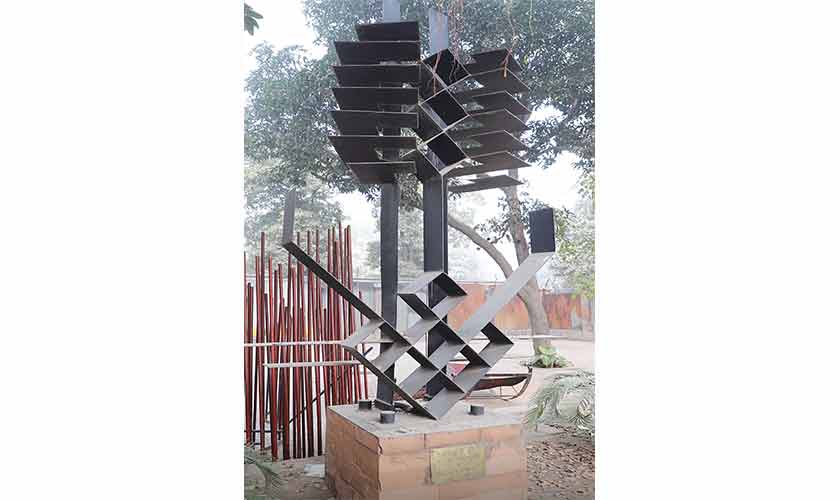
As a result, the present generation of students is largely unaware that works by Zahoor ul Akhlaq form part of both institutions, one where he taught for several years before retiring as head of the Fine Art Department, and the other with which he always maintained a close association. For his surviving contemporaries, admiring collectors and inspired followers, however, his name is not merely a memory but a monument: emblematic of a new movement in the trajectory of Pakistani art.
Zahoor ul Akhlaq engaged deeply with the pictorial traditions of this region while incorporating a sensibility shaped by global modern art. He examined art with a historically grounded eye, not only attentive to the subcontinent, but also to the wider Muslim legacy and beyond. His work echoed Gandhara sculpture, Islamic manuscripts, Indo-Persian folio painting, Arabic calligraphy and European imagery, among other influences.
Today, his work can be found in private collections and at the National Art Gallery, Islamabad, as well as in his long out-of-print monograph, The Rest is Silence.
Another name that rarely surfaces today is Ali Imam, a multifaceted figure: a practicing painter; a gifted art teacher; and a committed promoter of art and artists through his Indus Gallery in Karachi. Despite his tireless service to the country’s art scene, driven as much by private passion as public commitment, he spent years painstakingly archiving catalogues, articles and critical reviews, storing them in boxes within the gallery space. One suspects that he may soon disappear from our collective memory, having already slipped from contemporary art discourse.
Salahuddin Mian is another telling example of this regrettable phenomenon. Although a substantial publication, Beyond the Glaze, devoted to pottery in Pakistan, prominently discusses his work, and a monograph, Born of Fire, is dedicated to him, his name is now largely forgotten. So, too, is the physical record of his work, including a mural at the National College of Arts, today used mostly as a backdrop for selfies and casual conversations during lunch breaks.
The mural, now in a dilapidated state, recalls a crucial debate in post-colonial societies: how to negotiate a balance between the indigenous and the imported. Addressing this tension with a sense of playfulness, Mian juxtaposed traditional, functional objects, such as terracotta scrubbers and pan lids, with mass-produced symbols of modern desire, including Pepsi cans.
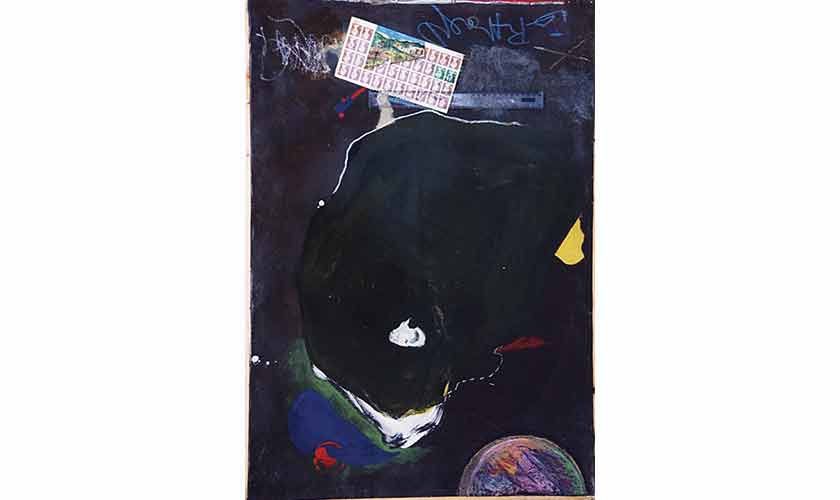
An artist as original, inventive, intelligent and individualistic as Iqbal Geoffrey was undoubtedly a rare figure. He deliberately distanced himself from the art establishment, academia and what he once described, only half in jest, as the art “mafia,” choosing instead to practice his art alongside his profession as a lawyer. Geoffrey produced an immense and astonishingly diverse body of work in unconventional formats, ranging from altered letters and unmeasurable collages to mixed-media canvases, conceptual works, installations and performances.
A handful of books, some self-published, document his life and practice, yet he appears to be gradually dissolving into collective amnesia. As Ali Imam once recalled, one of Geoffrey’s paintings was exhibited at the Tate Gallery in the 1960s, a period when artists were often judged less on their palettes than on the colour of their skin. At that time, no artist from South Asia, the Middle East, Southeast Asia or Africa was granted sustained entry into the hallowed spaces of institutions such as the Tate.
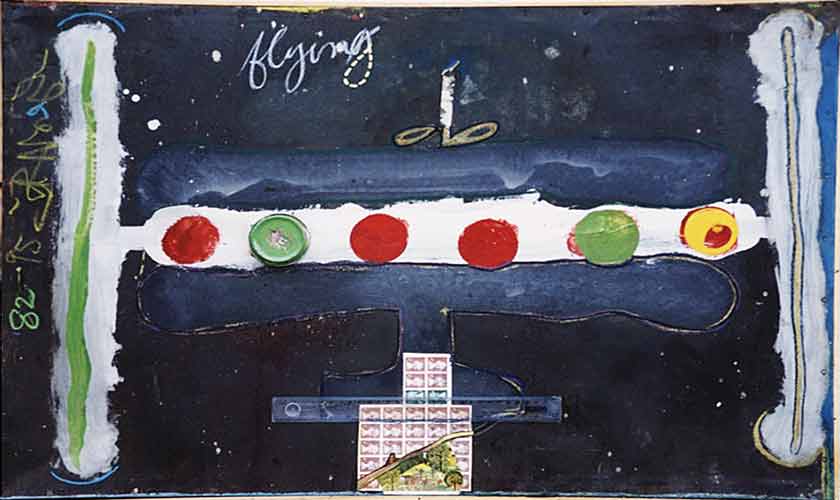
The list of artists who have been completely, partially or gradually forgotten continues to grow. Had they not lived in the Global South, many might have entered dominant art histories through institutional exhibitions, major gallery shows and international platforms such as biennales, triennials and art fairs. In some cases, recognition arrived belatedly: a visiting artist, museum director or foreign collector “discovered” their work, prices rose, visibility increased and their names re-entered local discourse and demand.
Others, however, remain unrecognised, their contributions buried beneath time and neglect, still waiting, silently, for a breakthrough that may never come.
It is easy to accuse foreign curators, art historians, gallerists and critics of consistently seeking out the “new,” introducing fresh products into the market of ideas and objects. Yet the primary cause of the initial erasure of regional art histories lies closer to home. It stems from an ingrained attitude of self-denial: a post-colonial mindset.
The Mexican poet and essayist Octavio Paz, in The Labyrinth of Solitude, illustrates this condition through a telling anecdote. When he knocks on a door and asks, “Is anyone here?” a maid opens it and replies, “No one. It’s me.” In her understanding, only the master of the house constitutes a true presence; the servant is a non-being. A similar logic applied to Africans who may once have been clan chiefs, nobles, warriors or shamans, but who, once captured and transported across the Atlantic, were stripped of their identity and renamed according to the whims of their masters.
The writing of history follows a comparable pattern. Dominant art-historical narratives have long projected the myth of “dark ages” across much of the world, while celebrating the so-called golden eras of European art, Greek, Roman, Renaissance and classical traditions. This framing conveniently ignores the extent to which Egyptian art (African art) shaped Greco-Roman practices, alongside numerous other parallel and highly sophisticated traditions.
Indian sculpture, Chinese bronzes, African sculptural heads, Mughal miniatures and Mesoamerican textiles all developed rich visual languages of their own. These societies, it would seem, practised what Milan Kundera later articulated: that national or regional contexts alone are insufficient to capture the meaning and worth of an oeuvre. Civilisations were in constant exchange, through trade, travel, translation, warfare and the circulation of skills and ideas. With the exception of Mesoamerica, no culture existed in isolation, and certainly not within a rigid hierarchy.
To suggest otherwise is not merely a distortion of art history but also a denial of the interconnected worlds that shaped it.
Later art historians began to carve out niches, segregating styles, categorising countries and carving the globe into discrete units, despite their many points of intersection. The framework persists today in the emphasis on divisions between Indian, Pakistani and Bangladeshi contemporary art, nations that came into being only after 1947. By contrast, one rarely encounters distinct labels such as Austrian, Dutch, Belgian or Swiss art in discussions of contemporary practice.
This process of reduction, demonisation and exclusion obscured artistic practices that did not conform to the biases of the white male canon. For many years, women were relegated to the marginal category of “female artists,” until they forcefully claimed equal space. Queer artists faced a similar fate, denied entry into mainstream discourse not on aesthetic grounds, but on moral and ethical prejudice. Likewise, artists working in materials or techniques unrecognised by the canon were pushed to the periphery.
Only in recent years has a broader, more inclusive approach begun to take hold globally, one that acknowledges that there is no fixed or singular definition of art. Change itself is art’s defining condition: its body and soul, its form and content.
The writer is a visual artist, an art critic, a curator and professor at the School of Visual Arts and Design, Beaconhouse National University, Lahore. He can be contacted at [email protected].