Print Story
X




The perennial struggle between proponents and opponents of the public expression of joy continues
| T |
hree hundred and seventy-six years ago, on December 20, 1649—months after the execution of Charles I and the establishment of the Commonwealth of England—a group of actors was arrested in St John Street, London, for performing a play. Bulstrode Whitelock, a lawyer and contemporary observer of the Cromwellian regime, recorded the event in his memoirs, Memorials of the English Affairs: “Some stage-players in St John Street were apprehended by troopers, their clothes taken away, and themselves carried to prison.”
Notably, these arrests occurred only twenty-six years after the death of William Shakespeare. The actors were disgraced for violating a law that banned plays and other cultural festivities, such as Maypole celebrations, which signalled the revival of crops and the arrival of spring.
The official decree, the Ordinance for the Suppression of Stage-plays and Interludes (released September 2, 1642), claimed that “public stage plays... being spectacles of pleasure, too commonly expressing lascivious mirth and levity” were incompatible with the solemnity required by the Irish rebellion and the burgeoning civil war. The ruling clergy—dubbed Puritans by their opponents for their desire to “purify” society of “evils and purposeless pleasures”—stated that it was instead a time for “fasting, prayer and repentance to avert God’s wrath.”
Puritans eventually migrated to the United States, concentrating in the Massachusetts Bay Colony. At the height of the witch-hunt hysteria in 1692, nearly 20 people were executed based on unsupported accusations of witchcraft, driven by the same rationale of purifying the society. Ultimately, however, Puritan rule vanished in both England and the US. Culture survived; the plays of Shakespeare and Marlowe eventually achieved global acclaim.
Pakhtun puritans and the Khudayi Khidmatgars
In the North-West Frontier Province of British India, a similar struggle unfolded as local clerics banned musical instruments like the dhol (drum) and surna (oboe). In his autobiography, My Life and Struggle, Khan Abdul Ghaffar Khan (Bacha Khan) recounts a musician explaining that after the ban, he hid his instruments in a corner, hoping that one day true religion (Musalmani) would return and he could play them again.
The tension between the clergy and the dhol persists in contemporary Khyber Pakhtunkhwa.
When Bacha Khan launched the Khudayi Khidmatgar movement in the 1930s, he defied these bans by asking musicians to beat their drums. The sound of the dhol alerted villagers that the Khudayi Khidmatgars were arriving, prompting men, women and children to welcome them. Bacha Khan would deliver speeches on eradicating social evils and raising socio-economic awareness before the caravan marched on. Because he was followed so enthusiastically by the masses, some of the opposing clerics dubbed him Dajjal (the false messiah), playing on local folklore that such a figure would attract a large following.
The Attan at Malakand University
The tension between the clergy and the dhol persists in the contemporary Khyber Pakhtunkhwa. Each December, Malakand University—a campus established in a former timber factory in Lower Dir—celebrates its foundation day. The university has survived the strict surveillance of the TTP rule in nearby Swat and continues to operate under the watchful eyes of local clerics.
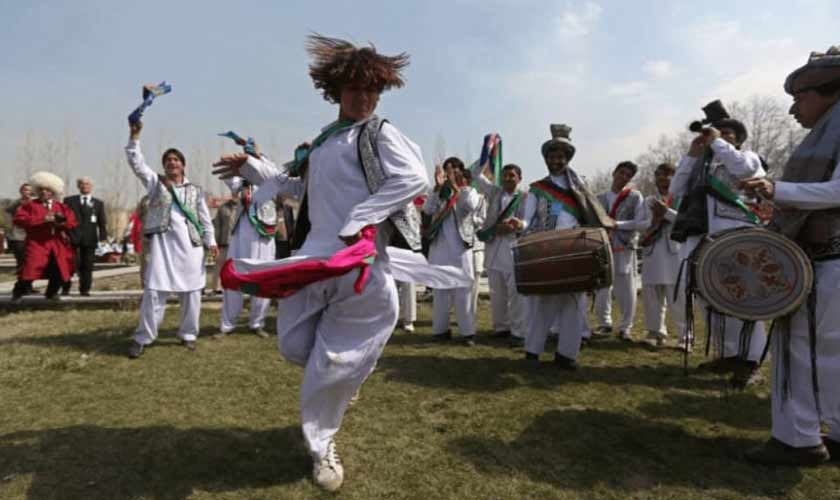
During its 25th anniversary this year, students from the Pashto Department and cultural societies arranged a stall to showcase Pashtun heritage. The display featured traditional charpoys and a red, flowered carpet where girls in traditional shuttlecock burqas played the dhol and rubab. In the centre, boys performed the attan, a traditional Pashtun folk dance. A political science professor, Sajid Mehmood, joined the students in the dance while others watched, clapped and recorded the scene using their their phones cameras.
When videos of the event surfaced on social media, they sparked a “storm of wrath” from modern puritans. Some of the critics labelled the university “a house of ill repute.” A religious-political party convened an ‘all-party’ conference to deliberate on the matter. While some parties urged restraint, others declared the event the start of a “grand plan for spreading obscenity among the Pashtuns.
The attan peformance was criticised for three specific reasons:
It was held at an educational institution.
It was performed in front of female students.
A professor participated in the dance.
The professor’s participation eventually became the focal point of the debate. In response, students across Khyber Pakhtunkhwa organised independent attan dances in solidarity, and teachers’ associations from Peshawar and Hazara University issued statements of support.
As this clash between joyful expression and oppression continues, the words of American writer HL Mencken, who covered the 1925 Scopes “Monkey” Trial, remains relevant. He defined Puritanism as: “The haunting fear that someone, somewhere, may be happy.”
The writer has studied English literature, history and politics. He can be reached at [email protected] and on X @nadeemkwrites