Print Story
X




Both the ruling and opposition parties have a history of exploiting electoral and administrative institutions via collaborations with non-political entities
| T |
here are two primary sources of knowledge: reading and traveling. Pakistan lags significantly behind both developed countries and other developing nations in these activities. The lack of interest in domestic travel among Pakistanis can be attributed to several factors, including a weak travel culture, economic constraints, inadequate infrastructure and security concerns. Similarly, various factors may contribute to the absence of a reading habit or culture among Pakistanis, including a deficient education system, an inadequate research and academic framework and the proliferation of digital and social media.
Consequently, Pakistanis from the middle and lower classes have been marginalised by elites, including the military, bureaucracy, landed interests, religious groups, professionals and industry. The non-elites fail sometimes to recognise that they have been subjugated by these elites for the past 78 years, perpetuating the colonial legacy of divide and rule.
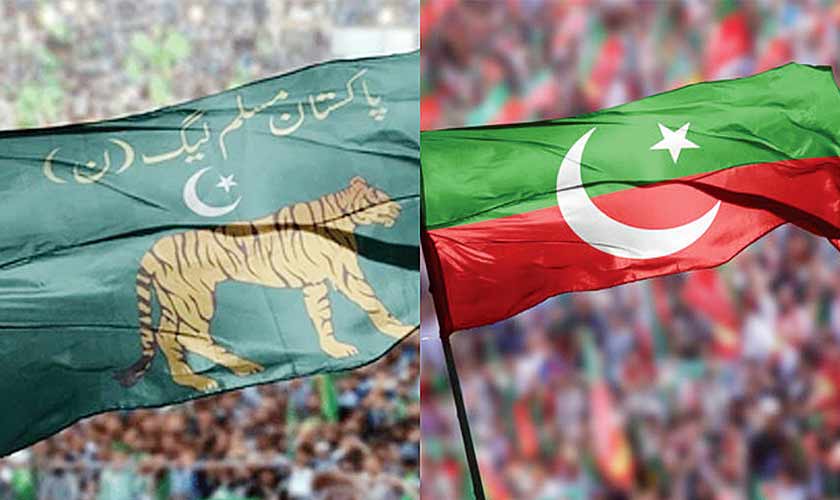
They have been divided along religious, ethnic, linguistic, provincial and regional lines. Recently, a significant political schism has emerged between the supporters of Pakistan Tehreek-i-Insaf and their adversaries, primarily the Pakistan Muslim League-Nawaz. The division has intensified to the extent that pro-PTI and anti-PTI groups routinely insult each other and engage in character assassination. In several documented instances, people have refused to marry each other due to the political discord. Such people are largely unaware that the pro-PTI and anti-PTI factions are two sides of the same coin. Both the PTI and the PML-N are right-wing political parties that espouse and execute identical ideas. They carry and implement similar policies. Some of those are reported here.
First, both the PTI and the PML-N implemented similar policies to curb social media use. The PML-N initiated this policy pursuant to the Prevention of Electronic Crimes Act, 2016. The PECA was enacted to suppress freedom of expression under the guise of addressing false news, cybercrime and misinformation. This has been practically demonstrated subsequently. Rather than rescinding this oppressive law, the PTI-led government passed an ordinance on February 18, 2022, amending the PECA to criminalise online ‘defamation’ of officials, including the military and judiciary, with severe consequences. The law not only contravenes the constitution but also endangers anyone who challenges the government or other state institutions. It specifically jeopardises journalists, human rights advocates and political adversaries who face legal repercussions for performing their duties. The PML-N, ostensibly an adversary of the PTI, instead of rescinding the subsequent adjustments to the PECA, advanced it with further contentious amendments to criminalise ‘fake news,’ limit online freedom of expression and suppress independent, critical media.
Second, the privatisation of state-owned entities (SOEs) and properties is another policy that both the PTI and the PML-N have pursued and implemented. Both these parties, as evidenced by their policies and activities, maintain complete and unreserved support for the privatisation and/ or restructuring of underperforming state-owned enterprises. In 2017, the PML-N, and in 2020, the PTI, attempted to privatise the Pakistan Steel Mills; however, both these efforts were unsuccessful. Additionally, the governments led by the PML-N from 2013 to 2018 and by the PTI from 2018 to 2022 both sought to privatise Pakistan International Airlines. The incumbent government has successfully divested PIA to the Arif Habib Consortium for Rs 135 billion through an auction. Additionally, these political parties have considered privatising public health and education facilties. If they were not two sides of the same coin, they would have implemented different policies.
Third, both the PML-N and the PTI have a history of exploiting electoral and administrative institutions via collaborations with non-representatives entities. They tend to achieve political gains by ceding political influence and space to non-political forces. Rather than fostering belief in the democratic system and nurturing democratic culture, they often explore non-democratic avenues to further their vested interests, thereby undermining the nation’s democratic culture and norms. Both have relied heavily on government officials to oversee elections. Both have appointed retired generals and justices to high offices in return for certain concessions.
Fourth, both have exhibited lack of tolerance, flexibility and a liberal disposition. Nawaz Sharif, following his disqualification in 2017, said the establishment had conspired against him. Yet he did not acknowledge that he had allegedly ascended to the position of PM through their collusion. Imran Khan, following his removal from power via a vote of no confidence, similarly condemned the establishment, claiming that they had conspired against him and did not mention his prior alleged collusion with them.
This analysis does not imply that the PML-N and the PTI lack diverse policies. They pursue distinct paths in many areas. However, they are right-wing parties with a similar ideological inclination.
Non-elites should examine and comprehend the ideological inclinations and policies of these – and other parties - and their leaders. This will help them avoid manipulation by the elites. It will also facilitate their comprehension of class disparity, class conflict and class struggle, the sole pathway to their redemption and the advancement of the state and society. The sooner they do so, the better it will be.
Mazhar Abbas, author of The Aftermath of the Bangladesh Liberation War of 1971: Enduring Impact (Routledge, 2024), has a PhD in history from Shanghai University.
He is a lecturer at GCU, Faisalabad, and a research fellow at PIDE, Islamabad. He can be contacted at mazharabbasgondal87@gmail.com.
His X-handle is @MazharGondal87.