Print Story
X




In ‘suspending’ the Indus Waters Treaty India has sought to weaponise river water
| F |
or more than six decades, the Indus Waters Treaty was one of the most resilient examples of trans-boundary water diplomacy in the world. Signed in 1960 under World Bank auspices, the treaty survived wars, crises and prolonged political hostility between Pakistan and India. Its endurance rested on a simple but powerful principle: water, especially in a climate-vulnerable region, must not be weaponised. Today, however, that principle is under severe strain. India’s recent actions on the Chenab River have raised serious concerns for Pakistan’s water security, food supply and economic stability.
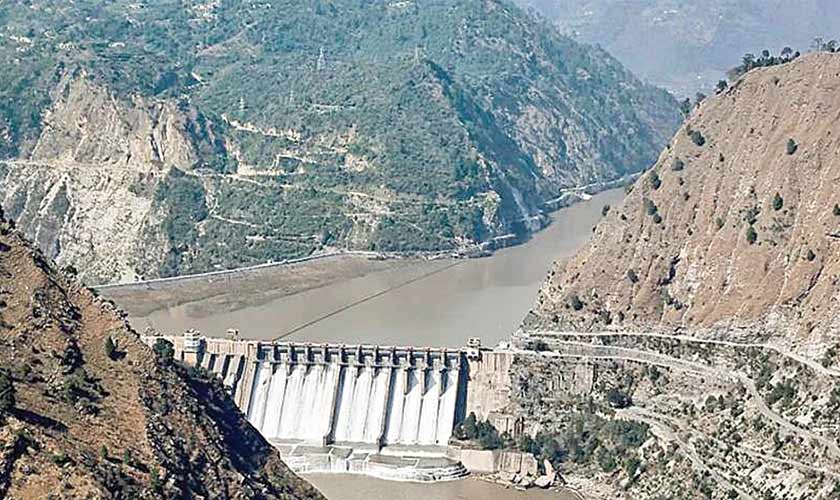
As a lower-riparian country, Pakistan’s agricultural lifeline is heavily dependent on predictable river flows. The Chenab, one of the western tributaries allocated for Pakistan’s unrestricted use under the IWT, plays a critical role in irrigating the Punjab — the country’s breadbasket. Any abrupt or unannounced change in its flow is not a technical inconvenience; it is a direct shock to millions of farmers and to national food security. Recent unannounced surges of water into the Chenab during the sensitive wheat-growing season have therefore triggered alarm across Pakistan’s agricultural and policy circles.
Wheat is not merely a crop in Pakistan; it is a strategic commodity. It underpins food security, price stability and rural livelihoods. Wheat crops are particularly vulnerable to sudden flooding or irregular irrigation cycles. When water is released without prior notice, fields can be inundated at one stage and dry in the next. This can damage plant roots, reducing yields and increasing susceptibility to disease. For farmers already grappling with rising input costs, climate variability and debt, such shocks can be devastating.
The core issue is not only the volume of water released but also the manner in which this is done. The Indus Waters Treaty contains clear procedural obligations, including transparency, timely data-sharing and advance notifications for any activity that could materially affect river flows. These provisions exist precisely to allow downstream managers to plan canal operations, regulate reservoirs and protect crops. India’s failure to provide timely hydrological information and prior communication undermines these safeguards and erodes trust — the very foundation on which the treaty rests.
Pakistan’s characterisation of these actions as “water terrorism,” reflects a growing sense of existential anxiety. In a region already under acute climate stress, water has become inseparable from national security. Glacial melt, erratic monsoons and prolonged heat-waves are shrinking the margin for error. Against this backdrop, unilateral actions on shared rivers are perceived not as isolated technical decisions but as part of a broad pattern that risks destabilising Pakistan’s agricultural economy.
Pakistan’s characterisation of India’s actions as “water terrorism,” while strong, reflects a growing sense of existential anxiety. In a region already under acute climate stress, water has become inseparable from national security.
The situation is further aggravated by India’s decision to suspend the Indus Waters Treaty. This move strikes at the heart of one of the most successful conflict-management frameworks in South Asia. The IWT was deliberately designed to be insulated from political disputes, ensuring that even during periods of extreme hostility, cooperation on water would continue. Suspending the treaty weakens this firewall and introduces uncertainty into a system that depends on predictability.
Irregular Chenab flows during the critical wheat season threaten irrigation across millions of acres in the Punjab. Reduced or uncertain water availability directly affects national grain output, potentially forcing Pakistan to rely more heavily on imports at a time when foreign exchange reserves are already under pressure. Lower yields also translate into higher food prices, disproportionately hurting low-income households and amplifying social vulnerability.
Farmers in the Punjab are the most exposed to these disruptions. Crop damage, declining productivity and rising costs will push many further into indebtedness. Over time, this can trigger a cascade of rural distress, including reduced investment in agriculture, migration to cities and increased pressure on already strained urban infrastructure. What begins as a hydrological shock can thus evolve into a wider economic and social crisis.
Beyond Pakistan, the erosion of the IWT carries troubling implications for the entire region. The treaty has long been cited globally as a model for managing shared rivers in conflict-prone settings. If such a robust agreement can be weakened or sidelined, this sets a dangerous precedent for other trans-boundary river systems. In a warming world, where water scarcity is intensifying, cooperation is not a luxury — it is a necessity.
Pakistan’s concerns, therefore, are not merely reactive or political. Water security, food supply stability and national resilience are deeply intertwined. Undermining established mechanisms of cooperation at a time of escalating climate risk threatens to push an already stressed system beyond its limits.
The way forward must be characterised not by unilateralism but in re-commitment. Restoring the integrity of the Indus Waters Treaty, ensuring full compliance with its procedural obligations and reviving transparent data-sharing mechanisms are essential first steps. Confidence-building measures on water can also serve as a rare channel for dialogue in an otherwise tense bilateral relationship.
In a climate-stressed South Asia, shared rivers should be a source of cooperation, not coercion. The Chenab’s waters sustain fields, feed populations and anchor livelihoods. Any action that disrupts this delicate balance endangers not just crops, but also regional stability.
The author works for The News. He can be contacted at [email protected]