Print Story
X




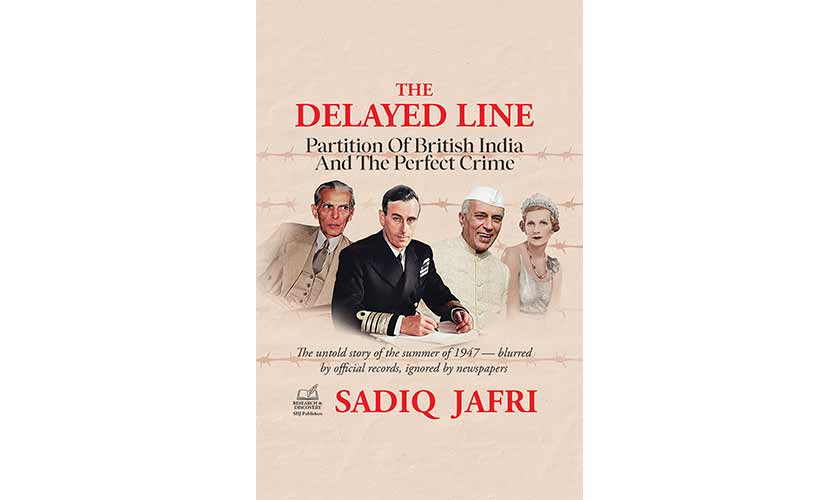
Sadiq Jafri argues that the Partition was a deliberate dismantling of a region, not a historical accident
| T |
he freedom struggle in the British Indian subcontinent against colonialism in the mid 20th Century was both a lesson in geography and a test of endurance. Most historians have interpreted the political wrangling and bloodbaths that accompanied the end of colonial rule through an opinionated lens, seldom allowing readers to grasp the veracity of the harrowing accounts of those events. For many, this was not the freedom envisioned by the suffering generation.
When does history cease to be a sequence of dated events and become, instead, a deliberate act of design? When does a nation’s most celebrated moment become its most concealed crime? These are not metaphors in The Delayed Line. They are investigatory imperatives. Sadiq Jafri’s explosive new book on the partition of British India opens with an unsettling quiet: a pause, a delayed announcement, a map that arrives late; and with it a trail of consequences echoing across South Asia eight decades later.
At first glance, the events of 1947 appear well known. But as Jafri delves deeper, a more unsettling picture emerges, one marked by calculated silences, manipulated timelines and deliberate exclusions. The manner in which the Partition was executed did not reflect the chaotic retreat of an empire; it was a carefully managed operation driven by imperial priorities. The disorder masked intent. Jafri argues that this rupture was the deliberate dismantling of a region to serve British and allied interests.
The violence and outward confusion obscured a deeper design, making the disorderly implementation of Partition, a “perfect crime” executed with precision, legitimised by false inevitability and buried under the debris of human suffering.
The book begins in a deceptively calm register. Jafri recounts the final months of British rule, the mounting pressure on Lord Mountbatten and the frenetic commissioning of Sir Cyril Radcliffe, a man unfamiliar with India, to draw the borders.
What reads initially like administrative procrastination soon reveals itself as strategic delay. Radcliffe’s maps and pronouncements did not merely appear late; they were held back to shape outcomes already in motion. The delay allowed for troop movements, political hedging and last minute pressures that ensured certain territories would align with particular interests, irrespective of local demographic preferences.
The writer juxtaposes the “chaos narrative,” the one that blames rushed timelines, with archival telegrams, classified memos and eyewitness accounts showing political calculation. He illustrates how pre existing biases, colonial anxieties and hurried arbitration created a vacuum into which the very agents of power poured their own interests. This interrogation of time — how it was manipulated, controlled and weaponised - is one of the book’s core revelations.
No single region bore the brunt of Partition like the Punjab and Bengal. The violence in these provinces, the bloodletting, the forced migrations and the obliteration of towns and villages fast entered the world’s memory. Jafri does not shirk from these horrors; he reframes them. The slaughter in the Punjab and Bengal was not a byproduct of hurried administrations and communal tensions; it was politically sanctioned demographic engineering.
These chapters, anchored by survivor testimonies that resist simplification, are some of the most poignant. The horror is familiar, so familiar in fact, that it has been retold with a certain inevitability. What the author does brilliantly is strip away that inevitability and expose the decision points where alternative paths were ignored.
As punishing as the stories from the Punjab and Bengal are, The Delayed Line forces the reader to ask: why do we focus primarily on these regions? Why do the cries from other territories, where Muslims lived and aspired for self determination, continue to echo in the margins of history?
The book illustrates in detail the scheme behind ignoring the voices of Muslims belonging to UP, Bihar, Hyderabad and Bhopal. This is where Jafri’s work diverges from conventional histories. It is not enough to document the most visible carnage; one must investigate who was excluded from decision making altogether.
The Muslims of the United Provinces, the book reminds us, were among the earliest and most articulate proponents of Pakistan. From political halls to grassroots campaigns, UP had significant Muslim leadership advocating for a future aligned with Muslim identity and security. Yet when the Radcliffe Line was drawn, not a whisper of UP’s Muslim population was solicited. There was no plebiscite and no consultative process.
These Muslims were left in a state of bewilderment, politically present yet historically uncounted. The author’s recounting of UP’s sidelining is not an academic afterthought; it is a moral indictment. He underscores the irony of a province whose Muslim populace gave intellectual heft to the Two Nation Theory yet received no agency when their own futures were decided.
The book relates the horrifying events in Bihar in 1946, where communal violence erupted months before the actual transfer of power. Thousands of people were killed, properties destroyed and entire Muslim communities rendered homeless. Yet when partitioning was being mapped, the survivors of Bihar were not offered a West Pakistan option. Most of them were pushed eastward into Bengal, in an orchestrated chaos, to a land already convulsing with upheaval.
Jafri points out the silence around this choice: why was West Pakistan not presented as a viable destination? Who decided this narrative of repositioning? Bihar’s Muslims were not merely collateral damage; they were strategically redirected without their consent.
Princely states represent a highly contested and under examined terrain in Partition studies. The author gives us Hyderabad and Bhopal as case studies of erased autonomy. Hyderabad sought neutrality and independence; Bhopal, with its Muslim majority, wished to determine its future. Both were effectively ignored in the grand design of 1947. Hyderabad was later annexed through force under Operation Polo; Bhopal’s aspirations were drowned in bureaucratic indifference.
The book mentions that the voices of peripheral Assam and Kerala’s populations were silenced through official manipulation. In Assam, demographic calculations were tied to resources and political leverage rather than popular will. In Kerala, Muslim communities remained non consulted, their futures presumed as incidental to the larger narrative of Indian independence.
These are not footnotes; they are fractures in the foundation of South Asian historiography. What elevates The Delayed Line beyond many Partition books is not simply the evidence presented - though the archives, telegrams, maps and declassified documents are extraordinary - but how the writer uses them. He approaches history the way a seasoned journalist approaches a cold case: questioning assumptions, challenging received wisdom and following traces where others see only dust.
This combination of journalistic rigor and historical depth allows Sadiq Jafri to reframe what history has “known” about Partition. The book is not polemic for polemic’s sake; it is argument backed by documentation. It rejects sentimental nostalgia but embraces human testimony. It holds neither indemnity nor rancor. It demands accountability for narratives that have for too long lived unexamined.
Some traditional historians might bristle at the book’s journalistic cadence, preferring a more academic style. But this accessibility is also the book’s strength: it brings serious historical scholarship to the readers beyond university seminar rooms.
The Delayed Line is not an ordinary book; its publication is a significant event in South Asian historical writing. Its interrogation of who decides, who is heard and who is silenced makes it an indispensable work for anyone seeking a just understanding of Partition.
In reminding us that history is not only about what happened, but also about what was allowed to be known, Sadiq Jafri has given us a work that refuses easy answers and demands unflinching attention. In a world increasingly conscious of whose histories are told and whose suppressed, The Delayed Line has arrived at a crucial moment.
Its relevance extends beyond South Asian borders; it speaks to any society wrestling with the discrepancies between official history and lived experience. For Pakistanis, the book resonates with particular sadness. It reframes a foundational moment not as a singular triumph or inevitable catastrophe, but as a series of choices with definite consequences.
It challenges readers to see beyond a grand narrative and attend to the voices pushed to the margins, where survival, memory and truth intersect.
No book is beyond critique. Some readers may argue that Sadiq Jafri’s assertions, especially regarding intentional delay of the Radcliffe Line, require further corroboration from yet to be declassified British and Indian archives. These are not flaws but invitations to conversation, to verification to continued inquiry.
The reviewer is a journalist of long standing, a teacher of journalism and a trade union leader