Print Story
X




A painter’s lifelong tribute struggles to survive
| B |
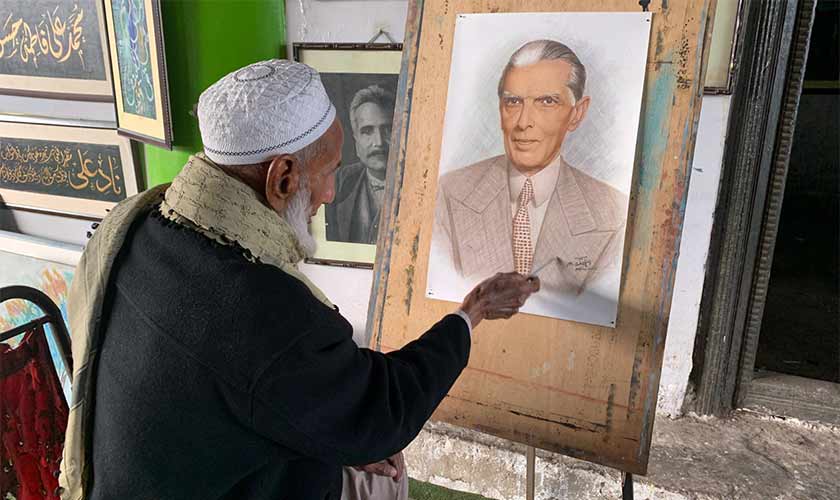
eneath the Jhal Khanuana overhead bridge in Faisalabad, 75-year-old painter Muhammad Shafiq sits on a broken chair, gazing at a portrait of Pakistan’s founder, Muhammad Ali Jinnah, mounted on a worn-out easel stand before him. He painted the portrait on December 25 as a tribute to the Quaid-i-Azam on his birth anniversary.
Living a life marked by hardship, Muhammad Shafiq has painted more than a thousand portraits of the Quaid-i-Azam over the past six decades. His body of work also includes dozens of paintings depicting other leaders of the Pakistan Movement, as well as the struggles and suffering of Partition refugees.
Two years ago his art gallery was robbed and almost all his paintings stolen.
Speaking to The News on Sunday, Shafiq said he had made a routine of painting a portrait of the Quaid-i-Azam every year on December 25.
“When all my paintings and portraits were stolen two years ago, it broke my heart. Even portraits of the Quaid-i-Azam are not safe here,” he lamented. “After that incident, I gave up painting altogether. However, love for the Quaid-i-Azam has compelled me to pick up the brush again. This is the only tribute I can offer him as an expression of my reverence and devotion.”
He said only a few paintings and portraits had survived the robbery—those that happened to be at his home on the day. “Even this portrait,” he added, “I will take home with me in the evening. It is clearly not safe here.”
Muhammad Shafiq said, after the robbery, he had registered an FIR at People’s Colony police station and approached various district administration officials, appealing for the recovery of his stolen artworks. “Unfortunately,” he said, “nothing came of it.”
Shafiq said that he had never received formal training in painting. “I developed a passion for drawing in my childhood,” he recalled. “My parents had passed away early and I was left orphaned. Whenever I had the opportunity, I would draw figures and patterns on walls, mostly using charcoal. At first, I was scolded for it, but people eventually started noticing my skill and some of them encouraged me.”
He said an elder once gave him a box of coloured pencils and some paper, advising him to draw on paper instead of walls.
Over the last six decades, hundreds of students and art enthusiasts have learned the craft of painting from him, including some students from established institutions such as the National College of Arts, Lahore, the Punjab University and the National Textile University, Faisalabad.
For a portrait produced at the age of 13, he received a Rs 20 prize.
“At that time, I was a student at City Muslim High School, Dhobi Ghat. When I learnt that fighter pilot MM Alam was scheduled to visit our school, I decided to draw his portrait. He worked throughout the night to complete the painting so that he could present it to the national hero during his visit.
“The school management had made special arrangements. The teachers and students were immaculately dressed. Green-and-white flags fluttered everywhere, and children were holding small flags and bouquets of flowers.”
When MM Alam arrived, he was given a rousing welcome. Amid the crowd, Muhammad Shafiq struggled to get closer. Noticing his eagerness, MM Alam himself asked him to come forward.
Shafiq’s story raises urgent questions about how we treat artists, protect cultural heritage and honour those who preserve our collective history through creativity rather than power or privilege.
“I kissed his hand and presented him the portrait I had painted. He was greatly moved. He appreciated my work, gave me with 20 rupees and made me promise that I would continue painting.”
He says he could not sleep that night. Instead, he lay awake thinking of painting canvases.
“Before the sun rose the next morning, I had decided that I would become a painter and establish an art gallery open to everyone.”
Muhammad Shafiq would soon realise that this was not an easy dream to turn into reality.
He began his artistic journey with a small cabin on the footpath near Regal Cinema on Regal Road. For four decades, he worked at that same, painting portraits of the founders of Pakistan, scenes from the Pakistan Movement, the refugees’ struggles and depictions of Punjab’s culture.
The work earned him accolades at many exhibitions and many prominent people came over to admire his art. Yet, despite his lifelong dedication to painting, financial hardship never left him. Even his dream of establishing a public art gallery seemed distant.
In 2010, calamity struck. The district administration decided to demolish the shops to make room for expansion of Regal Road.
“Once I learnt about the plan, my nights became sleepless. For four decades, I had nurtured the dream of my own art gallery. Now, I felt shattered.
“I was consumed by a single thought: how to save this fragile house of dreams?”
Finally, he decided to meet the then district coordination officer.
“On my way to the DCO’s office, I passed by my old school and was reminded of the day when Air Commodore MM Alam had called me a born artist.”
When he reached the DCO’s office, however, no one seemed to take notice of him. Disheartened, he stood quietly in a corner. When DCO Naseem Sadiq arrived, Shafiq gathered courage and greeted him.
“He was a connoisseur of art. Instead of taking offence, he invited me into his office. I poured my heart out before him. He was deeply moved and promised that he would help turn my dream into reality.”
The artist and the bureaucrat agreed to turn the space beneath the Jhal Khanuana Bridge into a public art gallery. The district government allocated the site, installed stone benches for visitors, built a one-room studio and a display wall, and formally handed over the space to Muhammad Shafiq.
That sanctuary and the treasure he accumulated is now under threat. The police have been unable to recover his stolen artworks. The Faisalabad Development Authority has also placed some billiards and snooker tables at the site, effectively altering its identity and undermining its purpose as a dedicated art space.
Shafiq says that when his artworks were stolen, he suspected that the theft was an attempt to force him to vacate the place.
“Some people had already visited me and asked me to leave the place, but I have an official allotment letter. Now I fear that someday some officer will arrive and say: the paintings because of which this space was allotted to you are no longer there, so you must vacate it.”
Shafiq’s story raises urgent questions about how we treat artists, protect cultural heritage and honour those who preserve our history through their creative endeavour rather than power or privilege.
The writer has been associated with journalism for the past decade. He tweets @naeemahmad876