Print Story
X

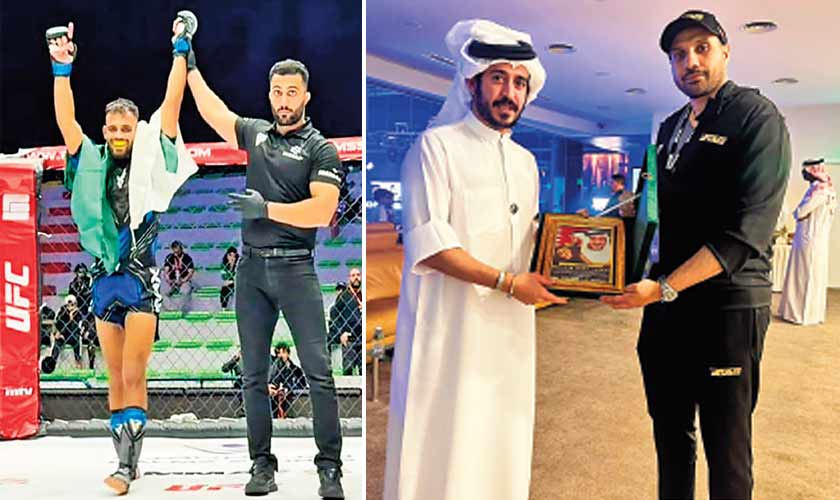
In 2025, Pakistan quietly achieved something few believed possible. Beyond politics, beyond traditional sporting hierarchies, and outside the glare of mainstream funding, a new national force emerged, disciplined, structured, and internationally respected. Mixed martial arts, long viewed as a fringe pursuit, became a symbol of Pakistan’s evolving sporting identity. From sold-out arenas in Lahore to elite cages in Georgia, Lebanon, Uzbekistan and the Middle East, Pakistani fighters did more than compete, they dominated. What unfolded was not a moment, but a movement.
The turning point came with Pakistan Combat Night, a landmark event hosted in Lahore that redefined the country’s relationship with combat sports. Supported by the Government of Punjab under the leadership of Senior Minister Maryam Aurangzeb, the event became the first truly national MMA platform in Pakistan’s history and the catalyst for everything that followed. For the first time, a structured pathway connected grassroots athletes to international competition, supported by unified rules, governance, and broadcast standards.
The impact was immediate. Eight Pakistani fighters qualified for the IMMAF World Championships, while five secured contracts or appearances with leading global promotions, including BRAVE Combat Federation. This was not symbolic representation. It was performance-driven validation that Pakistan’s MMA ecosystem had reached international competitiveness.
That momentum carried into the IMMAF World Championships in Tbilisi, one of the most competitive stages in global amateur MMA, featuring over 800 athletes from 72 countries. Pakistan arrived not as observers, but as contenders. Shahab Ali delivered a standout campaign, defeating Ukraine’s Dmytro Broznytskyi and Africa’s Prince Tafuna before pushing elite Tajik contender Qurbonali Shomahmadov to the limit. Abdul Mannan advanced deep into the tournament with composed, technically refined performances. Ayyan Hussain recorded a statement win over Bulgaria’s Kadirdzhan Isa, while Bano Butt represented Pakistan with resilience and professionalism, supported by structured medical and performance systems. For the first time, Pakistan was not learning on the job, it was competing to win.
The transition from amateur success to professional legitimacy came in Dubai. Competing at Absolute Championship Akhmat, one of the world’s most respected MMA promotions, Pakistan’s Rizwan Ali faced India’s Rana Rudra Pratap Singh. The bout ended in a decisive first-round stoppage, reinforcing Pakistan’s growing reputation as a serious competitive force. The performance resonated across regional MMA circles and confirmed that Pakistani fighters could operate at the highest professional level.
Momentum continued at BRAVE Combat Federation 101. Aqib Awan faced India’s Punyajit Likharu in a hard-fought contest that went the distance before being declared a no-contest due to an accidental eye injury. The bout demonstrated depth, composure, and parity with elite opposition, setting the stage for a highly anticipated rematch under the Pakistan MMA banner.
The journey reached another defining chapter at the IMMAF Asian Championships in Lebanon. Abdul Mannan delivered a dominant third-round knockout against Syria’s Obada Hussam, while Shahab Ali outclassed Kuwait’s Talal Alqallaf - a fighter trained under the Khabib Nurmagomedov system. Both advanced to the finals, reinforcing Pakistan’s standing among Asia’s top MMA nations. These performances built upon the success of Pakistan’s hosting of the IMMAF Asian Championship in Lahore, where over 300 athletes from 18 countries competed and Pakistan secured 12 medals, one of the strongest results in its sporting history.
Central Asia marked the next proving ground. At BRAVE 103 in Bukhara, Pakistani fighters entered one of the most unforgiving MMA environments in the world. Rizwan Ali accepted a short-notice bout against Uzbekistan’s Nozim “The Bukhara Warrior” Kalandarov, displaying resilience and composure under pressure. The evening belonged to Ismail “The Volcano” Khan, who secured a decisive submission victory over Kyrgyzstan’s Rayimbek Tazhibaev, his fourth consecutive win under the BRAVE banner, confirming his place among the region’s elite.
Behind this ascent stands Omar Ahmed, President of the Pakistan Mixed Martial Arts Federation, Director for South Asia at the International Mixed Martial Arts Federation, and an elected member of the IMMAF Police Commission. His leadership has focused on structure, sustainability, and international alignment. Through initiatives such as the Real Fight Project under Brave Gym, he has positioned MMA as a vehicle for discipline, youth development, and national representation, not merely a sport, but a system.
In 2025, Pakistan’s sporting identity underwent a defining shift. Long associated with a single discipline, the country has demonstrated that excellence can be built through vision, structure, and sustained effort. From Lahore to Tbilisi, from Dubai to Tashkent, Pakistani fighters are no longer guests, they are competitors, contenders, and in many cases, favourites. This is not a moment. It is a movement. And it is only beginning.