Print Story
X




Matthieu Blazy’s first Métiers d’Art collection for Chanel reads like an affectionate postcard to New York.
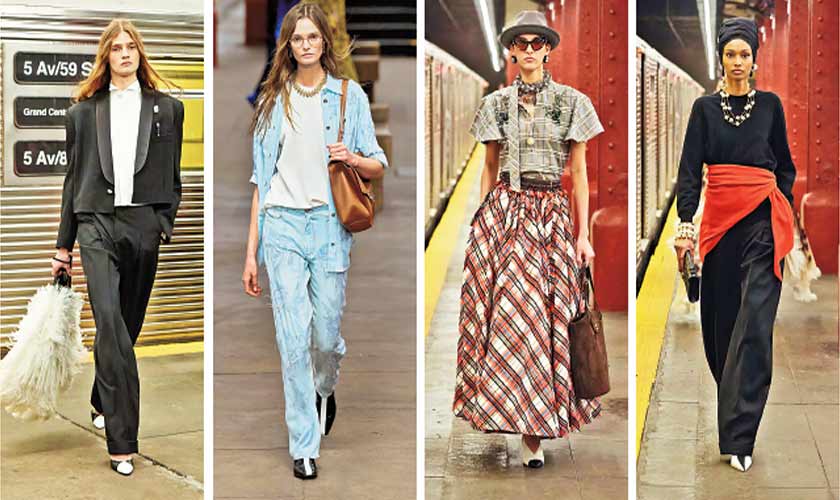
AConceived as the house’s annual showcase dedicated to its specialist ateliers, Métiers d’Art sits outside the traditional fashion calendar and has historically travelled to cities tied to Chanel’s heritage and imagination. For 2026, Blazy chose an abandoned New York City subway platform, transforming a space associated with daily transit into the setting for one of the house’s most rarefied offerings.
For a house long defined by controlled fantasy and European hauteur, staging a Métiers d’Art show underground is not merely a scenographic choice. It is a philosophical one. It is Chanel doing grit, accessibility and metropolitan cool. Beneath the spectacle lies a deliberate recalibration of what Chanel means now and who it is for.
Métiers d’Art collections traditionally function as celebrations of the specialised ateliers that make Chanel’s most ornate gestures possible. By placing this craftsmanship in a setting associated with routine, anonymity and shared experience, Blazy reframes it as something that exists alongside real life rather than above it.
The subway is the New York’s great leveller, a space where social hierarchies blur and style becomes instinctive rather than aspirational. This idea of anti-hierarchy quietly drives the collection. Denim appears to be denim but reveals itself as embroidered silk. Leopard prints feel downtown and dubious but are in fact painstakingly hand-woven tweed. What looks casual is labour intensive. What appears familiar is deeply coded.
This tension between appearance and reality is where Blazy’s hand becomes most recognisable. His work has consistently challenged the visual language of luxury by disguising effort rather than announcing it. At Chanel, that instinct gains added resonance.
The house’s codes have often functioned as signals of belonging and status. Here, Blazy softens them. Tweed is slouched. Coats are carried rather than worn. Scarves are knotted at the waist. Even eveningwear feels caught mid-journey, as if glamour is something you slip into rather than stage manage.
The characters on the runway reinforce this shift. Instead of a singular Chanel woman, Blazy offers a crowd. A student. A journalist. A businesswoman. A society matriarch. These are not muses in the traditional sense but social roles in motion. Chanel has often been accused of freezing femininity in an idealised past. Blazy allows it to move through time, suggesting continuity rather than nostalgia.

He also positions Chanel as a cultural language rather than a closed system. Even the most playful gestures carry weight. The “I Heart NY” T-shirt is not just a souvenir reel. Worn under tweed, it collapses the distance between high and low, official and unofficial. It also signals a willingness to let Chanel be absorbed into everyday visual culture, a move that would once have been unthinkable for the house.
The craftsmanship remains formidable. Embroidery, feathers and intricate detailing are all present, sometimes hidden in linings or revealed only on closer inspection. That concealment feels intentional. Blazy appears less interested in showcasing skill for its own sake than in questioning how craftsmanship functions within a contemporary wardrobe. The message is clear. Excellence does not need to announce itself to be felt.
Perhaps the most telling detail is the show’s lack of linearity. Models appear and disappear, linger on platforms, read newspapers and wait. Time feels fragmented, like a commute rather than a performance. In fashion terms, this rejects the traditional narrative arc of a runway show. There is no crescendo, no final look that attempts to summarise everything. Meaning accumulates instead through proximity and contrast. This is Chanel as lived experience rather than myth.
This collection marks a significant moment. It suggests that Blazy is not simply refreshing Chanel’s aesthetic but quietly reworking its social contract. Luxury here is not about distance or dominance but participation. The Chanel woman is no longer a fixed ideal but a shifting presence shaped by context, movement and choice.
In taking Chanel underground, Blazy brings the house closer to the ground, where fashion meets life in all its contradictions. The result is a Métiers d’Art collection that does not shout its importance but earns it through restraint. It is Chanel in transit, attentive to where it has been and unusually clear eyed about where it is going.
– Photo courtesy: Chanel