Print Story
X




The Christian community got together to celebrate, even as threat of violence loomed over the horizon.

Like other cities across Pakistan, Christmas was celebrated in Peshawar with deep religious devotion, prayers for peace, national security and prosperity and a renewed message of harmony and co-existence. Members of the Christian community marked the occasion under tight security but with visible enthusiasm, faith and hopes of a better future.
Christmas celebrations in Peshawar this year were not just religious events but also a reflection of resilience, hope and the desire for peaceful co-existence. Despite security challenges and long-standing concerns, members of the Christian community expressed optimism rooted in faith and social engagement.
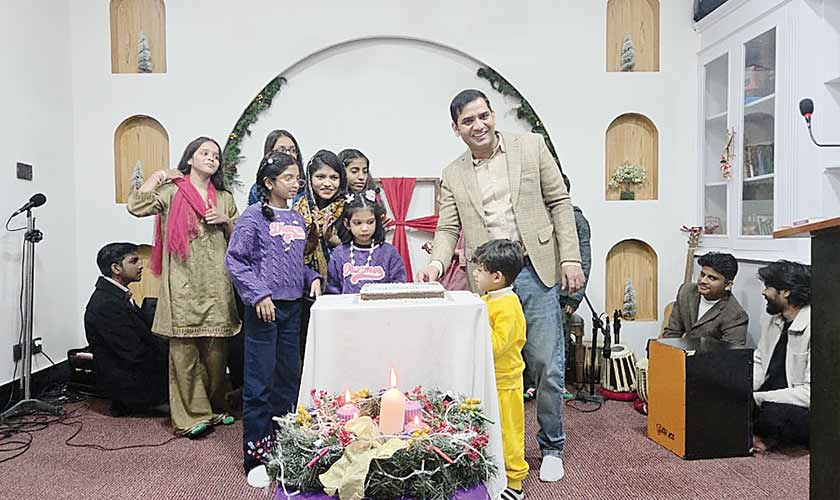
Kashif Basharat, a pastor at The Ark Church in Peshawar, organised a Christmas celebration along with his children and members of the local Christian community. The event brought together children and parents. Hymns were sung and a Christmas cake was cut in a modest yet joyful gathering.
Speaking to The News on Sunday over the phone, Pastor Basharat said that, this year, he had chosen to celebrate Christmas quietly with his children and family. He expressed hope that the coming year would be better than the previous one.
“May God bless our country with peace,” he said, adding that he prayed for a Pakistan where people could worship freely without fear or insecurity.
Beyond religious celebrations, Kashif highlighted the social work carried out by his church during the year. During the monsoon season, several districts of Khyber Pakhtunkhwa were badly affected by heavy rains and flooding. The Ark Church, in collaboration with the Tanzeem Naujawanan Topi, distributed rations, quilts and other essential items among 18 flood-affected families in the Topi area of Swabi district.
Kashif said that most of the flood victims were Muslim families who had suffered significant financial and human losses.
“As Christians, it was our moral and religious duty to help our Muslim brothers and sisters within our limited capacity,” he said, reflecting the spirit of interfaith solidarity that has survived growing religious intolerance in certain parts of the society.
Kashif said members of the Christian community continue to attend church services under strict security arrangements.
“We go to our churches and perform our religious rituals under heavy security. We pray that peace prevails in our country. One day, we will be able to worship freely, without fear,” he said.
Augustin Jacob, a Peshawar-based social worker, described 2025 as a significant year for Christians in Pakistan.
“For the first time, the Christian community was acknowledged and embraced at both federal and provincial levels,” he said, noting that official participation in Christmas celebrations created a sense of inclusion and recognition.
“This sent a positive message to the entire Christian community. There was a wave of happiness because the state sent the message that it was at one with minorities,” Jacob remarked.
Looking ahead, he expressed hope for 2026, saying he wished for national development and economic stability. However, he also raised concerns regarding the lack of institutional engagement with Christian professionals and activists.
Christmas celebrations in Peshawar this year were not just religious events but also a reflection of resilience, hope and the desire for peaceful co-existence. Despite security challenges and long-standing concerns, members of the Christian community expressed optimism rooted in faith and social engagement.
“As a social worker, I feel that opportunities are still limited. Active committees have not been formed at the federal or provincial levels,” he said.
Jacob said that at least half a million Christians live in Peshawar alone, nearly 100,000 are educated. “These educated individuals can play a vital role in the development of Peshawar and the province,” he said.
He suggested that the Auqaf Department should identify capable and educated individuals from the Christian community and engage them in development sectors committees.
Meaningful inclusion, he said, would not only empower minorities but also contribute to social and economic progress.
Jacob also welcomed the establishment of the National Commission for Minorities at the federal level after an eleven-year delay, following court directives.
“Now members from all provinces should be appointed on merit so that the commission can effectively work for minority rights,” he said.
Christmas in Pashto: A cultural milestone
This year’s Christmas celebrations in Peshawar also witnessed a cultural milestone. Daniel Shaukat, a young artist from Peshawar, released a Pashto-language Christmas song that received widespread appreciation from mainstream media and the local Christian community.
This was the first time a Christmas song in Pashto language was composed and released. Traditionally, Christmas hymns and songs in Pakistan have largely been in English or Urdu. Shaukat’s initiative was seen as a powerful symbol of cultural integration and inclusivity.
“Before this, our group of performers and artists used to go door-to-door, singing Christmas carols in Urdu, English and Punjabi. This year, we thought, why not compose a carol in Pashto so it has our local flavour,” said Shaukat.

The song, titled Khushhali (Prosperity), carries a strong message of peace, love and harmony. Its lyrics celebrate joy and goodwill, emphasising shared human values, rather than religious differences. These lines of the song convey the spirit of the message:
“There is prosperity everywhere,
Jesus has been born,
Light the lamps,
Yes, light the lamps of love in your hearts,
Leave hatred behind.”
“My father wrote the lyrics.Together we came up with the composition. Once we had the song ready, we went to shoot the video in Peshawar. As the setting, we picked a local bus and a haveli – both are unique to Peshawar.”
The song resonated with audiences across religious lines, reinforcing the idea that cultural expression can serve as a bridge between communities.
“It worked out wonderfully well,” said Daniel Shaukat, “Now we have a Pashto Christmas carol, complete with an ensemble of rubab, tablaand other local instruments. This carol is an ode to our identity and culture [as Christians in Khyber Pakhtunkhwa].”
On the occasion of Christmas, Special Assistant to Chief Minister for Information and Public Relations Shafi Jan extended greetings to the Christian community of Khyber Pakhtunkhwa and across the country.
He said that the provincial government was taking historic steps to protect minority rights and promote their development and welfare. Shafi Jan announced that Chief Minister Muhammad Sohail Afridi had approved a development package worth Rs 860 million for minority communities.
Jan said the provincial government was committed to ensuring access to education, employment opportunities and improved religious infrastructure for minorities. He said Rs 80 million had been allocated for scholarships for minority students from matriculation to PhD level.
Additionally, Rs 200 million has been approved to help the minority youth prepare for competitive examinations such as CSS and PMS and for skills training programmes. To promote interfaith harmony,community exchange initiatives and the organisation of minority religious festivals, Rs 300 million has been earmarked.
Other allocations include Rs 100 million for the renovation and beautification of places of worship in the merged districts and Rs 70 million for the repair and improvement of worship places in settled districts.
Jan said that these initiatives reflect the provincial government’s seriousness in translating policy commitments into practical actions.
“Religious harmony and equal opportunities are essential for a peaceful and progressive society,” he said.
The writer is a multimedia producer. He tweets @daudpasaney.