Print Story
X




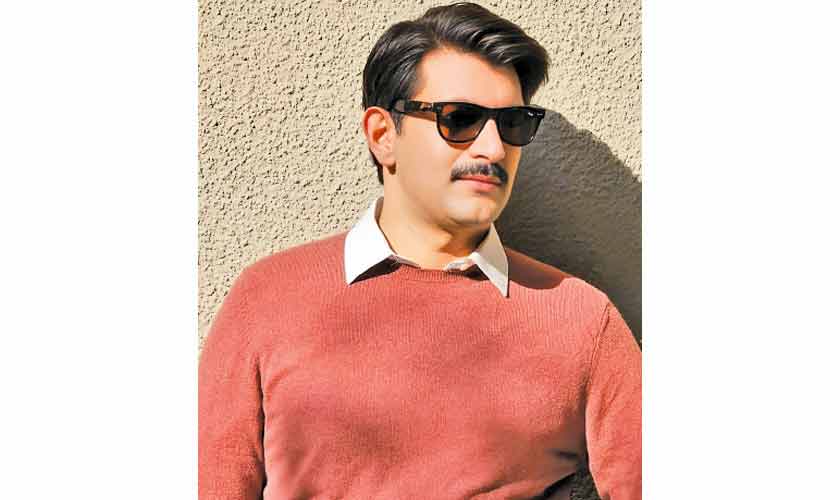
A prestige name in television direction, Musaddiq Malek has emerged as one of the most distinctive storytellers working in Pakistan today. In this conversation, he reflects on craft, character and the intelligence required to succeed.
| F |
rom the quiet streets of Abbottabad to the upper echelons of Pakistani television, Musaddiq Malek’s rise reads like a study in grit shaped by instinct and discipline. A natural go-getter, Malek began his prof-essional journey at 17 in a call centre before securing the sole quota seat at the National College of Arts. His trajectory was defined by relentless work ethic. While still a student, he moved from working as a photo-grapher for Unilever to managing the company’s regional ice cream pop-ups by his thesis year.
After interning with Sajjad Gul at Evernew Studios, Malek relocated to Karachi to join Six Sigma, where he refined his craft under seasoned names such as Nadeem Baig and Saba Hameed. Though directing has always been his primary calling, his acting roles in acclaimed serials including Alif, Mere Paas Tum Ho, Habs and Mein Manto Nahi Hoon offered him an invaluable vantage point into per-formance, character psychology and narrative rhythm.
A firm believer in fate, his defining breakthrough came with Noor Jahan, a script reportedly rejected by six directors and 18 actors. Malek reimagined the familiar saas-bahu framework as a cinematic narrative of psychological depth, anchoring it in a resonant idea: that forgiveness, rather than control, offers the only true path forward.
Today, Malek is recognised for what he describes as “intimate grandeur”, an atmospheric visual language that transforms domestic storytelling into cinematic experience. From the record-breaking Noor Jahan to the emotionally charged Meri Zindagi Hai Tu, his work continues to challenge the boundaries of contemporary television. In an exclusive conversation with Instep, Malek reflects on the quiet power of emotional intelligence in directing.
Instep: From your time as an assistant director on Mere Paas Tum Ho to directing hits like Habs, Noor Jahan and Meri Zindagi Hai Tu, how has your perspective on balancing artistry with commercial demand evolved?
Musaddiq Malek (MM): Mere Paas Tum Ho was an invaluable education in understanding the emotional pulse of the masses. It taught me how high-stakes drama functions and why emotional payoff matters. As a director, my focus has shifted to preserving artistic integrity within that commercial framework. I have learned that heightened drama and sophisticated visual storytelling are not opposites. You can deliver intensity while still relying on subtext and nuance.
Instep: Noor Jahan was rep-ortedly rejected by several directors and actors before you took it on. What was your vision for the matriarch and why did it resonate so strongly?
MM: I wanted to examine the corrosive nature of power within a traditional family. We often explore powerful men but rarely interrogate a woman who has constructed authority through emotional mani-pulation. At its core, the story asks what happens when love becomes conditional. Eventually, it consumes its architect. The resonance came from the familiarity of these uncomfortable dynamics. In Saba Hameed, we found someone who did not play a villain but portrayed a regally flawed woman marked by loneliness. The sons and daughters-in-law were written with internal conflicts and agency rather than narrative accessories. The final monologue was intentionally un-resolved. It reflected isolation rather than redemption.
Instep: What made Saba Hameed the ideal choice for this nuanced character?
MM: Saba jee is a powerhouse. She projects authority and vulnerability at the same time, bringing a regal steeliness that makes Noor Jahan’s dominance believable while revealing the subtle fear beneath her control. She portrayed a highly successful yet deeply flawed woman who is tragically alone.
Instep: In Meri Zindagi Hai Tu, the chemistry between Hania Aamir and Bilal Abbas Khan felt electric. How did you shape that dynamic to explore infatuation versus love?
MM: The emotional core of the show is honesty. Kamyar was not cruel by nature. He was someone running from himself. I allowed Hania and Bilal’s natural comfort to unfold organically. Hania brings vulnerability with ease while Bilal internalises complexity instinctively. Convincing Bilal to play Kamyar took time because the character is impulsive and emotionally scarred. We worked closely on understanding his moti-vations so the audience could see the loneliness beneath the bravado. Subtle gestures and non-verbal cues were essential. Vulnerability often emerges in silence.
Instep: How would you define your directorial aesthetic and
how has your acting background shaped it?
MM: I would describe it as emotional intensity paired with clean contemporary storytelling. I approach familiar themes such as love, betrayal and family politics with a cinematic lens that feels grounded yet elevated. My acting experience is my greatest asset. I do not think only in terms of camera placement. I ask what a character wants in that precise moment. That helps me communicate emotional intent clearly to my actors. Technology may streamline pro-duction but emotional intelligence and human connection cannot be automated.
Instep: Who are your main inspirations, locally and interna-tionally?
MM: Locally, I grew up inspired by watching Pakistani television and the work of directors like Shoaib Mansoor and more recently Nadeem Baig and Nabeel Qureshi. Internationally, I admire David Fincher and Steven Spielberg. However, Martin Scorsese has been a profound influence on my process, particularly in how I approach morally complex characters and their inner worlds.
Instep: How do you view the role of AI (artificial intelligence) in direction?
MM: AI can streamline technical and analytical tasks but a director’s vision, emotional intelligence and ability to inspire performances remain irreplaceable.
Instep: Your supporting char-acters often feel as layered as your leads. How do you approach secondary roles, for example, in Meri Zindagi Hai Tu?
MM: Supporting characters are the skeleton of a story. For Meri Zindagi Hai Tu, Ayra’s family defined her emotional grounding. Her father’s unconditional love and her mother’s pragmatism shaped her moral compass. Kamyar’s grandmother embodied inherited trauma and social expectation. Giving each character specific needs and habits ensured their actions carried weight.
Instep: How do you balance intense drama with moments of humour without disrupting tone?
MM: Life is never one note. In Meri Zindagi Hai Tu, humour emerged naturally from character, particularly within Ayra’s family. Their exchanges created breathing space. The key is restraint. I avoid abrupt tonal shifts, loud cues or sharp edits. A moment must resolve before the camera signals a return to drama.
Instep: Critics and viewers often praise your treatment of familiar narratives. What elevates your work beyond conventional television?
MM: Our scripts often rely heavily on exposition. I prefer subtraction. I let sound, silence and visual rhythm carry emotion. I work closely with my composer Mohsin Allah Ditta to ensure the score mirrors the character’s internal state. Silence is where subtext lives. Often, what is left unsaid resonates the most.
Instep: You have a deep love for cinema. How do you see the current state of the big screen?
MM: I miss the magic of cinema deeply. I used to travel from Abbottabad to Rawalpindi just to watch films. While circumstances have altered my original plan of producing multiple films in a year, my connection to cinema remains central. Whether for television or film, I am drawn to stories that challenge convention.
Instep: What lies ahead for you creatively?
MM: I am currently considering three scripts, two for television and one for film. I want to explore complex themes such as faith and modernity and the workings of our judicial system. Psychological thrillers and dark comedies that critique social hypocrisy particularly interest me.
Instep: What is your goal when it comes to nurturing new talent?
MM: I want to work with emerging voices who bring sincerity and fresh perspective. My goal is to tell stories that have not yet been explored and to amplify talent that deserves space in our industry.