Print Story
X




As Pakistan Idol moves deeper into its rounds, the competition begins to shed its early sheen of spectacle.
| B |
y Episodes 21 and 22, Pakistan Idol has reached a clear inflection point. The competition is no longer about discovery alone. It is about definition. Who are these singers when the lights dim, the novelty fades and the margin for error narrows? Across both episodes, the show quietly but decisively shifted its emphasis from polished performance to emotional truth, from technical competence to artistic identity.
Episode 21 leaned heavily into scale and momentum. The Gala round expanded, expectations hardened and the production appeared keenly aware of the cultural weight it was carrying. Judge Fawad Khan was absent across both episodes due to promotional commitments for his latest film, with Shuja Haider stepping in as guest judge for episode 21 and setting a markedly different creative tone. His presence mattered as a creative barometer. Representing a generation that bridges mainstream success and artistic credibility, Shuja reinforced that balance through his own performance of ‘Jind Mahiya’, which was received with warmth and restraint rather than a spectacle. It reframed the benchmark for the contestants. Mood alone would no longer suffice. Meaning had to follow.
That tension between appearance and substance ran throughout the episode. The most charged moment came with the announcement of the first wildcard return. Muhammad Minaam re-entered the competition on the strength of public votes, framing his comeback as a test of resilience rather than entitlement. His choice of ‘Akhiyan’ by Fuzon was telling. The performance balanced energy with restraint, allowing him to move between shifting musical moods without losing his core identity. The judges’ response suggested relief as much as approval. Minaam’s return felt earned, reinforcing the idea that Pakistan Idol remains as invested in growth arcs as it is in elimination drama.
Following Minaam’s return, Romaisa Tariq performed ‘Dupatta’ by Hadiqa Kiani. Technically assured and visually composed, the performance nevertheless struggled to land emotionally. The judges were direct in their feedback. What was missing was not skill but vulnerability. Romaisa appeared to be performing the song rather than inhabiting it, prioritising control over connection. The critique felt less like dismissal and more like a warning. At this stage, presentation without feeling is a dead end.
If Romaisa faltered, Merab Javilin provided the episode with its most joyful release. Performing ‘Dil Hua Bo Kata’ by Fariha Pervez, she transformed the stage into something communal and nostalgic. It was not only about vocal precision, though that was firmly in place, but about an intuitive understanding of cultural memory. Bilal’s delighted reminiscence and Zeb’s emotionally grounded response captured why the performance resonated. Handled with sensitivity, context elevated the performance beyond notes and scales.
Aryan Naveed closed the episode on a more introspective note with ‘Aatish’, composed by Shuja Haider himself. Moving away from his comfort zone of retro selections, Aryan’s execution was uneven, marked by breath control issues and moments of hesitation. Yet intent mattered. Rather than penalising imperfection, the judges acknowledged his willingness to take risks. He emerged as a contestant still searching for his range, but no longer playing it safe.
Where Episode 21 wrestled with ambition and expectation, Episode 22 turned inward. However, before that tonal shift could fully settle, the show was hit by its first major controversy of the season. Top 16 contestant M. Ibrar Shahid abruptly quit the show and accused the production of fostering an unfair and emotionally damaging environment. The show has categorically denied the allegations. Shahid announced on social media that he left the set during a December 9 shoot and would not appear in upcoming episodes. In a video statement, he cited heavy autotuning of his performance as the breaking point, claiming it misrepresented his real voice. According to Shahid, his public objection led to pressure from the production team and warnings against speaking out. He alleged that the show’s processes were scripted and exploitative, though he clarified that his criticism did not extend to the judges, whom he described as supportive. Shahid said the experience had eroded his trust and left him disillusioned, despite anticipating personal and professional consequences for speaking publicly.
In response, the Pakistan Idol team rejected the claims as false, misleading and defamatory. In a statement, the production asserted that the contestant had voluntarily withdrawn and that the show adheres to strict international production standards set by Fremantle, the global rights holder of the Idol franchise. The statement emphasised that all stages of the competition follow established guidelines and that the matter is being addressed through appropriate legal channels. For now, Pakistan Idol maintains that the platform remains fair, transparent and respectful, with the situation under control. At the start of Episode 22, the host Shafaat Ali confirmed that Ibrar had left of his own accord and wished him well.
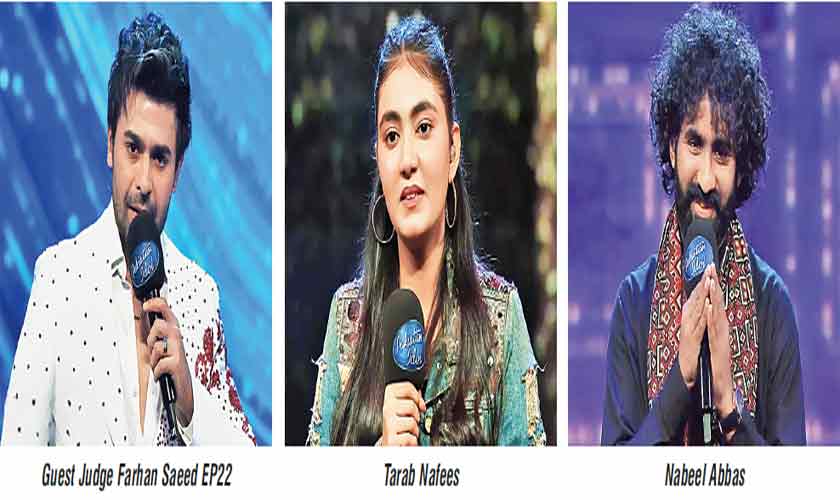
The episode proceeded without eliminations. Farhan Saeed joined the panel as guest judge and opened the night with a performance of his latest track ‘Khat’, setting a contemporary but grounded tone.
The first half of the epi-sode leaned strongly into folk and regional memory. Nabeel Abbas performed ‘Allah Allah Kar Bhaiya’ by Allan Faqeer and Muhammad Ali Shehki, delivering a rendition rooted in rawness rather than polish. Judges repeatedly referred to the “smell of the soil” in the voice, a phrase loaded with meaning in Pakistani musical discourse. This was not about refinement but about rootedness. Bilal noted how convincingly the performance marked a shift from earlier, more filmy expressions to something far more organic. Zeb echoed this emphasis on emotional grounding over technical showmanship.
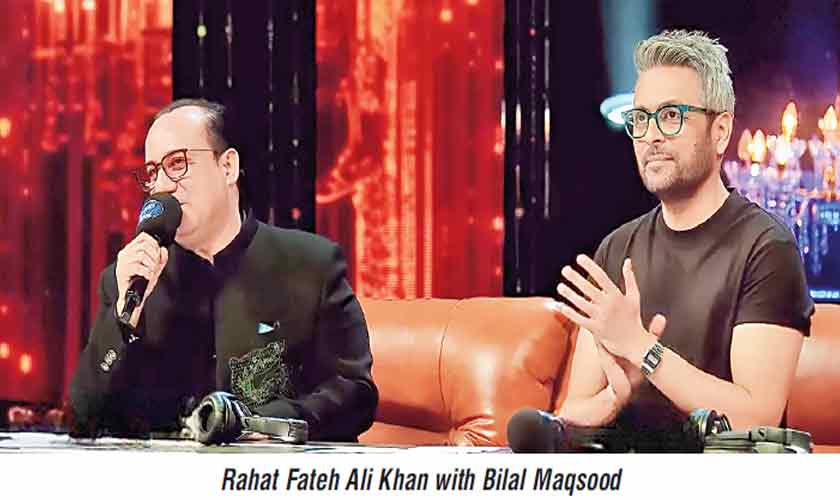
That conversation deepened with Samya Gohar’s performance of ‘Chan Mera Makhna’ by Shazia Manzoor, which leaned into folk exuberance while maintaining control. However, it was Rawish Rubab’s rendition of ‘Sanu Nehr Wale Pul’ by Madam Noor Jehan that reignited debate. Already viral from earlier rounds, Rawish has become a lightning rod for discussion around her nasal tone. Episode 22 did not shy away from that tension. Rahat praised her for reining in what he perceives as excess, while Bilal pushed back, arguing that the very quality under scrutiny is also Rawish’s defining strength. Farhan Saeed cut through the debate with clarity. Pakistan’s musical legends, he reminded the panel, were rarely flawless but always unmistakable. Rawish’s voice, slightly unruly and mischievous, belongs to that lineage. The emphasis shifted from correction to discernment. Knowing when to lean into one’s uniqueness and when to hold back is part of artistic maturity.
The episode’s undeniable high point came with Tarab Nafees. Performing ‘Thora Thora Pyar’ by Fariha Pervez, she delivered a fully realised pop performance that felt confident, controlled and stylistically assured. Standing ovations followed immediately. Zeb highlighted the song’s technical difficulty and Tarab’s command over its quieter moments. Rahat praised her genre fluidity, while Bilal reframed pop as something that can be expressive without becoming careless. Farhan Saeed went further, calling it the best performance of the night and applauding her rapid artistic growth.
Tarab’s crowning as Rising Star of the Week felt organic rather than engineered. It aligned seamlessly with the episode’s broader argument. Singers who understand themselves often outperform those chasing perfection. The absence of elimination reinforced this ethos, allowing space for nuance, disagreement and reflection. Growth was treated as nonlinear and individuality as something to be protected rather than ironed out.
Taken together, Episodes 21 and 22 mark a subtle but significant evolution for Pakistan Idol. The show is moving beyond spectacle and sentimentality towards a more mature conversation about music. Technical skill remains essential, but it is no longer sufficient. Contestants are being asked to feel, interpret and communicate, turning performance into storytelling.
As the competition edges closer to its decisive rounds, one truth is becoming increasingly clear. Pakistan Idol is no longer about who can hit the highest note. It is about who can remain honest under pressure, who can balance control with vulnerability and who, in a crowded field of voices, can sound unquestionably individual and stay incomparable.