Print Story
X




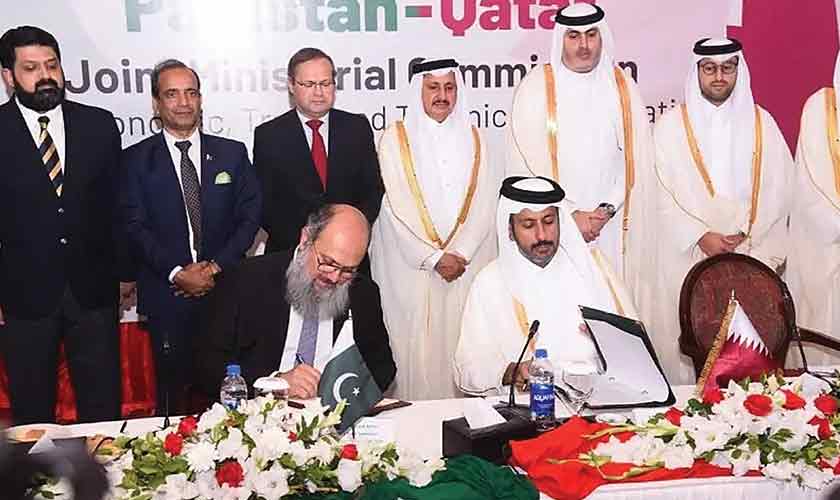
Pakistan-Qatar technology partnership is set to strengthen digital infrastructure and build long-term innovation capacity
| N |
Now, Pakistan and Qatar are moving toward a strategic technology partnership that can reshape Pakistan’s economic future by expanding startup financing, strengthening digital infrastructure and building long-term innovation capacity. For both countries, this may be a step forward as global economic growth is increasingly driven by digital capability, data flows, venture capital, artificial intelligence and cross-border technology ecosystems. Both sides realise that the countries that fail to position themselves correctly risk falling behind. Pakistan’s incumbent leadership has demonstrated clear understanding of this shift by making technology, investment facilitation and modern governance national priorities. A partnership with Qatar, a country with strong financial reserves and proven capability in building technology-ready environments, gives Pakistan a welcome opening.
The justification for this partnership is straightforward and compelling. I work with the Punjab Sahulat Bazaar Management Authority, which offers spaces to small businesses. I have closely observed that the Punjab’s startup sector has untapped promise. It has already attracted $350 million in investment at continues to produce companies that command regional interest. Given this progress, the financial ecosystem remains underdeveloped compared to regional competitors. Venture capital availability is far lower than in markets such as the UAE and Saudi Arabia; even some smaller Southeast Asian economies. Domestic investors tend to remain risk-averse and focus mostly on traditional assets rather than early-stage technology ventures. This has created a structural financing gap that prevents innovative firms from scaling beyond the survival mode. Qatar, through its sovereign wealth institutions, technology funds and global investment networks, has the scale and appetite to bridge this gap in a way that could alter Pakistan’s technology trajectory.
If Qatar channels even a fraction of its investment portfolio toward Pakistan’s technology and digital economy, it could multiply the size of Pakistan’s venture capital landscape within a short period. Qatari investments tend to come with disciplined governance structures, financial oversight and international partnerships that help local ecosystems professionalise and grow sustainably. Pakistan needs not just more financing, but also smarter and longer-term financing that encourages startups to innovate, expand exports and become global competitors. Qatar has the capacity to provide this kind of catalytic support.
In addition to startup financing, Pakistan’s digital economy stands to benefit substantially. Qatar has developed advanced capabilities in artificial intelligence, cyber security, cloud infrastructure, sports technology and smart city systems. These capabilities align strongly with Pakistan’s priorities in public sector modernisation, digital governance, fin-tech expansion and building a knowledge-based economy. Pakistan’s leadership has already set in motion a shift toward technology-led reforms in public services, welfare, documentation, taxation and public procurement. A partnership with Qatar can accelerate these reforms by introducing global best practices, investment in digital infrastructure and collaborations that strengthen institutional capacity.
From an international perspective, this partnership has strategic value beyond economics. Qatar is diversifying its global economic relationships as part of its long-term national vision, particularly in Asia. Pakistan offers a large population, an expanding technology talent pool, competitive labour costs and a geographic position that connects South Asia, Central Asia and the Middle East. These attributes create a strong commercial logic for Qatar to deepen engagement. For Pakistan, aligning with a Gulf state that has both political stability and consistent investment discipline provides predictability and security—qualities essential for long-term economic planning.
However, there are practical challenges that Pakistan must manage carefully. Investors will judge its regulatory consistency, currency stability, data governance standards, intellectual property protections and ease of doing business. Pakistan has made progress but must continue to simplify investment processes, reduce administrative barriers and strengthen legal frameworks. These improvements are not merely bureaucratic adjustments—they are financial safeguards that increase investor confidence and reduce risk premiums. If Pakistan demonstrates predictability and transparency, the financial flows from Qatar and other global partners can become significantly larger.
Pakistan also needs to ensure that foreign investment is channelled toward sectors with high multiplier effects. Technology investments often produce strong returns because they increase productivity, create skilled jobs and expand exports without heavy reliance on physical infrastructure. For example, a fin-tech or AI startup that scales internationally can bring in foreign exchange at a fraction of the cost required for traditional industries. Pakistan’s leadership recognises this advantage and has emphasised digital entrepreneurship, IT exports and innovation-driven growth as core national objectives. A Qatar-backed fund or accelerator specifically focused on Pakistani startups could become a major catalyst for export earnings and global market entry.
Another critical dimension is human capital. Pakistan has one of the youngest populations in the world. Millions of its students are pursuing technology-related education and digital skills. However, without strong industry linkages, access to capital and international exposure, their potential remains underutilised. By forming strategic partnerships with Qatar’s universities, research centres and innovation hubs, Pakistan can integrate its talent into global networks. This could reduce brain drain, increase domestic innovation output and position Pakistan as a preferred outsourcing and research and development destination for regional markets.
Geopolitically, such a partnership will allow Pakistan to maintain a balanced international stance. Qatar has consistently supported Pakistan’s development agenda and has maintained a principled, stable foreign policy. Unlike some major powers where technology partnerships come with strategic alignment requirements, Qatar’s cooperation model is based on mutual benefit and respect for national autonomy. This gives Pakistan room to grow without compromising sovereignty or entering restrictive dependency frameworks.
The writer is a chartered accountant and a business analyst.