Print Story
X




At Tagh’eer Lahore, twelve artists turn inward to explore solitude
In Solitude, I Am Whole is on till 10th December at Tagh’eer Lahore.
| J |
ulia Cameron, in her book The Artist’s Way, emphasises the need for creative people to consider their practice akin to a spiritual experience, to take the act of creation as devotion. While creative work does not happen in silos and is always in conversation with the world, it is also important for artists to look inward, not in a navel-gazing manner, but as almost a meditative reflection, to understand what the inner creative wants of them. In this state of solitude, the artist gets to nourish their innovative spirit and answer a range of questions about their practice: What is my work saying? Who is it for? How does the chaos around me find place (or doesn’t) in my practice?
Answers to these questions are what I continue to excavate as part of my practice (often using Cameron’s method) and are what a recent show in Lahore aimed to arrive at. In Solitude, I Am Whole is a group exhibition being held at Tagh’eer Lahore, a creative space run by Nashmia Haroon, as a collateral event to the NCA Triennale. Twelve artists with diverse practices came together to ponder fundamental questions about their creative approaches and what they observe when removed from the world around them.
Nashmia Haroon is a multi-disciplinary creative herself. Her practice includes visual art, photography and vocal arts. She has worked with the participating artists to put on a show that hits at the heart of their personal philosophies. As I entered Tagh’eer on a sunny afternoon, the small, cosy space felt expansive and the curatorial direction evident. Despite the number of artists and their varying individual concerns, there was cohesion in the exhibition and a unifying dialogue. Medium certainly played a role in this, as almost all work was on paper.
Paper, as I have recently come to realise (a realisation compounded by this show), is a favourite medium of mine. There is an ephemeral nature to work on paper, even if produced on archival paper. Paper requires painstaking care. Paper is fickle; paper is unforgiving. For a show focused on the internal conversations of an artist, seeing most of the work on paper felt appropriate and instinctive.
Another element that wove a thread through the work was a focus on transitory-ness, on the decay of memory, of the natural world, of architecture, of relationships. What it means to lose someone. Can one mourn someone who is alive? How does one remember when the space that held the memory has disappeared? Can one intervene in the working of memory and change its threads to alter it without catalysing chaos?
The twelve interpretations on display at the exhibition all endeavoured to grapple with these. Naturally, some stayed with more than others. Maheen Khan’s two opaque water colours, with their delicate brushstrokes and soft palettes, for instance, pulled me in immediately. The depictions of disappearing birds set against a grassy field (Held and Unheld) and marshy pond (What the Water Knows) left haunting after-images in my mind. I was instantly reminded of literary works such as Owl Sense by Miriam Darlington and The Peregrine by JA Baker that deal with the rapid disappearance of avian life, as their habitats continue to be destroyed by human folly. Khan’s balance between transparency and opacity represents inner states of being that are never fully finished, yet feel heavy with the weight of the world; the half-formed birds become a sad, yet successful, metaphor for this.
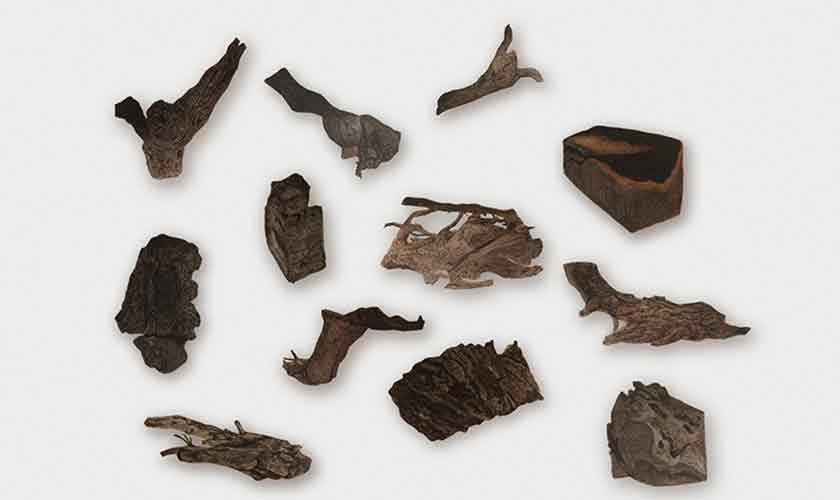
This tension carried on in Samina K Ansari’s Udaas Geet, a collection of intricate pencil on paper fragments, which at first glance give the impression of found objects and then of wooden sculptures, till the eye finally settles and recognises what it is looking at. This fragmented paper sculpture depicts branches, bark and gnarled tree refuse that one may pick up on a walk in the park or in the woods, but in this context represents a jarring image, confronting us with yet another reminder of the dying natural world around us. Hung on the wall, these twelve pieces come together as one object that indeed becomes an udaas geet, a veritable lament for the trees.
Other works that resonated with me were Asif Khan’s cyanotype diptych (Stock) that commented on the hoard as a promise of future; the imagery of footballs stored in an outdoor shed and textiles piled up in a corner of a mosque pointed to the futility and absurdity of such promises.
Attiya Usman’s watercolour triptych (Bittersweet) continued this conversation on the endurance of domestic objects, of claiming space, albeit a bit more abstractly. She turns the gaze inward. Using the braided hair as a symbol of generational continuity, she weaves a narrative centred around the interiority of women’s lives, the unseen intimate bonds that transcend time and space.
Intimacy and solitude find each other in Fatima Faisal Qureshi’s oils. Solitude for this artist is “not an escape, but a condition that explores disconnection.” This comes to light in Love is Measured in Square Metres, where two figures sit facing away from each other, their intimate connection and their inherent discomfort with that bond palpable through the canvas. In Left on Red, this disconnect finds form in unrequited intimacy and the resignation to fate.
In Solitude, I Am Whole presents a solid collection of work; however, in the absence of wall text, the central premise of the show is left to the viewer to decipher. A show that focuses intensely on an artist’s response to solitude in an existential manner would have benefited from that interpretation not being only visual, or not only relegated to a digital catalogue. While the curation allowed for commonalities to be observed, it left me wondering how the presented pieces were the answer to the artist’s reflections on the theme. Naturally, this opens space to a multitude of interpretations, but also leaves one unfulfilled, like a conversation that began only for the interlocutor to disappear in the middle.
The writer is a literary editor, publisher and photographer from Lahore. He is the co-founder of The Peepul Press and managing editor at The Aleph Revie