Print Story
X




The neighbouring arch-rivals face similar environmental challenges including smog and floods
| O |
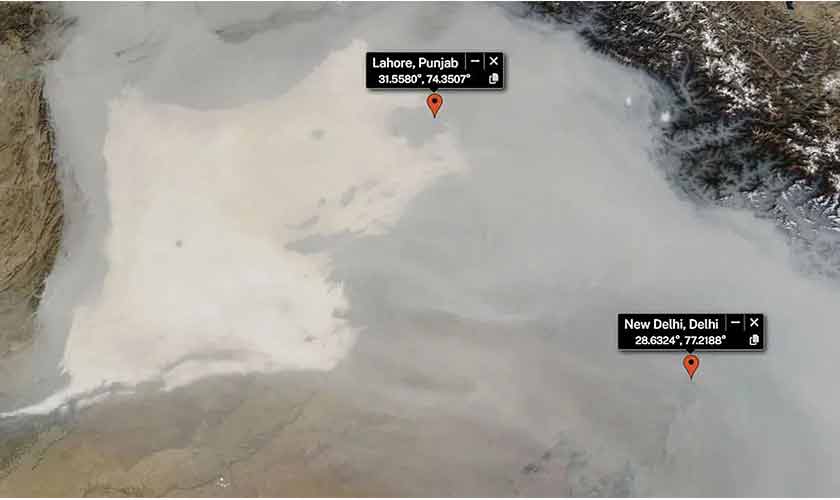
ver the past few weeks, Lahore and New Delhi have been competing for the distinction of being the world’s most polluted city. The Air Quality Index for Lahore reached 386, a level that can cause health problems for many; the average for New Delhi was around 428, also posing serious health risks. These cities and their residents share many things, including food and culture. Now they also share a pall of pollution that hangs over the cities for a significant portion of the winter months.In November, the air smells and tastes like ash, the sky looks overcast and for millions of people across northern India and eastern Pakistan doing something as simple as stepping outdoors feels like a challenge.
In recent years, Lahore has rapidly surged up AQI rankings, sometimes even surpassing New Delhi, which has consistently ranked among the world’s most polluted cities. Smog, a common enemy, draws our attention to the phrase: divided by borders, united by crises.
India and Pakistan came into being as modern nation-states as a direct consequence of the partition of the Indian subcontinent that took place in August 1947 by the British. Several factors, domestic and foreign, contributed to this event. Instead of diving into the circumstances that led to the partition of the Indian subcontinent and the creation of two nation-states, we emphasise the common crises.
The recent floods in the River Ravi and the River Sutlej caused significant damage in the Punjab both in the Charrhda (India) and Lehnda (Pakistan) regions. The discharge in Ravi River exceeded 1.4 million cusecs, surpassing the 1988 record of 1.1 million cusecs. The Sutlej also saw significant flooding. The floods caused extensive damage to infrastructure, agriculture, livestock and human settlements across the border.
In Pakistan, the floods destroyed approximately 2.2 million hectares of cropland and resulted in the loss of over 22,800 livestock. The FAO reported that in the Punjab, 1.12 million hectares of agricultural land was affected, representing nine per cent of the province’s total agricultural land. In Sindh, 291,744 hectares was impacted, accounting for six per cent of the agricultural land. Floods have caused an estimated $1.23 billion in agricultural losses in the Punjab, Sindh and Khyber Pakhtunkhwa. Significant losses in crops and livestock, coupled with disrupted harvests and markets, resulted in elevated food prices in several regions, with a reported 25 per cent increase in wheat flour prices from August 28 to September 4. Additionally, over six million people were affected by floods across Pakistan, with around 2.5 million displaced. Around 700 kilometres of highways, 239 bridges and more than 8,400 homes sustained damage or destruction.
The Indian state of Punjab, too, experienced one of its worst floods in recent history, impacting all 23 districts. Approximately 2,050 villages were affected, with 387,898 people displaced from their homes. The confirmed death toll exceeded 50, with numerous individuals still unaccounted for. The agricultural sector experienced significant losses, with over 176,000 hectares of farmland inundated. In addition to crop damage, livestock suffered significantly, with over 252,000 animals and 588,000 poultry birds impacted by water-logging, fodder shortages and inadequate shelter. The housing damage, too, was considerable: 97 homes were destroyed and 363 were partially damaged, necessitating the use of relief camps for numerous families.
The floods in the Ravi River have not only caused catastrophic damage to human settlements, crops, cattle and infrastructure, but also uprooted about 30 kilometres of the border fence separating the Lehnda and Charhda regions of the Punjab. Interestingly, the floods forced the border security forces of both India and Pakistan to withdraw from the frontiers. This is evidenced by numerous reels and videos shared on social media. Additionally, people from both sides of the Punjab came together to help one another during these trying times. They were battling a common enemy, flooding, that caused them to forget the long-standing hostility.
The rise of religious extremism is another crisis both sides face currently. Though it claims to be secular, India has become a hard-line Hindutva state with one billion Hindus (80 per cent of the population), 220 million Muslims and 30 million Christians. India’s secular democracy has shifted toward Hindu nationalism and societal and governmental fundamentalism under Narendra Modi. Discriminatory laws and policies against non-Hindus show a deterioration in secular principles. Non-Hindus, notably Muslims and Christians, face rising persecution, violence and social marginalisation, endangering their safety and culture. Muslims are described by some as long-term invaders and Christians as colonial oppressors of indigenous culture and religion. This rising extremism threatens non-Hindu groups and Indian national security.
Like India, some religious minorities in Pakistan face significant challenges. The population consists predominantly of Muslims (95 percent), with Hindus (1.9 percent), Christians (1.6 percent) and smaller religious groups including Baháis, Buddhists, Kalasha, Parsis, Sikhs and Zikris. Some of these groups are legally recognized; others experience varying levels of discrimination. Ahmadis, whose population is not clearly quantified, have been classified as non-Muslims for decades. The minority communities in Pakistan experience significant adverse effects from discriminatory laws. Accusations of blasphemy have been used to incite mob violence, frequently affecting particular groups, including Christians and Ahmadis.
The list of common crises that pose serious threats not only to the peaceful existence of people but also to the national security of nation-states across borders does not end here. It may include poverty, food insecurity, environmental challenges, unemployment and illiteracy. Nature has repeatedly reminded us of our reality. The sooner we listen to nature’s call to fight against our common enemies, the better it will be.
The writer, author of The Aftermath of the Bangladesh Liberation War of 1971: Enduring Impact (Routledge, 2024), has a PhD in history from Shanghai University.
He is a lecturer at GCU, Faisalabad, and a research fellow at PIDE, Islamabad. He can be contacted [email protected]. His X-handle is @MazharGondal87.