Print Story
X




Rabeya Jalil’s latest work reveals an artist intent on peeling away the world’s pleasing surfaces
| I |
f, for a brief moment, one ignores the varying titles of Rabeya Jalil’s recent work (on display from November 25 to December 4 at Canvas Gallery, Karachi), it becomes obvious that the painter’s personality is strongly and strikingly present in each of her canvases. In her content, imagery and strategy of making, there is an inclination towards a primitive diction, not plain by any means, but indicating a desire to forget the overpowering and ever-present art academia: the strict learning of the European scheme of replicating reality, which in our circumstances, like other colonised societies, is still revered as the most authentic, true, refined and sublime means of producing a picture, an idea, a record of imagination.
Rabeya Jalil graduated in 2005 from the National College of Arts, equipped with similar training in drawing and painting, but, like many modern and contemporary artists, began to disrupt, distort and deconstruct the canon of “naturalistic” art as the sole mode of expression. She drifted towards a visual language that some viewers lazily describe as “child art,” while ignoring the age, education and achievements of the artist. Significantly, children may draw trees, houses, mountains, clouds, grass, flowers, people, animals, the sun, stars, the sky and rainbows, but they do not create art; not intentionally. Hence, the majority use pencils, pastels and paper. Professional artists who prefer imagery superficially classified as child-like, on the other hand, employ oil, acrylic, gouache, canvas, board, as well as paper and mixed media.
The other, conveniently neglected fact is that of size and the raison d’art. Large-scale pieces are produced to be installed in public venues (as in Jalil’s current exhibition, Lines and Language). The most important aspect distinguishing a child’s scribbles and sketches from an artist’s composition is the nature of the content. While children’s drawings are usually appreciated as cute, sweet and clever, a grown-up’s work, even if it evokes similar responses, has something more: serious concerns, including autobiographical, political, sexual and formal.
In Rabeya Jalil’s paintings, reality is unavoidable but diversified. It encompasses human presence, perception and production. Thus, in the solo show, one encounters people, quadrupeds, vegetation and script: faces, characters, cats, cows, dogs, rabbits, goats, camels, flowers, vegetables, plants and forests — the identities of these entities are reinforced through the titles.
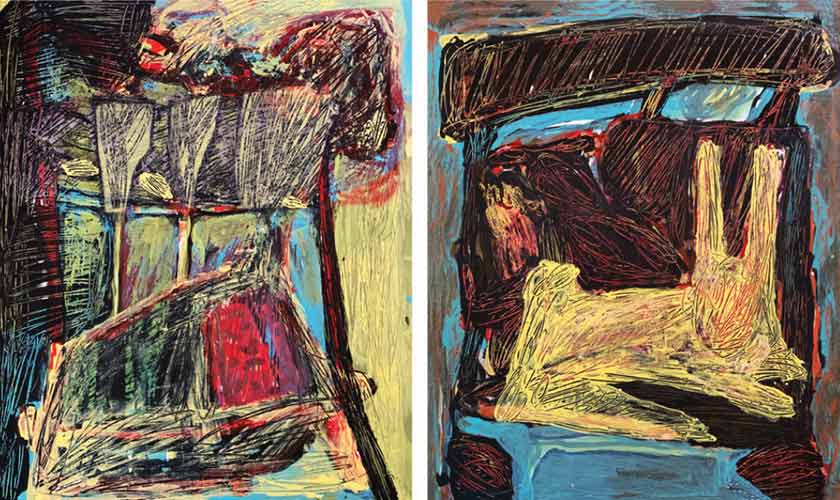
Describing her imagery in any language (English, at present) evokes countless variations and confusions in a reader’s mind. Yet, interestingly, gazing at her paintings does not provide a single definitive sign either. Beyond a multitude of seismic lines, spontaneous marks, roughened shapes and stylised forms lies the artist’s investigation of her internal and external realms. It is as if she adopts the language of innocence in order to uncover a not-too-happy world today, and, in doing so, comments on the deformities that have unsettled the world’s ideal and peaceful order.
However, there is a difference, or a risk, inherent in this approach. A child’s expression is honest but limited by age, inexperience and restricted resources; a mature artist, by contrast, is well-informed, trained and exposed to the world around them. Their approach can easily become tainted or trite.
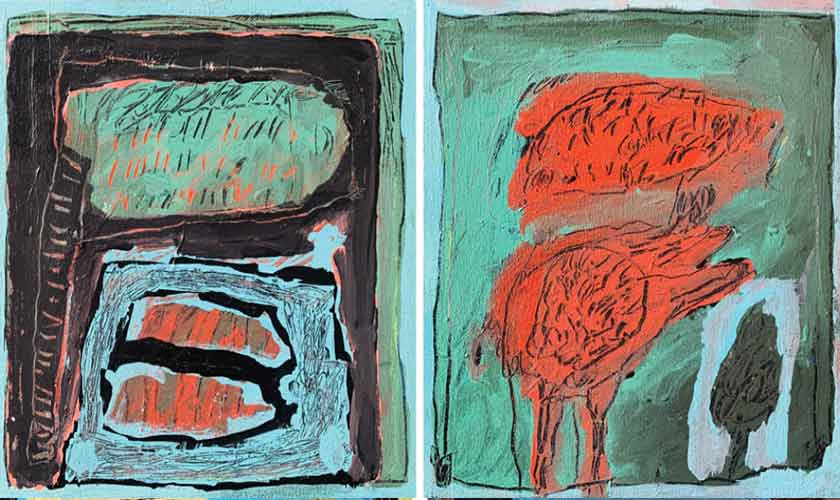
Beyond a multitude of seismic lines, spontaneous marks and stylised forms lie the artist’s investigation of her internal and external realms.
Many artists attempt to free themselves from their conditioning. A few, like Rabeya Jalil, succeed, not through a formula or technique, but through their choice of imagery. In a sense, it can be understood as driving in two lanes simultaneously: one exploring the framework of the visual world through materials and tools; the other, perhaps more important, peeling away external and conventionally pleasing appearances.
Rabeya Jalil’s world consists of identifiable clues alongside flattened spaces and layered textures, composed within a structure that balances order and looseness. It resembles the system of handwritten language: a fixed set of letters, words and phrases that nonetheless appear different in every hand, so no two sets of lines ever quite match. In one work, Morse Code, Jalil creates script-like imagery, traces that may be read as numbers or letters, across a series of tablets: 18 small sections joined to form a single piece. Here, not only the imagery but also the architecture of the work relates to language, much like the arrangement of lines in a paragraph or on a page of text.
This sensibility emerges in other works as well, such as Lipsticks II and Town Plan. The former is composed of several blocks containing tiny forms that may suggest make-up items in one moment, residues of touch in another and an array of strange creatures contained within rectangles in yet another. Echoes of these reappear in other canvases, including Wheel and Zoo II. The latter, Town Plan, offers a blend of aerial views of houses, almost like a Google map, in which one can locate details of buildings, furniture, objects and living beings, lightly obscured by bold dark marks placed randomly across edges, corners and open spaces.
A painting like Town Plan is not a landscape of the external surroundings; it is a replacement for the painter’s mindscape, an arena of interaction, contradiction and conflict, a strong connection between the raw and the tamed, between culture and nature, between intellect and instinct. This quest is illustrated again in Single Cat, in which 36 surfaces, each composed of small circular marks laid out against lighter backdrops, are joined together. A quirky creature, rendered in hasty strokes, stands large across this macro composition. Beyond its six legs, the stark contrast between violence and calmness suggested in Single Cat is repeated in several other paintings, including Garden Plants and Garden Flowers.
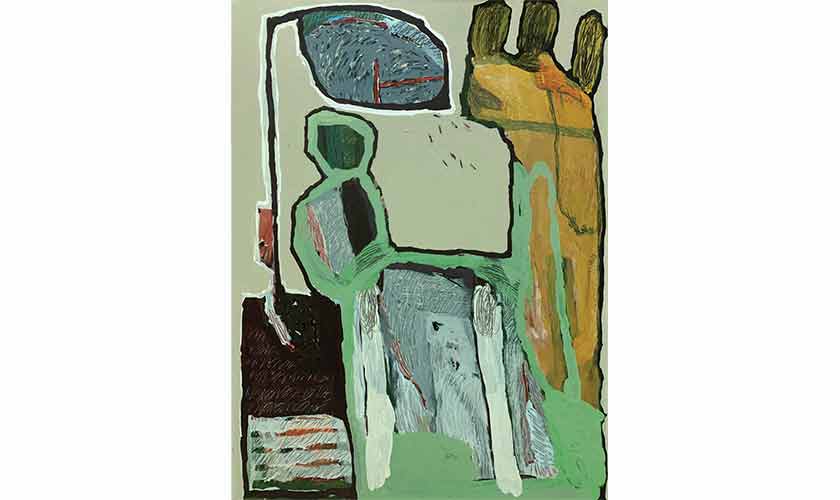
A similar sensibility continues in Rabeya Jalil’s pieces that resemble portraits of people grouped within large compositions. Works such as Army, Forty Six Cousins and Neighbourhood Watch feature figures whose expressions, features and grimaces appear strange, caricatured or puppet-like; yet their backgrounds are painted in flat, steady hues.
These faces seem to stretch from mirror reflections to passport photographs, from the reality of how an individual is seen by others to the idealised version carried within his or her own mind.
The struggle between Dr Jekyll and Mr Hyde exists in every human being. It is often more evident in an artist’s life and in a painter’s studio practice. How does one cultivate the natural current? How does one convert the creative impulse, while simultaneously negotiating the act of covering a perfectly prepared white surface with a mess of marks, lines and impasto? This dream appears to be taking shape in Rabeya Jalil’s new work, most convincingly in Animal Play. It is a canvas filled with unnameable zoological entities, cramped within the boundary yet bursting with unplanned colours. The overlapped, intrusive and uneasy components of the imagery do not suggest the atmosphere of oppression found in Orwell’s Animal Farm, but rather map the pleasure every artist seeks, recalling the freedom of childhood once they have grown beyond it.
The writer is a visual artist, an art critic, a curator and a professor at the School of Visual Arts and Design, Beaconhouse National University, Lahore. He can be contacted at [email protected].