Print Story
X




In Wicked: For Good, Elphaba (Cynthia Erivo), fights for animal rights and attempts to get Glinda (Ariana Grande) on side.
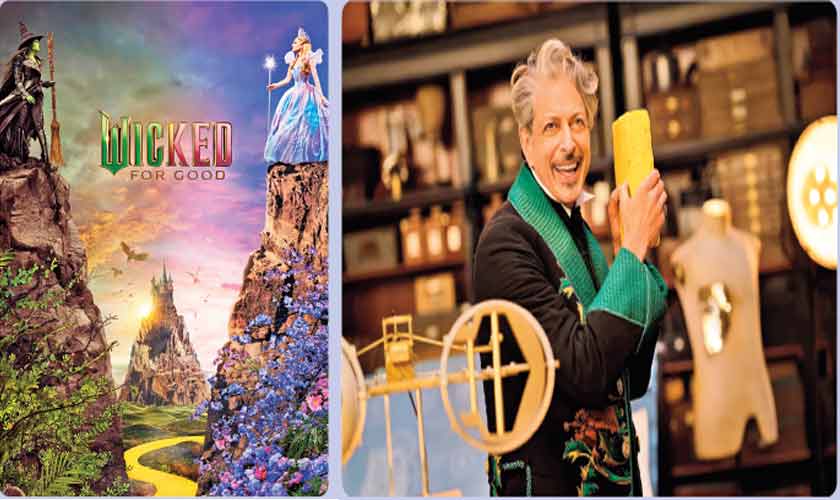
Jeff Goldblum
Directed by: Jon M Chu
| L |
ast year’s Wicked had to defy a lot more than just gravity. Jon M. Chu’s first film, which adapted the 2003 musical by Stephen Schwartz and Winnie Holzman, which in turn adapted the 1995 book by Gregory Maguire, offered an alternate history to L. Frank Baum’s 1900 The Wonderful Wizard of Oz mythology and had to take on critics, cynics, and flying-monkey sceptics. The received wisdom goes that musicals aren’t hits in the modern era. Are theatre kids even a box-office demographic anymore? Yet against the odds, it was a sensation, Chu bringing his experience on In the Heights and Step Up to turn the somewhat minimalist Broadway show into a maximalist explosion of colour and pizzazz, buoyed by canny casting (Cynthia Erivo, Ariana Grande and Jonathan Bailey). We held space.
Now it returns to finish the story, in a sequel filmed concurrently with the first film. Wicked: For Good forms the second half of the stage show. We have, in effect, had a 12-month-long interval and in a story of two halves, to borrow the footballing cliché, this is the weaker of the two: sadder, more understated, a lower percentage of bangers, and not going out on the literal high of ‘Defying Gravity’, as the first half/first film does. The odds are stacked against, again. The sceptics are out in force.
Perhaps conscious of this, Chu starts with a bang. The opening of Wicked: For Good is packed with more pageantry, pep and firework. It has been some years since the events of the last film and everyone has moved on. Glinda (Grande) is now a force in Oz, a celebrity figurehead and beloved spiritual leader like Dolly Parton with a floating bubble.
The citizens of Oz are particularly enamoured with her budding romance with hunky Fiyero (Bailey), now promoted to Captain of the authoritarian, green-jacketed Wizard’s Guard. Their relationship is carefully stage-managed by the PR machinations of Madame Morrible (Michelle Yeoh), and signed off by the big dog himself, the self-styled Wizard (Jeff Goldblum), who seems more interested in model trains than his quasi-fascistic autocracy.
Meanwhile, Elphaba (Erivo) is now persona non grata and an enemy of the state, and is attempting to dismantle this propaganda machine by engaging in a kind of airborne guerrilla warfare via her broom, disrupting construction on a vast infrastructure project involving some yellow bricks: think the M25, if it were built by CG animals.
“The opening is fun and fast, establishing the literal witch hunt now dominating Oz. But it quickly becomes clear that the tone is different from that of the first film: less peppy, more glum. It’s missing some dynamism, some energy. The two newly written songs are nice enough (lyrics like “Why Do I Love This Place That Doesn’t Love Me?” feel politically timely) but decelerate the pace.”
The opening is fun and fast, establishing the literal witch hunt now dominating Oz. But it quickly becomes clear that the tone is different from that of the first film: less peppy, more glum. With the exception of Goldblum who appears to be acting in his own film, delighting in stuttery drollness, all the characters are much less cheerful than they were last time around, and as a result it’s less enjoyable for us to watch.
Grande’s Glinda does far less hair-swishing, Bailey’s Fiyero replaces flirtiness with broodiness, and Erivo’s Elphaba is having a full-on nervous breakdown. Even Elphaba’s sister Nessarose (Marissa Bode) has done a Daenerys Targaryen-abrupt moral 180 all over unrequited love for a Munchkin. Nobody seems allowed to have nearly as much fun, this time.
Compounding this tonal shift is the fact that the songs are simply not as good. It was a problem on stage and it’s a problem on screen. ‘No Good Deed’ is perhaps the highlight, a genuine belter and an opportunity for Erivo to stretch her extraordinary lung capacity (and to do it while flying), but there’s nothing close to ‘Defying Gravity’ here, not even a ‘Dancing Through Life’ equivalent. It’s missing some dynamism, some energy. The two newly written songs are nice enough (lyrics like “Why Do I Love This Place That Doesn’t Love Me?” feel politically timely) but decelerate the pace.
There are other frustrations: the original main story of The Wizard of Oz runs parallel to this, with Dorothy’s face never shown, a running gag on stage but oddly coy and awkward here and key scenes from it are omitted, perhaps so as not to tread on the toes of the mothership, a choice which leaves the storytelling feeling both slow and rushed. Still, the origin-story reveals of the Tin Man and the Scarecrow are fun, played like body-horror nightmares, and thanks to some undeniably talented performers, the film just about completes the magic trick of the original books and show: reframing the Oz myth in a political, emotionally potent light. Not quite over the rainbow, then, but just enough of its colours and candour to get by.
–Courtesy: Empireonline.com