Print Story
X




Vehicle emissions, crop burning and industrial smoke alone do not explain the severity of rising smog levels in urban areas
| T |
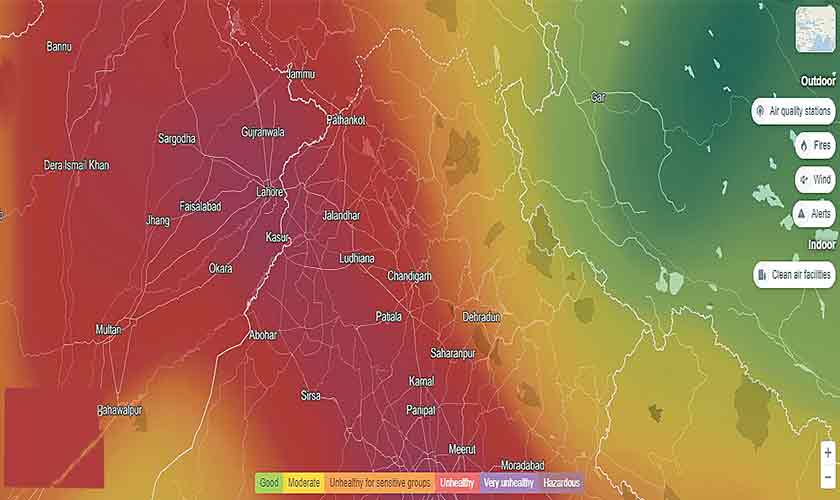
he Punjab has been enveloped in worsening smog for several weeks, with cities across the province repeatedly ranking among the most polluted urban centres in the world. Lahore, Gujranwala, Faisalabad and Sialkot have all recorded persistently hazardous air quality levels during the month as thick grey smog settles over urban areas, dims the sunlight, disrupts daily life and raises serious health concerns for millions of residents. Monitoring stations across Lahore have shown consistently poor readings for several weeks, with pollution levels remaining far above globally accepted safety limits and only brief fluctuations driven by changing weather conditions.
As smog hangs over the Punjab and reduces visibility, health experts have warned that prolonged and repeated exposure during winter can trigger respiratory complications, persistent coughing, chest tightness, eye and throat irritation, and long-term risks to the heart and nervous system. Hospitals have already reported an uptick in patients complaining of breathlessness and allergy-like symptoms, prompting renewed advisories urging citizens to limit outdoor activity, especially in early mornings and late evenings when pollution tends to concentrate near ground level.
While the public discussion has focused mostly on vehicle emissions, crop burning, industrial smoke and waste burning, experts say these sources alone do not explain the severity of Punjab’s winter smog. Increasingly, they argue that the deeper crisis lies not just in the emissions, but in how these cities trap that pollution. Fog, a natural winter condition, mixes with pollutants such as nitrogen oxides, sulfur compounds, carbon monoxide, volatile organic compounds, PM2.5, PM10 and black carbon. Normally, warm air rises and disperses dirty air. But during winter, temperature inversion locks a cold layer of air close to the surface, preventing pollutants from escaping upward. In cities with good wind flow, this trapped air at least disperses horizontally. In the Punjab, however, cities have expanded in ways that restrict airflow, causing pollutants to stagnate and intensify.
Lahore, in particular, has undergone a rapid shift from green to grey over the last two decades. Vast green belts, open fields, agricultural edges and tree cover have given way to dense clusters of concrete, commercial plazas, high-rise corridors and unbroken stretches of asphalt. Urban planners say this development pattern has created “urban canyons” — long, narrow passages where buildings on both sides block wind movement. Once pollutants enter these canyons, especially during temperature inversion, they linger for extended periods. This structural trapping of air is one of the key reasons why smog episodes have grown both in duration and intensity during recent winters.
We need to address the structural roots of the crisis. Cities need to be redesigned in ways that allow air to circulate. This includes protecting and restoring wind corridors, regulating building height in key ventilation zones, preserving remaining green belts, enforcing setbacks and preventing commercial encroachments that choke the city’s natural breathing pathways.
We need to address the structural roots of the crisis. Cities need to be redesigned in ways that allow air to circulate. This includes protecting and restoring wind corridors, regulating building height in key ventilation zones, preserving remaining green belts, enforcing setbacks and preventing commercial encroachments that choke the city’s natural breathing pathways.
The construction boom has added another layer of complexity. Without proper dust control, excavation works, road expansion projects, demolition sites and unregulated construction release large amounts of particulate matter. In an environment where air is already stagnant, dust remains suspended for far longer than it should. Industrial expansion near residential zones, often without adequate emission-control equipment, contributes further to the toxic mix. Open burning of municipal waste, rubber and plastics, even medical waste, remains a persistent problem in several districts. This releases highly harmful toxins such as dioxins and furans.
Fuel quality continues to worsen matters. Pakistan still relies on 20th Century fuel standards. These fuels generate significantly higher emissions compared to cleaner fuels used elsewhere in the region. This means that even relatively new vehicles emit more pollutants than their counterparts in countries with stricter fuel regulations.
Public health studies in Lahore during recent years have repeatedly indicated that residents are exposed to dangerously high pollution levels throughout the winter months. The findings show that both adults and children face chronic respiratory risks, with pollutant concentrations frequently exceeding national and international safety thresholds by wide margins. Experts warn that repeated seasonal exposure — year after year — compounds long-term harm, especially for children, the elderly and those with asthma or heart conditions.
Environmental planners and researchers now argue that the Punjab must move beyond short-term, reactionary measures. Seasonal crackdowns on rickshaws, old vehicles or brick kilns may provide symbolic relief, but they do not address the structural roots of the crisis. Cities need to be redesigned in ways that allow air to circulate. This includes protecting and restoring wind corridors, regulating building heights in key ventilation zones, preserving remaining green belts, enforcing setbacks and preventing commercial encroachments that choke the city’s natural breathing pathways. Several big cities around the world — including Beijing, Seoul and Tokyo — have already implemented similar urban ventilation strategies to manage pollution more effectively.
At the same time, improving fuel standards, expanding mass transit, enforcing continuous emissions monitoring in industries, promoting cleaner technologies and eliminating open burning remain essential steps toward long-term improvement. Agricultural practices also need reform to prevent seasonal burning.
With winter still under way and pollution levels likely to fluctuate depending on rainfall and wind conditions, experts caution that short-term dips in pollution should not distract from the broader trend. Punjab’s cities are experiencing increasingly hazardous air each winter. Both emissions and physical design of urban spaces need to be addressed. Else, the crisis will deepen further. For now, millions of residents across the province continue to breathe air that is far from safe, a reminder that the real challenge lies not in occasional enforcement drives but in rethinking how our cities breathe.
The writer has an MS in environmental conservation from the University of Trier, Germany.