Print Story
X




Cricket, like many other sports, has a rich history of being used as a powerful diplomatic tool
| I |
n the on-going Asia Cup Rising Stars Cricket Tournament, India A’s captain Jitesh Sharma refused to shake hands with Pakistan Shaheen’s captain Irfan Khan. The Indian players also refrained from shaking hands with their Pakistani counterparts after the match. The handshake between captains following the toss and between players after the match is not obligatory. However, the tradition has persisted long, primarily to signify that cricket is a gentleman’s sport. A break with this tradition could indicate that cricket is no longer seen as a gentleman’s game; that it has become too politicised, corrupted and sullied by animosity.
The theatrics started on July 20, when the India Champions declined to compete against the Pakistan Champions in the World Championship of Legends, citing political tensions between the two South Asian nations. India had earlier accused Pakistan of orchestrating the Pahalgam terrorist incident in Indian-administered Jammu and Kashmir on April 22, resulting in the death of 26 civilians. Pakistan had denied the charge. Pakistan government had then requested proof from the Indian government. It had also proposed collaborating with an international investigative team or commission. This was followed by a short India-Pakistan conflict that commenced on May 7 with Indian missile strikes in Pakistan designated as Operation Sindoor.
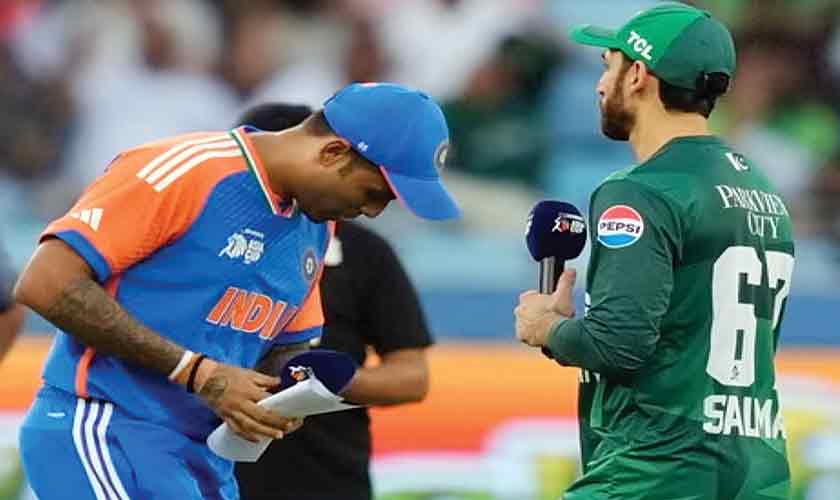
The cricketing community was taken aback when Surya Kumar Yadav, captain of the Indian cricket team, refused to shake hands with his Pakistani counterpart, Salman Ali Agha, during a 2025 Asia Cup match. This did not stop there. The situation escalated after the Indian team management refused to receive the Asia Cup Trophy from Mohsin Naqvi, the chairman of the Asian Cricket Council, who is concurrently the chairman of the Pakistan Cricket Board and a federal minister. The Indians said they would not receive a trophy from him. As chairman of the ACC, Naqvi regretted India’s request. The trophy has since been lying with the ACC.
Following these developments, the Pakistan Hockey Federation declined to send its squad to the Junior Hockey World Cup scheduled to be held in India and requested a neutral venue. Next, Pakistan Women’s cricket team did not travel to India, instead playing its matches of the International Cricket World Cup 2025 in Sri Lanka. The politicisation of sports has extended beyond cricket to include hockey and athletic disciplines. India and Pakistan could have utilised sports, particularly cricket, as a means to mitigate the intensity of their rivalry as they have done in the past.
Sport, often underestimated as a diplomatic tool, has the unique ability to foster unity among individuals and nations. It transcends political animosity, serving as a universal language that communicates beyond mere verbal expression. Sporting events can be prominent platforms for discourse beyond formal negotiations. As Nelson Mandela aptly put it, “Sport has the power to change the world. It has the power to inspire. It has the power to unite people in a way that little else does. Sport can awaken hope where there was previously only despair. Sport speaks to people in a language they can understand.” This potential of sports to bridge political divides should inspire hope and optimism in all of us.
The cricketing community was taken aback when Surya Kumar Yadav, captain of the Indian cricket team, refused to shake hands with his Pakistani counterpart, Salman Ali Agha, during a 2025 Asia Cup match.
Sports have brought nations and communities together many times, as Henry VIII of England and King Francois I of France did in 1520. After a century of war, the two Kings met at the Fields of Cloth of Gold in northern France. After the 1514 Anglo-French Treaty, Francois, Henry, and their entourage spent two weeks competing in archery, jousting and wrestling to strengthen their alliance.
Mandela, who became South Africa’s president in 1994, realised that reconciliation was the key to the Rainbow Nation’s survival. South Africans used athletics to achieve this goal. The video of Mandela entering the final at Ellis Park in Johannesburg, smiling and wearing a Springboks rugby jersey, is a simple yet powerful example of how sport can heal wounds, celebrate goodwill and advance nations. The Boks’ 15-12 final win over the New Zealand All Blacks added to the monumental occasion.
Cricket, like many other sports, has a rich history of being used as a powerful diplomatic tool. The term “cricket diplomacy” was coined after Pakistan’s president Zia-ul Haq visited India to watch a cricket match in 1987. Zia met Rajiv Gandhi in Jaipur during a cricket match. The meeting successfully eased strained relations between the two neighbours that had escalated after India’s Operation Brasstacks. The historical success of cricket diplomacy should reassure and instill confidence in the potential of sports to bridge political divides.
After India and Pakistan tested their nuclear weapons in May 1998, then prime ministers Nawaz Sharif and Atal Bihari Vajpayee met in 1999 and decided to resume cricket competitions. Subsequently, Pakistan sent its cricket team to the April 1999 One Day Cup in India. It was Pakistan’s first cricket squad to tour India since 1987. The Pakistani cricket team received a standing ovation from 40,000 Indian fans in a show of goodwill.
In 2004, Gen Pervez Musharraf and Vajpayee agreed that ‘Cricket Diplomacy’ would build confidence between India and Pakistan. Both countries then played Friendship Series in Pakistan.
Musharraf then declared his intention to visit India to watch a cricket match between the rivals and discuss politics. Resultantly, New Delhi invited Musharraf. Musharraf attended an ODI in India in April 2005. Then prime minister Manmohan Singh met Musharraf and they pledged peace negotiations in a joint statement after their meeting.
The 2005-2007 period is regarded as the “golden age” of India-Pakistan cricket. Cricket supporters from both sides were friendly. The Mumbai terrorist strikes in 2008 shattered the peace process. Before the Mumbai attacks, cricket diplomacy was unaffected by Hindu fanatics bombing the Samjhota Express, a terrorist attack on a train that killed 68 Pakistanis and injured many others.
Despite the souring relationships, then prime minister Yousaf Raza Gilani accepted Singh’s invitation to attend the 2011 India-Pakistan Cricket World Cup semi-final in Mohali.
India and Pakistan can learn from the experiences of other countries as well as from their own past. They should utilise it as a diplomatic instrument to reduce the tensions between them.
Mazhar Abbas has a PhD in history from Shanghai University. He is a lecturer at GCU, Faisalabad, and a research fellow at PIDE, Islamabad. He can be contacted at [email protected]. He tweets at @MazharGondal87
Muhammad Yasin Shafique is an MPhil student in history at GCU, Faisalabad.