Print Story
X




A new study reveals how Qurratulain Hyder’s work turns Partition’s fractures into an ethics of resistance
| S |
ome writers challenge conventional notions of literary geography. Rather than being confined to a single language, gender or nation, they represent a dynamic intersection of these identities. Their work spans historical periods and treats history as a mutable text shaped by multiple languages. One such writer is Qurratulain Hyder. She exemplifies this approach, functioning as both historian and novelist. Yet she also preserves Indo-Islamic cosmopolitanism in her writing despite the Twentieth-Century nationalist pressures. Through her work, Hyder engages with the ongoing project of modernity, particularly the pursuit of a moral language that addresses displacement.
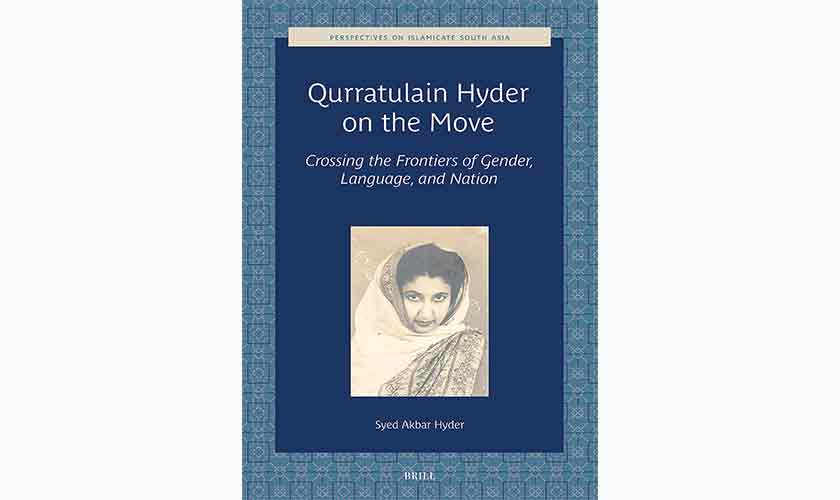
This dynamic energy underpins Qurratulain Hyder on the Move: Crossing the Frontiers of Gender, Language and Nation, Syed Akbar Hyder’s comprehensive study of Urdu modernism. Mirroring its subject’s complexity and breadth, the narrative is both erudite and digressive. Throughout, the ethical dimensions of literature as an act of memory remain at the forefront.
Akbar Hyder opens his study with an account of a personal meeting with Qurratulain Hyder in 2003 in Noida, India: a moment that shapes the trajectory of his research. He explores ‘movement’ not just geographically but epistemologically: Hyder’s transitions span from Lucknow to London; journalism to fiction; and from the aftermath of Partition to the pluralist context of the Deccan. In response, Akbar Hyder adopts an interdisciplinary approach, weaving together philology, theology and cultural history to reflect his subject’s complexity.
The initial chapters trace Qurratulain Hyder’s growth as a writer, framing it as a story of Indo-Muslim modernity. Akbar Hyder examines her responses to Ghalib, Sir Syed and Iqbal, especially how she transforms Iqbal’s idea of the “faithless wanderer” into a feminist image of independence and dissent. This angle shows her work exploring divided loyalties in language, religion and identity.
The chapter The Dance of a Spark demonstrates the book’s methodological balance between archival research and interpretive analysis. Hyder reconstructs Qurratulain Hyder’s intellectual background using anecdotal evidence and etymological study, transforming biographical details into broader historical narratives. However, the analysis occasionally veers toward excessive admiration, which can diminish critical rigour and compromise interpretive depth in moments of stylistic embellishment.
When the prose steadies, its critical acuity is notable. Hyder’s argument that Qurratulain Hyder’s fiction constitutes an archive of “poetic reportage” is a significant contribution to Urdu studies. He analyses her novels and essays in a Persian-Urdu historiographical framework, highlighting how narrative, elegy and ethics operate together. Her novels, including Mairay Bhi Sanam-khanay and g k Dary , serve as acts of witnessing and document social change.
Language, in Akbar Hyder’s account, is both her medium and her battlefield. He traces her lifelong struggle—what she called the “divided loyalties” of religion and language—with admirable clarity. This false binary between Urdu and Hindi, institutionalised by Partition politics, pervades her writing. Akbar Hyder’s own sensibility as a comparatist and teacher of Urdu in America adds moral force to the discussion. Quoting her lament that Urdu “has been paying the political price for the establishment of Pakistan,” he expands it into a meditation on the fate of minority languages in modern nation-states.
Hyder’s reading of Qurratulain Hyder’s reportage Dakkan s Nah ñ h r Sans r meñ is analytically rich. By examining Hyder’s use of Seventeenth-Century poet Vajh ’s couplet, he positions Hyderabad as a historical site of pluralism, where Persianate, Dravidian and Islamic idioms coexisted. The analysis traces the transformation of this coexistence into heritage and frames the Deccan not just as a setting but as a philosophy increasingly at risk of erasure.
Language, in Akbar Hyder’s account, is both her medium and her battlefield.
If the first half of the book maps Hyder’s engagement with language, the second half explores her dialogue with history, particularly her reworking of the marsiyah (elegiac) tradition. Few critics before Akbar Hyder have recognised how central the feminine voice is to this genre. His reading of Hyder’s invocations of Zainab (peace be upon her), the sister of Imam usain (peace be upon him) at Karbala, as the moral centre of the Urdu epic is revelatory. In this light, the marsiyah becomes not merely a lament for the dead but a mode of ethical resistance, a literature of witness through which women reclaim history from masculine heroism.
These analytical strengths are significant, but they sometimes undermine the book’s coherence. While Akbar Hyder’s interdisciplinary methodology enriches the work, it can also fragment the narrative. There are some abrupt shifts between memoir, archival research and theoretical analysis. The inclusion of diverse references broadens the discussion, yet occasionally weakens the central argument. This approach reflects a tension between scholarly precision and narrative expansiveness.
The later chapters, such as Tumult Rises in the Prison: An lam shob, demonstrate a synthesis of personal context with political meaning. Hyder situates Qurratulain Hyder’s fiction within the lam shob genre, redefining it for the modern era. The motif of the “prison” is critically analysed as symbolising both the nation-state and the literary text, each containing turmoil yet unable to entirely suppress it. This metaphor connects Hyder’s work to a tradition of artistic testimony.
The book’s analysis has a weakness: it does not examine Qurratulain Hyder’s social contradictions deeply enough. While it notes her elite, cosmopolitan and English-educated background, it stops short of a full critique. Her political hesitations, discomfort with popular culture and preference for modernist over accessible writing are acknowledged but not explored in detail. A deeper critique could have clarified her role as both a radical thinker and an elite member.
Qurratulain Hyder on the Move adopts a literary style uncommon in academic writing. Akbar Hyder’s prose employs metaphor, rhythm and rhetorical devices to reflect Qurratulain Hyder’s multilingualism and stylistic complexity. However, this method can lead to excessive detail, digressions and extensive use of transliteration. Even specialised readers may find these features challenging. The book displays considerable erudition, although its accessibility is sometimes limited.
This complexity may be necessary to represent Qurratulain Hyder’s intricate literary world, defined by layered allusions and cultural references. Akbar Hyder’s approach, characterised as philological empathy, requires engagement with the linguistic and cultural context. By focusing on these elements, the analysis shows how the work reflects Qurratulain Hyder’s imaginative landscape rather than adhering to conventional literary commentary.
The book’s epilogue, From a Spark to a Constellation, brings the narrative full circle. The “spark” of the title recalls the youthful Hyder, restless in colonial India; the “constellation” evokes the interconnected lineages of women writers, poets and teachers that Akbar Hyder reconstructs from her shadow. It is a moving finale, tempered by scholarly humility. The critic acknowledges that Qurratulain Hyder’s “third eye” ultimately perceives more than any critical lens can: a vision that sees time as a moral continuum rather than a chronological order.
The book leaves the reader with a sense of intellectual complexity rather than a unified argument. Its length, density and tone are uneven, yet it remains a significant and valuable contribution. By examining how Qurratulain Hyder transformed Partition’s experiences into an ethical framework for imagination, Akbar Hyder re-establishes the global significance of Urdu literature.
Qurratulain Hyder on the Move serves as both a tribute to a writer who resisted categorisation and a challenge to literary criticism to transcend disciplinary and conceptual boundaries. The book’s complexity is intentional, reflecting the depth of its subject. For readers who value literature’s capacity for critical thought, Akbar Hyder’s study offers not only scholarship but also a form of moral instruction.
Qurratulain Hyder on the Move
Crossing the Frontiers of Gender, Language and Nation
Author: Syed Akbar Hyder
Publisher: Brill, Leiden | Boston, 2025
Pages: 382
Price: $199 (Hardback)
The reviewer is a Pakistan-born and Austria-based poet in Urdu and English. He teaches South Asian literature and culture at Vienna University.