Print Story
X

There are athletes who win medals, athletes who win hearts, and then there are athletes who, by sheer force of will, reshape the destiny of an entire sport. Arshad Nadeem belongs to the last category. Every time he steps into the run-up lane, the weight of expectation, history, and hope rests on his shoulders. Yet he walks in with the calm of a man who knows that pressure is a privilege.
The javelin arching through the Riyadh sky at the Islamic Solidarity Games this week was far more than a sporting feat, it was the continuation of a story that Pakistanis have grown emotionally invested in. It was a reminder that resilience, not circumstance, defines true greatness.
Arshad’s latest triumph, an 83.05m gold-winning throw in Riyadh, may not be the record-breaking explosion we witnessed at the Paris Olympics, but in many ways, it was more meaningful. Only two months ago, the same athlete stood under the blazing lights of Tokyo’s World Athletics Championships, heartbroken but honest, telling the nation that injury had stifled his hopes. His words were soaked in humility: “I know I let you all down, but I promise to come back stronger.” And he did, with the dignity, grit and maturity that separates legends from fleeting stars.
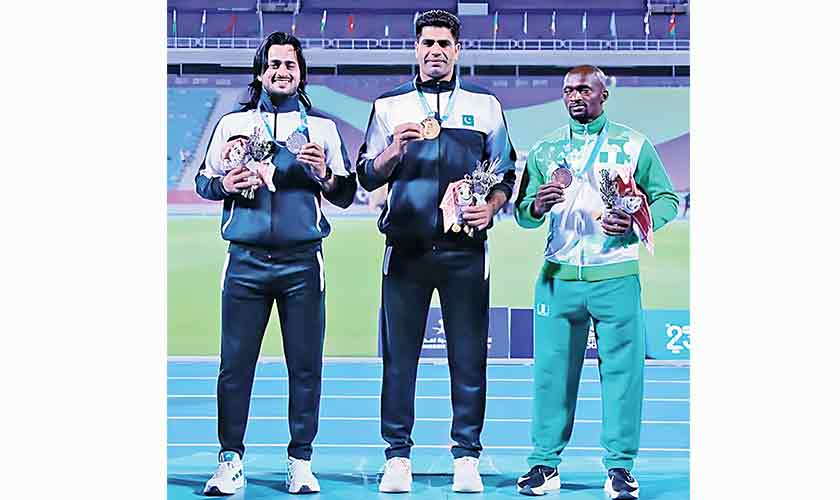
What unfolded in Riyadh was a masterclass in composure. Arshad began modestly, registering 75.44m, but immediately seized control of the field. His second throw, the mighty 83.05m strike, sealed the gold long before the evening ended. Even his follow-up throw of 82.48m was more than enough to remind the region why Pakistan’s javelin icon continues to dominate a sport where margins are brutal and competition unforgiving. There was no roar, no theatrics; just a deliberate exhale and a quiet acceptance, the trademark of a champion who knows a podium is not a privilege but a responsibility.
Yet the story of that night was bigger than one man. Pakistan completed a 1-2 finish when Muhammad Yasir delivered a thrilling final-round 76.04m throw to snatch silver. It was a moment that deserves its own chapter in Pakistan’s athletics history, not just for the medals, but for the symbolism. For the first time in years, two Pakistanis stood on an international podium together, proving that Arshad’s brilliance has begun to inspire a ripple effect. Yasir, once an understudy, now stands as an emblem of the future, disciplined, fearless, and hungry.
But Arshad’s gold and Yasir’s silver in Riyadh reveal a deeper truth about modern sport: success is not always linear, and resilience counts as much as raw ability. Arshad’s journey from the surgical room to the top of the podium, missing Diamond League events, battling calf pain, and enduring a disappointing world championship, is a reminder that elite performance often hides behind both physical and emotional scars. In a world quick to praise victories and quicker to condemn failure, Arshad dared to be transparent. He acknowledged pain. He accepted imperfection. And that vulnerability made his comeback even more powerful.
His Riyadh victory was not merely a sporting outcome, it was a psychological statement. The champion we saw bowing in sujood on the runway, shaking hands with competitors, and drawing energy from the fans clustering behind the javelin sector is the same champion who carried the nation’s prayers into Paris, broke an Olympic record with 92.97m, and introduced millions of Pakistanis to a sport previously outside their imagination. That is his real achievement: he made javelin throw a household conversation. He made Pakistan watch, truly watch, track and field.
And Pakistan responded. When he faltered in Tokyo, fans didn’t abandon him. Social media filled with messages of love and encouragement. “Chin up, champ,” they repeated. “You are still our hero.” Sports is a rare arena where a nation’s identity can gather around a single individual. Arshad, in that vulnerable moment, united a country not through victory, but through honesty.
In Riyadh, he repaid that faith, not fully, because his ambition burns brighter than medals, but sufficiently to remind us that he remains the region’s undisputed force. His competitors knew it. The commentators knew it. Even the sparse stadium crowd knew it, waving flags and smartphones desperately trying to capture a glimpse of Pakistan’s towering athlete. And when Arshad orchestrated rhythmic claps before his final throw, the crowd responded instinctively, as if acknowledging that brilliance had once again returned to its rightful stage.
There is also a crucial lesson buried beneath his success: Elite athletes are shaped not only by federations, but by people who care. Arshad openly credited the support of the Athletics Federation of Pakistan, his coach, and medical professionals like Rd. Rizwan Aftab Ahmed, CEO of ACTIVIT and Director of National Hospital Lahore, whose role in his recovery, health and nutrition, has been vital. Pakistan sports rarely sees such humility from its stars, and this too sets Arshad apart, he remembers where he comes from, and he acknowledges every hand that pushed him forward.
But Pakistan must now ask itself an uncomfortable question: Are we doing enough to support our rare global achievers? A country of 240 million should not rely on accidental brilliance. Yasir’s silver, Fatima Zahra’s and Qudrat Ullah’s boxing bronzes, and Arusha Saeed’s historic Kurash medal show that Pakistan has depth, raw, untapped, and eager. But without structured facilities, sports science, financial stability, and long-term coaching systems, these triumphs risk becoming isolated sparks instead of sustained momentum.
Arshad’s success story is both a blessing and a warning. It is a blessing because it shows what Pakistan can achieve. It is a warning because it highlights how much of this success depends on individual perseverance rather than national infrastructure. Pakistan must realise that the next global champion may already be among us, but might never reach the international stage without the support that athletes like Arshad desperately had to fight for.
As Arshad prepares for an intense 2026 season, including the Asian Games, World Championships and further global competitions, Pakistan must move beyond celebratory tweets. The state, corporate sector, and sports institutions need to shoulder their share of responsibility. They must ensure that Arshad is not an exception but the beginning of a new era.
At home, Arshad’s story is already shaping a new generation. In villages, parks and school grounds, young boys now imitate his run-up instead of a fast bowler’s action. In sports academies, coaches are drawing diagrams of javelin angles and release points. And parents, for the first time, are entertaining the possibility that their child’s future might lie outside cricket.
This is the true power of an icon, he expands the boundaries of national imagination. Pakistan desperately needs such expansions. We must diversify our sporting identity, invest in Olympic disciplines, and embrace the global stage with ambition. Arshad Nadeem represents that ambition, a beacon of resilience, humility, and excellence.
And this is why, gold or no gold, records or no records, Arshad remains the hero of this nation. Because heroism is not built on perfection; it is built on courage. It is built on the willingness to stand up after falling. It is built on the ability to carry a nation’s hope even when your own body fails you. Arshad Nadeem carries that hope with grace. And Pakistan stands with him, not just in moments of triumph, but in every step of the journey.