Print Story
X




A one-minute ad quoting Ronald Reagan derailed US — Canada trade talks — a reminder that in the 21st Century, diplomacy plays out not in boardrooms but on screens
| I |
n the age of performative politics, it is no longer negotiators who blow up trade deals; it is advertisements.
Last week, trade talks between the United States and Canada collapsed and the cause was not a clause in a tariff schedule or a midnight leak. It was a sixty-second television spot.
“A provincial premier bought airtime, and suddenly two governments were at odds.”
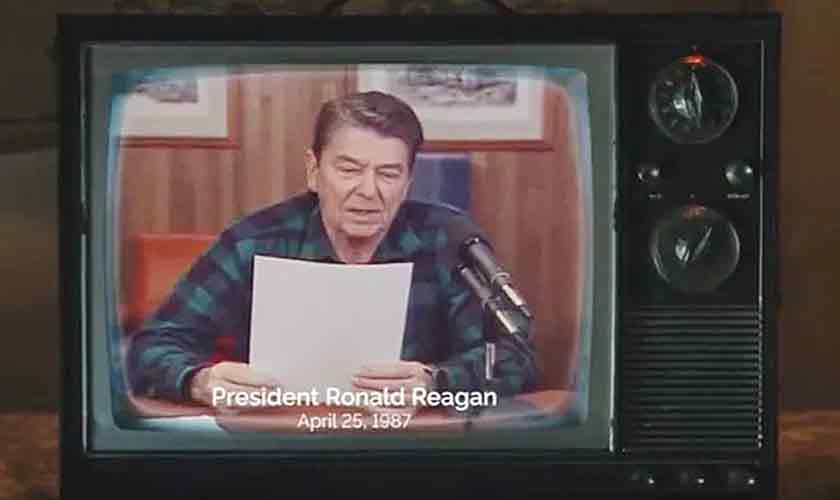
Ontario’s provincial government had commissioned a commercial using archival footage of Ronald Reagan, quoting his 1987 warning that tariffs, however patriotic they may seem, “over the long run… hurt every American worker and consumer.”
The ad ran during prime-time baseball broadcasts across American networks, particularly in Republican districts. Its intent was clear: to invoke a sense of awe and remind the United States that the conservative saint of free enterprise once opposed protectionism.
“Television no longer reports politics; it performs it.”
Within hours of the broadcast, the commercial reached Donald Trump’s feed. The president declared it a “fake,” insisted that Reagan “loved tariffs” and abruptly called off negotiations with Prime Minister Mark Carney. Months of economic diplomacy were derailed by a single media moment. A provincial premier bought airtime and the world’s two largest trading partners fell out on live television.
What unfolded was not a policy dispute but a performance of power. Ontario’s ad had entered the bloodstream of American media politics, where framing matters more than fact. It was not addressed to US negotiators but to American viewers. It bypassed official diplomatic channels to speak directly to a domestic constituency, using Reagan’s ghost to appeal to the conservative imagination. The spot worked like an act of political ventriloquism: Canada voiced free trade, but through the mouth of a dead American president.

The irony was almost cinematic. A province that had no direct role in federal trade negotiations managed to recast the narrative of North American commerce. The advertisement was activism disguised as advocacy, its real message symbolic rather than economic. It presented Canada as the guardian of a lost orthodoxy and the United States as its apostate.
Trump’s response revealed the logic of media politics. He did not counter the argument; he challenged the authorship. In his reaction, the insult lay not in what was said but in who was allowed to say it. Reagan, in Trump’s worldview, belonged to him—to the pantheon of conservative legitimacy that his movement claims as inheritance. The ad violated that ownership. Its offence was aesthetic: it disrupted his control of the script.
The episode illustrates how politics today functions through the vocabulary of advertising. Campaigns and governments alike now operate in the attention economy, where visibility equals power. The image must circulate before it can persuade. The circulation therefore becomes the measure of its success. Ontario’s premier, Doug Ford, made this logic explicit. “We achieved our goal. As we say, ‘mission accomplished,’” he told reporters at Queen’s Park. “They’re talking about it in the US. They weren’t talking about it before I put the ad on.”
It was the perfect expression of contemporary statecraft: success defined by conversation, not outcome. Ford was satisfied not because the ad changed policy but because it became a story. The spectacle was the product.
Television has always been the natural habitat of this kind of politics. Since the 1960 Nixon-Kennedy debates, broadcast has rewarded presence over argument, the aura of authenticity over its substance. Reagan, himself a product of the screen, understood this instinctively. His presidency translated the studio’s dramaturgy into governance. The “radio address to the nation” became a genre of reassurance—a monologue that domesticated policy and humanised power. He was the first modern politician to realise that the microphone was not a tool of communication but of choreography. The Ontario commercial resurrected that tradition and re-aimed it across borders. It was a televised negotiation conducted in the language of persuasion rather than policy. Yet in re-animating Reagan, the ad also re-animated the logic of the medium that made him: the belief that emotion, properly framed, carries more truth than deliberation.
The camera demands clarity, immediacy and emotion. It cannot accommodate nuance because nuance does not rate.
Trump’s fury followed the same script. The performance of indignation is an integral part of his political persona. To be offended is to dominate the narrative. In this sense, he did not misread the ad; he completed it. By reacting so publicly, he confirmed the premise that power today is exercised through spectacle. The president’s Truth Social post became a sequel to Ontario’s commercial, a dialogue conducted entirely through screens.
The breakdown of the trade talks revealed something more fundamental about the relationship between television and diplomacy. For most of the Twentieth Century, diplomacy depended on discretion. Negotiations happened behind closed doors; statements were calibrated to maintain ambiguity. Television, however, has profoundly shaped modern diplomacy. The camera demands clarity, immediacy and emotion. It cannot accommodate nuance because nuance does not rate. As a result, foreign policy now unfolds as a series of images: handshakes, outrages, symbolic gestures. The Reagan advertisement merely dramatised what has already become the norm—the substitution of messaging for mediation.
In this environment, national identity becomes a matter of brand management. Reagan’s image, long commodified by American conservatism, is like a trademark. To use it is to claim lineage. Ontario’s ad effectively borrowed that brand equity to position Canada as the rightful heir to Reaganite free trade. Trump’s outburst was a cease-and-desist in political form. The fight was over intellectual property: who owns the myth of the market?
The nostalgia embedded in the ad was not accidental. In contemporary politics, nostalgia is currency. It offers emotional resonance in an age of fragmentation, packaging ideology as comfort. By invoking Reagan, Ontario was selling not a policy but a feeling—stability, optimism, moral certainty. The irony is that these are precisely the commodities television is best at reproducing. In its grammar, every image is a promise of order, every cut a gesture of control. The Reagan clip, neatly edited, served as both argument and aesthetic.
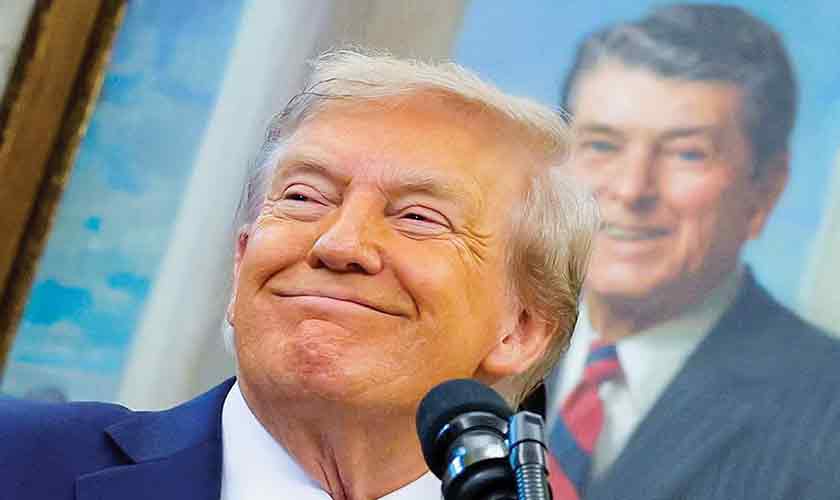
Canada’s federal government tried to restore the old tempo of diplomacy. Carney’s statements were deliberate, measured and almost apologetic. Yet moderation is nearly invisible in a spectacle economy. The camera has no patience for composure; it seeks reaction. What used to be the virtue of diplomacy—its restraint—now reads as weakness. The prime minister’s calm press conferences could not compete with Ford’s swagger or Trump’s fury. Television does not amplify reason; it rewards friction.
The episode also underscores how provincial politics has learned to operate on a global scale through media—a regional government with no direct foreign-policy mandate managed to dominate international headlines. In the networked world, the distinction between local and global audiences has collapsed. A message crafted for one market migrates instantly to another, often with unintended consequences. The Ford government aimed at American voters but hit the US president. In the logic of virality, every broadcast is an open broadcast.
The cost of the campaign—seventy-five million Canadian dollars—now appears less an expense than the price of participation in global visibility. To be seen, governments must now behave like brands, purchasing attention in the same marketplace as corporations. The boundaries between governance, marketing and media production are dissolving. The question is no longer whether an action is political but whether it trends.
Television, despite the rise of digital platforms, remains the most authoritative stage of this theatre. It offers the illusion of intimacy at scale. The viewer feels addressed, even implicated, while remaining passive. Reagan mastered that illusion; Trump inherited it; Ford exploited it—the medium rewards assertion over accuracy, immediacy over reflection. When Ford claims “mission accomplished,” he is not quoting policy language but television language—the slogan of closure, the tagline of victory.
“Trump didn’t challenge the economics; he challenged the authorship.”
The deeper tragedy is that this aesthetic of immediacy now governs diplomacy. The work of negotiation, which depends on patience and ambiguity, is increasingly shaped by the imperatives of the broadcast cycle. Governments are forced to perform clarity in public even as they seek compromise in private. The result is a politics that must always appear decisive, even at the cost of resolution.
Ontario’s advertisement was, in that sense, a parable for our time. It showed how an image can do the work of a policy, how a frame can become an act of state. The commercial did not merely represent a position; it created one. Once the clip aired, Canada could no longer disown its message. The province had spoken for the nation. The line between domestic posturing and international messaging dissolved into static.
In the days that followed, commentators treated the incident as a diplomatic embarrassment. But it was also a glimpse into the future. The advertisement was not a deviation from politics; it was politics in its contemporary form—fast, visual, emotive and self-referential. Its logic governs elections and crises, even wars. A gesture is valuable only insofar as it circulates. Visibility is the new virtue.
Reagan’s voice, preserved in grainy monochrome, was once a symbol of authority. In the Ontario ad, it became an instrument of spectacle, an archive mobilised for immediacy. The man who had used radio to make policy feel personal was resurrected through television to make policy feel viral. The circle was complete.
The trade talks will resume, perhaps quietly, after a suitable pause. But something irreversible has happened. The stage of diplomacy has shifted. Its scripts are written for the camera, its crises designed for replay. In this world, a minute of footage can wield more force than a hundred pages of negotiation.
Politics has always depended on persuasion. What has changed is the medium of belief. The microphone that once mediated between the ruler and the ruled now mirrors them back to each other. Every government is an ad agency; every leader a spokesperson. And sometimes, a single clip is enough to end a conversation between nations.
Politics once sought an audience; now it performs for the feed.
Narendra Pachkhédé is a critic, writer and essayist who splits his time between Toronto, London and Geneva