Print Story
X




In her new memoir, Arundhati Roy turns the story of her mother into an inquiry about love and rebellion
| A |
memoir is like a trial in which the writer is both a prosecutor and an arbiter facing a largely hostile jury of readers. Adjectives seem ineffectual in seizing the body of the memoir. But Arundhati Roy’s memoir Mother Mary Comes to Me comes full circle, depicting her mother’s persona, a mosaic of selves; ‘Mary Roy,’ ‘Mrs Roy,’ ‘She,’ and ‘Mommy.’ Apart from striking the right salutatory tone for her mother, Roy has called her a ‘gangster’ whose ‘gangsterism’ and asthma went hand in hand. Always hot under the collar both in public and private, Mrs Roy was born with a type of ‘rage’—the word buzzes in the memoir alarmingly— that can only be countered either by maintaining silence, suggesting surrender, or by running away from the physical bounds of a parent demanding filial submission at all costs. Ironically, the result of such bravado can be even more painful as Arunduthi Roy, born with a ‘vagrant mentality,’ and being an ‘off-grid drifter’ admits the spectral haunting her mother’s absence caused, which she, as a grown-up adult and mature writer, could not shake off. Only when she literally left her mother’s place, a hostel-home, and moved out from Kerala to Delhi, studying architecture, she realised that her relationship with her mother was grounded on a cycle of removal and deferral.
The runaway daughter of a single mother was a way of ‘exorcising’ the ‘bleakness’ of life. Impervious to judgmentalism, yet mournful from the core of her heart, Roy spells out the trajectory of her relation with her mother setting the tone of her narrative preserving memories in separate silos of conflicts separating the wheat from the chaff; the inwardness and subjectivity of a relationship doomed from the beginning retrieved in intervals sparking unspoken love buried under time: “In these pages, my mother, my gangster, shall live. She was my shelter and my storm.” Susanna’s (later she dropped that prefix from her name) and Mrs Roy’s relationship was destined to be unstable, enduring possibilities, from intimacy to abandonment, from exclusions to inclusions. Young Roy couldn’t get over the lingering effects of her mother hitting the panic button, throwing her out of the car, from nowhere on the road, and from the home, too. She was the ‘cult’ and ‘Mother’s Guru model’ everyone was supposed to supplicate. Roy makes no bones in laying bare the tyrannical side of her mother’s personality; a regimental teacher, an eccentric feminist, a woman who gifted her daughter a typewriter, instilling in her a faith befitting a writer. Notably, the ‘gifts bestowed’ on Arundhati Roy by her mother outnumbered the curses hurled at her. She conferred on the adult Roy a poise without a utopian glow. Conversely, Mrs Roy was harsher with her son, a fact Arundhati could not swallow living in India, ‘a land of son-worshippers.’ But family disputes were kept with grudge and pride. Albeit, Mrs Roy handed over the reins to his brother on the issue of property rights and returned to her mother’s village, Ayemenan in Karelia, defeated but resilient. Roy, the writer, inherited this spirit of resilience from her mother. Pulling out all the stops once she had founded the school, she was ‘no longer [her] mother’, recounts Roy. Such were her strategies she applied to control her staff and students that whenever there was a ‘spike in her asthma,’ she became a ‘theatre’ where the peripheral cast would bring their histrionics. As for Roy, her mother’s disease was that thin veil between her silent care and boisterous punishments. In one of the more visceral moments of this memoir, the daughter switches roles, bringing Mrs Roy under her wings: “I became her lungs. Her body. I attached myself to her in ways she wasn’t aware of. I became one of her valiant organs, a secret operative, breathing my life into hers.” With a degree in architecture, doing odd jobs, always short of money, sauntering for shelter in Delhi’s suburbia of shanties, ghettos and dargahs, namely Nizamuddin, she remained out of contact with her mother for seven years.
“In these pages, my mother, my gangster, shall live. She was my shelter and my storm.”
Factual with a pinch of sarcasm, a trademark of her political writings, in her memoir, she shifts gears from the ‘gangster’ to the land of goons, political mafias and the rise of right-wing Hindu nationalism, beating the drums of Hindutva. The narrative’s sporadic transition from the figure of mother to the motherland is episodic, merging events happening within the timeline as wide as the eighties, nineties and the new millennium. The Naxalite uprising, which began in the village of Naxalbari in West Bengal, kindled the spirit of revolt; Naxalites were enemies of class. Even though the CPI won in West Bengal, the Naxalites considered the CPI a chip of the same block of the political class ruling India from Delhi. Bizarre, but one of the many indignities she suffered at the hand of her mother, an incident remained on her mind in which she got a tongue-lashing— “Bitch”—for tinkering with a Blacklite telephone, the first ever installed in the school. On the same day, newspapers ran the stories of Naxalite insurgencies. “A pall of fear” prevailed over the country, not to speak of an ominous cloud lurking over the Roy siblings. Mrs Roy was not ‘unsympathetic’ to communists challenging Uncle Sam’s Vietnam War, whom the latter called ‘gooks.’ She wore Vietnamese insurgent ideas on her sleeves so much so that Kerala and Vietnam were topographically and ideologically the same, both under attack by capitalism. By implication, Naxalites were the reincarnations of gooks, and Mrs Roy believed that with revolution, the world would be ‘less unfair.’ At least a change was ensured, rather than the circus called democracy disguised as oligarchy, which had brought India to an elitist halt. Needless to say, the younger Roy’s introduction to global politics was a window Mrs Roy opened, making her rehearse debates in school about Ho Chi Minh, the Soviet gulag, famine in Ukraine or the Great Leap Forward in China, in which millions had perished. Mentally barraged by a dialectics of contradiction which shaped Mrs Roy’s political thought, mercurial like any other thought, showed fascist buddings, doubtless to deny her sympathies for the communists, was both a gesture of freedom and a freedom controlled by a selected few. In the poem Daddy by the American poet Sylvia Plath, she sniggers at her absent father, integrating personal with the political, as does Roy— “every woman adores a fascist.” In Roy’s case, the father was also absent, so the mother took over the available space. If that weren’t enough, the daughter reunited with her father after a hiatus of twenty years. Micky Roy, a derelict, beggarly soul, resembling the tramps and addicts younger Roy used to encounter during her stay near the shrine of Nizamuddin. The architect Laurie Baker, whom Mrs Roy approached to build her campus building, is banteringly called ‘Daddy;’ his buildings had ‘soul’ and no ‘ego.’ Perhaps he was the right inspiration for young Roy to draw maps and study architecture. On the other hand, ‘Iron-lady’ Indra Gandhi, as Henry Kissinger called her, imposed the Emergency and suspended the constitution. The Indian army committed a sacrilege, as Sikhs perceived it, when they entered the Golden Temple to capture the Sikh separatists. When Indra was gunned down by her Sikh bodyguards, “organised gangs of Congress party goons” went berserk, slaughtering Sikhs in the streets of Delhi; now the BJP is widely known for this. Gangsters, goons and godfathers govern Roy’s India. They have turned Indian into a gangland of capitalist greed, nuclear armaments and dam development.
Though gangsterism in its wide variety is the main theme, the shadow narrative of love gives this memoir a lyrical life. How she fell in love with Pardip Kumar, the film director and journalist, a man already married with children. He was in an open relationship with other women; so was his wife. Pardip offered her a role in the film, though not her niche, but an opening she always looked back on with gratitude. She called it a “classic trap,” “a very young woman in love with an older man.” In her period of courtship, she wrote letters, not love letters, mere descriptions of daily life, anticipating that a day would come when Pardip would ask her “Have you ever considered becoming a writer?” He did. Mrs Roy gave her the typewriter, Pardip love and inspiration. There came Arundhati Roy, the writer of The God of Small Things and The Ministry of Utmost Happiness books, which were written based on this memoir long curdling in her literary system. The ‘bilingual’ Roy discovered the “live language animal” in her. She loved Pardip for loving Ted Hughes’s poem The Thought-Fox. Hughes and Plath were both lovers and poets, and language-animals.
Towards the end of the 374-page memoir, Roy writes that “I felt terrible for her” (her being the writer’s mother) and then tells how she describes to her mother helping herself to an abortion “by eating raw papayas and with a coat-hanger.” Haunted but attached, she catches the peeling ripples of her mother’s guillotine-like tone, “I wish I had dumped you in an orphanage,” “You are a millstone around my neck,” “All my sickness is because of you.” To all intents, these are precious painful shreds of her mother’s memory showcased in this memoir, incurring the memoirist this title—“a seditious, traitor-writer.”
Roy’s brother did not “pretend to be sad” on his mother’s death, an absolute real-life replica of fictional Meursault in Camus’s The Stranger, but Arundhati Roy plays it by ear: “without her, I couldn’t make sense to myself.” Elizabeth Bishop does in her well-known villanelle One Art: The art of losing isn’t hard to master. The day after his mother’s death, October 25, 1977, Roland Barthes began a “mourning diary.” Friedrich Nietzsche, Emmanuel Levinas and Derrida were unusual among philosophers for the clear interest they showed in motherhood, although the ways they approached it have many feminist readers grinding their teeth. Adrienne Rich in her essay Of Woman Born. Motherhood as experience and institution. critiques the societal stereotype of the ‘natural’ mother, exploring a subversive, alternative and anti-patriarchal vision of motherhood while grappling with her own conflicted feelings of love and resentment toward her children. Roy’s memoir is a bewildering labyrinth of “grief” over her mother’s loss, making her “grow in a peculiar shape.”
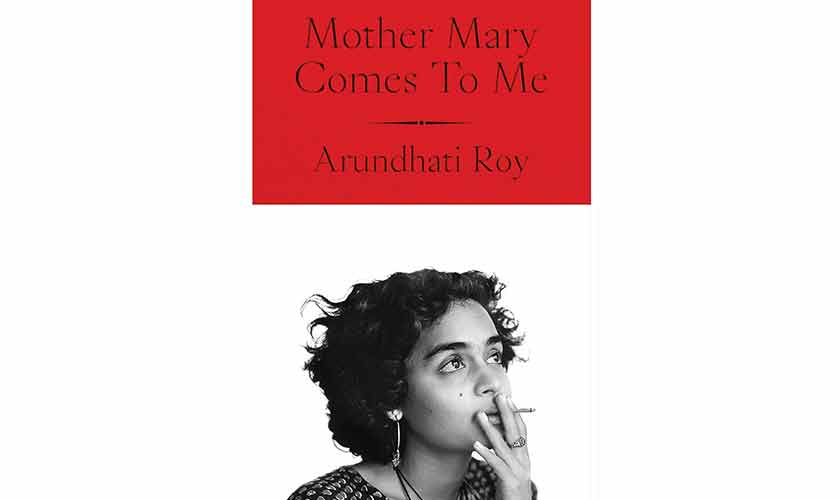
Mother Mary Comes to Me
Author: Arundhati Roy
Publisher: Hamish Hamilton, 2025
Price: Rs 3,995
The reviewer is an English-language poet based in Lahore. His first collection of poems,Lahore, I Am Coming (2017), was published by the Punjab University Press