Print Story
X




Set in 19th-century Ireland, this show is a true to life critique of power, class and identity
| S |
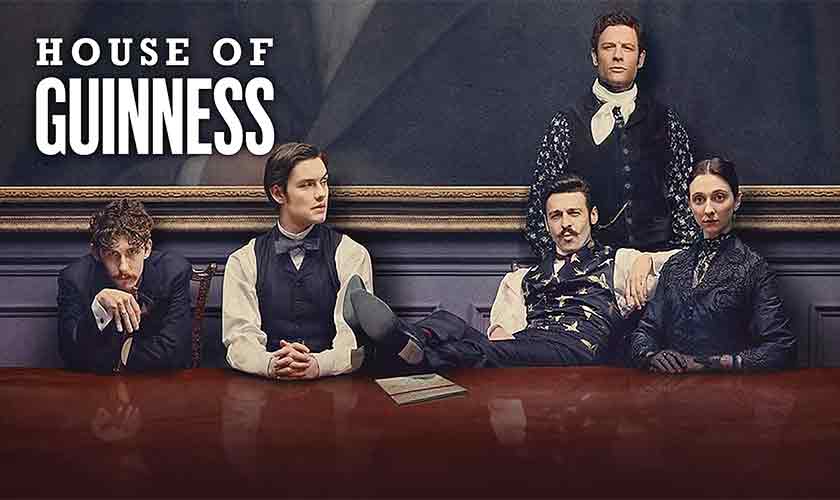
teven Knight’s House of Guinness unfolds like a dark pour of stout. Thick, heady and quietly intoxicating. Set in 19th-Century Ireland and England, the Netflix series traces the dynasty behind the world’s most famous brewery. What it really distills is not beer; it is power.
At its heart, House of Guinness is less about business and more about the emotional and moral debts inherited by those born into privilege. It captures the burden of legacy, the politics of empire and the private rot beneath the polished oak tables of wealth.
When patriarch Benjamin Lee Guinness dies, his four children are left to navigate the empire’s future amid a nation teetering on political unrest. Arthur, the reluctant heir, seeks to escape the weight of the family name but finds himself bound by it; Edward, all cold ambition and calculation, views the empire as his inheritance by right; Anne, intelligent yet constrained by gendered expectations, fights for her voice in a man’s world; and Benjamin II, the youngest, sinks into addiction and despair. Their lives become a microcosm of a society in transition — one grappling with moral, class and national identities.
Beneath its gilded production design, House of Guinness thrives on its social commentary. The family’s brewery becomes a symbol for capitalist morality: its profits flow from both Irish soil and Irish suffering. The Guinnesses’ wealth is tied to labourers who can barely afford a pint of the drink they produce. Through the servants, workers and radicals, the show quietly critiques the illusion of benevolence that often accompanies privilege. Steven Knight, who previously dissected working-class struggle and ambition in Peaky Blinders, here shifts his focus upward - to the genteel cruelty of those who run the world.
The political background is never distant. The specter of Irish nationalism haunts the series, just as much as the lingering guilt of colonialism. The brewing empire’s expansion into New York underscores the duality of the Guinness legacy: an Irish name that became a British symbol, an emblem of both national pride and imperial reach. The show’s attention to such contradictions makes it more than a period drama. It becomes a psychological map of divided identity. Arthur Guinness, portrayed with brooding intensity by Anthony Boyle, embodies this split. He is loyal to his family yet drawn toward the very political currents that threaten it. His inner conflict becomes a reflection of Ireland itself: torn between belonging and rebellion, between conscience and convenience.
Then there is quiet but persistent commentary on masculinity and repression. Arthur’s secrets, including his hidden encounters with men, speak to the suffocating moral codes of Victorian society. His shame is not only personal but political, an emblem of the hypocrisy embedded in upper-class respectability. Addiction, too, functions symbolically: Benjamin’s descent into laudanum dependency mirrors a society intoxicated by power and wealth, unable to confront its decay.
The family’s brewery becomes a symbol of capitalist morality: its profits flow from both Irish soil and Irish suffering. The Guinnesses’ wealth is tied to labourers who can barely afford a pint of the drink they produce. Through servants,workers and radicals, the show quietly critiques the illusion of benevolence that often accompanies privilege.
Anne Guinness, played with understated brilliance by Emily Fairn, is the show’s moral core. Through her, House of Guinness examines the gendered architecture of control: women in high society are polished into ornaments, their intellects contained within drawing rooms. Anne’s growing defiance becomes not just personal liberation but also an early feminist gesture. Her scenes with Edward, in which business and family are discussed in the same breath, expose how patriarchy sustains both domestic and economic power structures. Every negotiation, every dinner conversation, is a battlefield of class, gender and inheritance.
Knight’s writing laces these themes with poetic subtlety. His characters rarely sermonise; instead, their gestures and silences do the work. A dinner table becomes a parliament, a toast becomes a declaration of war and a handshake hides betrayal.
The cinematography reinforces this with dimly lit interiors that evoke the secrecy of boardrooms and confessionals alike. Even the landscapes of Ireland are filmed not as romantic backdrops but as contested spaces: green and beautiful, yet scarred by ownership and control.
What keeps House of Guinness from becoming mere costume drama is its insistence on moral ambiguity. No character is purely villain or hero. The Guinness children are, in essence, captives of their privilege. They inherit not only wealth but also the sins that built it. Knight does not allow easy sympathy; instead, he invites viewers to question what progress really costs and who pays for it. This psychological complexity lends the series its slow, smouldering tension. Every episode feels like watching an empire ferment — the longer it sits, the darker it grows.
The show’s critics, particularly from Ireland, have argued that it smooths over certain political truths and glamorises Anglo-Irish aristocracy. There is some validity in that. House of Guinness occasionally romanticises what it should indict. Its strength lies in its ambiguity. It neither fully condemns nor excuses. It shows that privilege, like addiction, corrupts quietly. The empire does not collapse in fire; it rots from within.
House of Guinness is a story about inheritance; not of money, but of guilt. The family’s struggle mirrors a broader historical reckoning: how nations, like families, live with the legacies they would rather forget. It is a portrait of Ireland seen through the stained glass of wealth and remorse, a reminder that prosperity and oppression often share the lineage.
Knight has crafted something rare, a period piece that feels politically alive and psychologically modern. In its silence, its shadows and its moral unease, House of Guinness reminds us that history is not a museum but a mirror. Sometimes, the reflection it holds is uncomfortably clear.
The writer has a degree in psychology with a minor in mass communication. She can be reached at [email protected]