Print Story
X




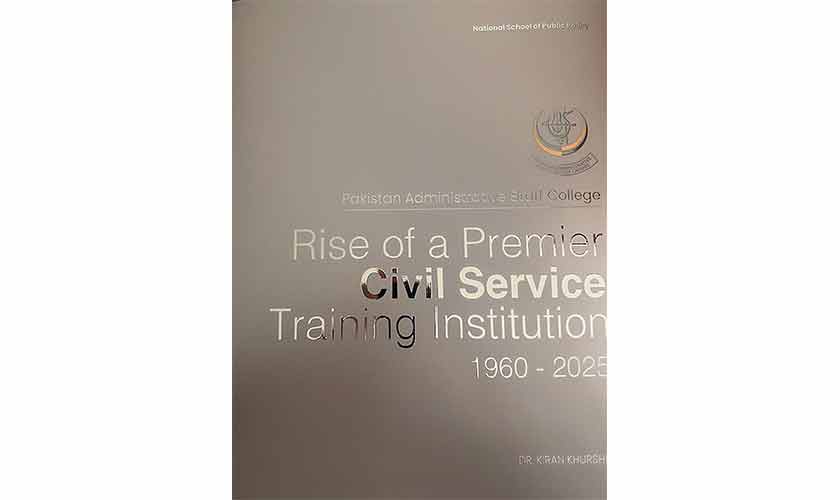
Kiran Khurshid charts the evolution of the National School of Public Policy in her recent book
| T |
he intellectual roots of modern management education can be traced to military institutions, where the cultivation of judgment, discipline and decision-making was paramount. In 1801, the Senior Military Department of the Royal Military College was established in Britain, eventually evolving into the Staff College at Camberley. By 1858, the college had pioneered the syndicate method – an approach based on collaborative problem-solving in small groups under the supervision of a senior commander. This method marked an early recognition of what organisational theory would later describe as experiential and peer learning, enabling officers not merely to absorb information but also to sharpen their analytical skills and leadership capacity through structured dialogue.
The syndicate approach influenced the trajectory of civilian management education, laying the groundwork for future institutions. The Berlin School of Business (1906) and Harvard Business School (1908) institutionalised systematic approaches to leadership and decision-making, drawing on both case study methods and applied research. In Britain, these trends culminated in the founding of the Henley Administrative Staff College in 1948. Endorsed by Prime Minister Clement Attlee as the civilian counterpart to the Royal Defence College, Henley combined syndicate learning with Harvard’s case study model, offering a dual pedagogy that soon became a benchmark for executive education worldwide.
In theoretical terms, Henley’s model exemplified what would later be described in management literature as praxis-oriented education – an approach that bridges theoretical knowledge with the practice of leadership.
Placed against this global intellectual backdrop, newly independent Pakistan faced a serious dilemma. In 1947, the country inherited a skeletal and overstretched civil service, one designed to serve the administrative needs of a colonial empire rather than the developmental demands of a sovereign state. The theoretical problem, framed in terms of organisational development, was one of path dependency: Pakistan’s institutions were trapped in the logic of colonial bureaucracy – rule-bound, compliance-oriented and resistant to innovation. A shift from bureaucratic rationality, in Max Weber’s sense, to developmental rationality was required. The administrators would not only enforce rules but also envision, design and implement public policies to foster socio-economic growth.
The early decades of Pakistan’s existence were characterised by piecemeal reform efforts. From the 1960s onwards a new orientation emerged. Recognising that governance required more than mechanical administration, the state began to emphasise planning and developmental administration – a shift that reflected global trends influenced by modernisation theory and development economics. Institutions such as the Pakistan Administrative Staff College (the precursor to today’s National School of Public Policy) were tasked with training officers not only in procedural efficiency, but also in economic management, planning and governance. This evolution mirrored what scholars such as Dwight Waldo described as the “administrative state,” in which bureaucracy became both the executor of policy and a central participant in shaping national development strategies.
The National School of Public Policy, established later and headquartered in Lahore on the grounds of the former Punjab Club, crystallised these shifts into an institutional framework. The NSPP grew into Pakistan’s premier training and policy research institution, with a mandate combining education, advisory services and intellectual leadership. Its initiatives ranged from standardising training programmes for mid-career and senior civil servants, to providing policy advice to the federal government and collaborating with the Higher Education Commission as a degree-awarding institution. The creation of the National Institute of Public Policy expanded its research capacity, enabling comparative learning through linkages with institutions in China, Turkey and Russia.
In parallel, the NSPP invested in infrastructure – libraries, automated databases, digital learning platforms and conference halls – to align itself with international standards. It also introduced curricular innovations such as research methodology modules, specialised training for elected officials like nazims, and the restructuring of mid-career and senior management programmes. These reforms reflected an awareness that effective governance is not simply a matter of technical competence, but of cultivating critical thinking, leadership and a values-based orientation towards public service.
Her chronicle becomes not only a resource for scholars and policymakers, but also a mirror for the institution itself, reflecting both its achievements and its unfinished agendas.
The impact of these initiatives has been multi-dimensional. At a functional level, the NSPP has professionalised civil service training, providing coherence across career stages. At a strategic level, it has reinforced Pakistan’s policy research capacity, producing knowledge that informs governance decisions. At a cultural level, it has sought to foster attitudinal change, encouraging civil servants to move beyond proceduralism and embrace accountability, transparency and citizen orientation. This reflects a theoretical shift from bureaucratic management towards public value management – a concept advanced by Mark Moore – that emphasises the role of public institutions in co-creating value with citizens.
What makes this story particularly compelling is the way it has been captured in Kiran Khurshid’s book on the NSPP, which represents a commendable scholarly and narrative achievement. Conceived initially as a coffee-table volume, Khurshid’s work rises far above that modest ambition. It becomes, instead, a layered institutional biography that blends archival depth with contemporary analysis. Her narrative illuminates not only the evolution of the NSPP but also the broader story of Pakistan’s administrative state, situating it within global traditions of management education. She offers insider insight as a civil servant, yet writes with the clarity and objectivity of a historian, documenting how the School’s motto – Knowledge to serve people – has been translated into institutional practice.
Equally important is the visual and material quality of the book itself. Produced in a majestic, large-format edition, the volume commands attention not only for its content but also for its physical presence. The extensive use of photographs, illustrations and archival visuals adds layers of texture to the narrative – bringing to life the architecture of the institution, the faces of its leadership and the milestones in its evolution. These visuals transform the book into a living chronicle: not merely words on a page, but a tableau where history, memory and identity converge. The grandeur of its design complements the substantive depth of its content, making it both a scholarly reference and a collector’s piece that conveys the stature of the institution it documents.
Khurshid’s book is particularly valuable in three respects. First, it provides an authoritative account of the School’s evolving role in shaping Pakistan’s civil service ethos, showing how training has moved beyond instruction towards attitudinal change. Second, it places the NSPP within a comparative global framework, illustrating how models pioneered at Camberley, Henley and Harvard were contextualised in Pakistan’s institutional landscape. Third, it preserves institutional memory at a time when the histories of public bodies in the country are rarely documented with care. In doing so, her chronicle becomes not only a resource for scholars and policymakers, but also a mirror for the institution itself – reflecting both its achievements and its unfinished agendas.
Several lessons emerge from this institutional journey. First, global models of management education – whether the syndicate method or the case study approach – demonstrate enduring adaptability when contextualised to local needs. Second, training institutions cannot function in isolation; their legitimacy and effectiveness depend on integrating pedagogy with applied research and policy advisory roles. Third, investments in infrastructure are not merely symbolic but instrumental – enabling global engagement and intellectual exchange. Fourth, civil service reform must be understood as a cultural project as much as a technical one, aimed at reshaping mindsets and values. Finally, institutional histories such as Khurshid’s work on the NSPP are of considerable importance; they offer continuity, identity and a framework within which reform can be meaningfully anchored.
In conclusion, Kiran Khurshid’s chronicle of the NSPP transforms what could have been a commemorative account into a critical case study of Pakistan’s administrative evolution. By situating the NSPP within a global lineage stretching from Camberley to Henley to Harvard, the book illustrates how Pakistan has localised international pedagogical models to serve its governance needs. Equally, through its majestic form, rich imagery and substantive content, the book underscores the School’s continuing role in bridging theory and practice, training and research, national priorities and global trends. For policymakers, civil servants and scholars alike, the NSPP story – as told by Khurshid – offers more than historical insight: it provides a blueprint for how knowledge, when directed towards the public good, becomes the cornerstone of effective governance.
Rise of Premier Civil Service Training
Institution
1960-2025
Author: Kiran Khurshid
The reviewer is a professor in the Faculty of Liberal Arts at the Beaconhouse National University, Lahore