Print Story
X




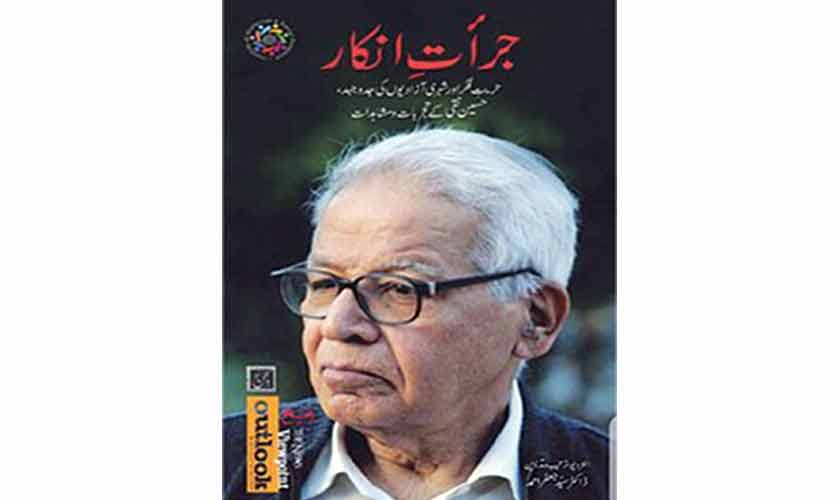
A book carrying an extended interview with Hussain Naqi revisits Pakistan’s turbulent political history
| J |
ulien Benda once wrote that “real intellectuals are supposed to risk being burned at the stake, ostracised or crucified. They have to be in a state of almost permanent opposition to the status quo.” Such figures are rare but they exist. In Pakistan, Hussain Naqi is one of tands among them.
A new book, presented as an extended interview with the veteran journalist, traces his unyielding journey through the incendiary realm. The interviews, conducted and compiled with intellectual finesse by Dr Syed Jaffar Ahmed, director of the Pakistan Study Centre at the University of Karachi, go far beyond surface-level recollections. In the book, Naqi exhumes buried truths and revives long-forgotten memories, offering fresh insight into pivotal moments of the country’s political history.
Recalling his roots, he says that the household into which he was born, where the seeds of his thought first began to sprout, was steeped in politics and books. As a child, he encountered Pandit Nehru, Raja Sahib of Mahmudabad and Khaliquzzaman, and heard the thunderous voices and fiery orations by Maulana Abul Kalam Azad, Jawaharlal Nehru and Maulana Hafizur Rahman.
Narrating his journey, he sheds considerable light on his new life after arriving in Pakistan, while most of his family remained in Lucknow. Upon settling down, he resumed his education, but his involvement in student politics soon attracted the wrathof Ishtiaq Hussain Qureshi. The conflict that began in Karachi continued in Lahore, where he had enrolled at Islamia College where Prof Hameed Ahmad Khan was the principal.
Naqi paints a reverent portrait of Khan: an immensely knowledgeable, eloquent, compassionate and charismatic educator, stern in appearance but soft at heart, whosetop priority always was the welfare of his students.
A particularly revealing anecdote highlights the ideological gulf between rhetoric and reality in Ayub Khan’s regime. When Ayub seized power and flooded the nation with propagandistic slogans such as, “good education, good uniforms, good teaching and good fees,” Naqi approached Prof Khan to understand the intent behind the policy. The principal responded with piercing clarity: these measures, he said, were designed to deny rebellious, liberal-minded youths like Naqi access to education. The elite would receive quality education.In turn, they would uphold the status quo; the underprivileged would be condemned to mental stagnation, like yoked oxen going around a mill, labouring, but neither resisting nor progressing.
He says that while studying for a master’s degree in political science in Karachi, one of the subjects he was taught was constitutional law. He says Ayub Khanobjected to it: he had yet to promulgate a constitution in Pakistan, so why were they teaching this subject? As a result, constitutional law was removed from the curriculum.
Naqi says Ayub Khan’s government used various tactics to corrupt the press and impose censorship. It was, he says, an age of Orwellian Newspeak. Presidential ordinances of 1961 and 1963brought newspapers directly under state control, stifled freedom of expression, silenced the pen, imprisoned thought and smothered speech. Freedom of the press became subject to official “press advice.” He recalls that students faced intense oppression during that regime. Not only were they subjected to stentorian savagery, education, too, was reduced to a political tool.
Freedom of the press became subject to official “press advice.”
After completing his master’s, Naqi took up journalism. He joined the Anjamnewspaper as a reporter. While working there, he was transferred to Hyderabad. At the time, the commissioner of Hyderabad, Masroor Hasan Khan, organised an extravagantly pompous hunting expedition for President Ayub. When the president arrived for the hunt, a formal press interaction was scheduled at the airport.
There, Field Marshal Ayub Khan addressed Naqi directly: if he wanted to ask any awkward question, he should go ahead. Naqi initially parried the provocation. On Ayub’s insistence, however, he posed a plain question: you have been talking a lot about accountability, so what have you thought about Hasan Mohammad Khan? Will you also hold your friends accountable?
Ayub Khan was visibly rattled. His face turned grim, his forehead tightened with anger and without uttering a single word in response, he brusquely walked away. That night, the commissioner phoned Anjam’s editor, Muazzam Ali, exclaiming angrily that “this boy will ruin his career” and ordering the editor to send him back to Karachi immediately. Naqi was transferred forthwith.
There is a striking account also of the turbulent politics of the Bhutto era. Naqi calls it a time of ruthless authoritarianism and undemocratic politics. He also paints a grim picture of the Yahya regime, which he says, manipulated both Bhutto and Mujib. Bhutto, Naqi observes, increasingly aligned himself with the military, and knowingly tolerated its political role. Had Bhutto genuinely desired reconciliation, talks with Mujib could have succeeded. He allowed those to fail.
Naqi recalls returning to West Pakistan after a meeting with Bhutto(in East Pakistan?), where he confronted him directly: “No one can better fathom the dynamics of politics than you. Why are you doing all this? Don’t you realise the country’s future is in jeopardy?” To this, Bhutto replied bitterly: “You are treating me like Qayyum Khan.”
Naqi responded: “You are an educated man, erudite, well-versed in history and geography;on what basis are you making these choices?” A silence followed.
He also recalls another meeting with Bhutto, in which he warned him: “You cannot run a country with generals, but you can certainly break it apart.” By then, Naqi says, the alliance between Bhutto and the military had become all too apparent. Mujib, he adds, was aware of Bhutto’s ways and knew exactly who was dictating terms to him.
It is important to note that Pakistan’s nationalisation policy was formally announced shortly after the fall of Dhaka on December 16, 1971. On January 3, 1972, the government nationalised ten major industries. Two days later, on January 5, Zulfikar Ali Bhutto addressed a massive public gathering in Nishtar Park, Karachi, and delivered a long, impassioned speech.
In that address, he referred to Sheikh Mujib-ur Rahman, then imprisoned in Pakistan, as an honest and patriotic man and announced his intention to release him. He asked the crowd three times whether they supported this move, and every time the crowd roared back in agreement. In the same speech, Bhutto denounced GenAgha Muhammad Yahya Khan as a traitor and told the people that Yahya had deceived both him and Mujib. He went further, stating that Yahya had been trying to humiliate politicians and undermine democratic processes.
Shortly afterwards, Bhutto placed Yahya Khan under house arrest and ordered the seizure of lands near Lahore belonging to retired senior military officer Hamid Dogar, a symbolic move carried out through public occupation. Yet, in that very speech, Bhutto also said he would not seek political revenge against anyone.
Naqi describes in detail how Bhutto’s treatment of journalists grew increasingly harsh. Under his rule, weeklies Zindagi and Punjab Punch were banned. Notably, Bhutto’s information minister, Abdul Hafeez Pirzada, had once described press censorship as “a curse.” Yet under Bhutto’s leadership, Pirzada played a significant role in curbing press freedom, to the extent that journalists lost public trust.
The Bhutto regime asphyxiated the press. Angered by criticism, he throttled it. Bhutto even turned newsprint distribution into a political weapon.
Naqi recounts that during his imprisonment, Mujeeb-ur Rehman Shami, Ejaz Hassan Qureshi and Altaf Hassan Qureshi were also jailed alongside him. Shami, he says, arrived in tears, and it was Naqi who consoled him. Altaf Hassan Qureshi, cited as a witness, has denied this.
From the very beginning of Gen Zia-ul Haq’s martial law, certain high-ranking individuals, including some members of the judiciary, tried to lend legitimacy to the authoritarian rule. Justice Shaukat Aliallegedly suggested that no elections be held for the next three years and that GenZia should appoint himself as president and name provincial governors.
Naqi recalls how Zia shackled journalism using arbitrary regulations and censorship, and chained free expression in the name of morality, religion and national security. He decribes numerous attempts made during Zia’s rule to crush democracy, including the distribution of newsprint based on political allegiance.
The book also offers thought-provoking commentary on the role of editors and the state of journalism today. Naqi says journalism was once apurposeful profession. Most editors handpicked their teams and enjoyed editorial freedom. Working journalists, he says, did not face job insecurity. He says the “contract system” prevalent today has distorted the landscape and weakened the editors’ authority.
This is an important book on account of its exploration of the Bhutto and Zia eras.One wishes for a similarly candid account of the governmentsthat followed Zia’s, especially the Musharraf regime.
Jurat-i-Inkaar
Compiled by: Dr Syed
Jaffar Ahmed
Publisher: Institute of
Historical & Social Research
The writer is a lecturer in the History Department at GCU, Lahore