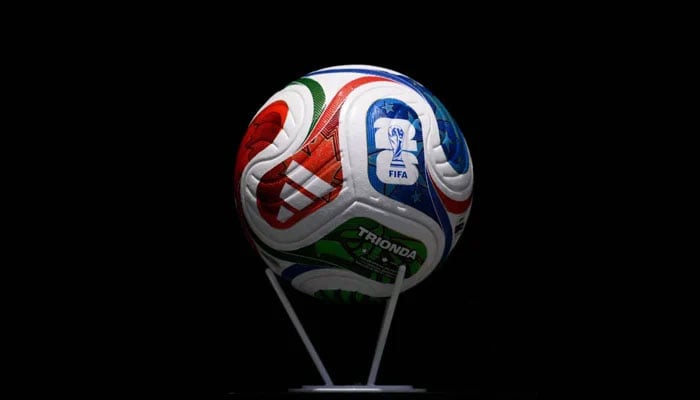
FIFA is the world’s largest playground. FIFA is also the world’s largest screen. Every four years, four to five billion watch one game, one field, one ball. And that ball has again been made in Sialkot. Tango Espaaa in 1982. Azteca in 1986. Etrusco Unico in 1990. Questra in 1994. Tricolore in 1998. Fevernova in 2002. And now, Trionda in 2026. Behind those names stood Pakistani workers. Pakistani entrepreneurs. Pakistani exporters. Pakistani skill.
Sialkot became the global centre of hand-stitched football production. Pakistani workers. Pakistani entrepreneurs. And Pakistani exporters have built a reputation for quality. At one point, Pakistan supplied a majority of the world’s hand-stitched footballs. By 2006, football had changed – on the field and in the factory. FIFA and Adidas moved from hand-stitched balls to thermally bonded footballs. The new era demanded five things: automation, machinery, precision, scale and standardisation.
Sialkot stood still and fell behind. Shenzhen moved faster. Others adapted more quickly. Sialkot was slower to invest, slower to upgrade, slower to protect its lead. The result was brutal. A city that had dominated the market lost the flagship contract. Remember: Global markets reward innovation. Global markets do not pay for yesterday’s excellence. They pay for tomorrow’s capability.
Lo and behold, Sialkot’s story did not end there. Many thought Sialkot’s football-manufacturing era was over. It was not. Sialkot’s manufacturers upgraded their technology, improved their production methods, rebuilt their global relationships and returned to the World Cup stage. Sialkot came back in 2014. Again in 2018. Again in 2022. And again in 2026. Sialkot’s comeback matters. Very few industries lose the world’s biggest contract and then win it back repeatedly. Sialkot did.
Fact number 1: Pakistan can manufacture products used on the world’s biggest stage. Fact number 2: Pakistan can meet global standards. Fact number 3: Pakistan can compete with China, Thailand and others. Fact number 4: Pakistan can build export clusters. Fact number 5: Pakistan can create reputational capital.
Sialkot succeeded because it was not merely a city of factories. It was a cluster. Exporters, vendors, stitchers, cutters, packagers, freight agents and global buyers operated in one dense ecosystem. Skills travelled. Orders moved. Trust compounded. That is how a city becomes a value chain.
Why did Sialkot succeed? Sialkot has roughly 130 firms producing for major brands, but Sialkot is not just a city with stitchers. Sialkot is a cluster. Sialkot has exporters, vendors, cutters, stitchers, packaging units, freight agents, testing labs and global buyers all sitting close to one another. That density created speed, trust and skill transfer.
Cold truth: The issue is not capability but replication.
Power is now concentrated in Pakistan. That power now faces its real test. It can use authority to control markets, assets, companies, ports, borders and bureaucracies. Or it can use authority to unlock enterprise, build export clusters and create fifty more Sialkots.
Pakistan does not need to invent capability. Pakistan needs to multiply it. Sialkot is the evidence. The football is the symbol. The lesson is clear. If one city can make the ball used by the world, Pakistan can build many more cities that sell software, fintech, minerals, copper, marble, denim and engineering goods to the world.
Red alert: Sialkot is proof of capability. Fifty more Sialkots would be proof of leadership.
The writer is a columnist based in Islamabad. He tweets/posts @saleemfarrukh and can be reached at: [email protected]