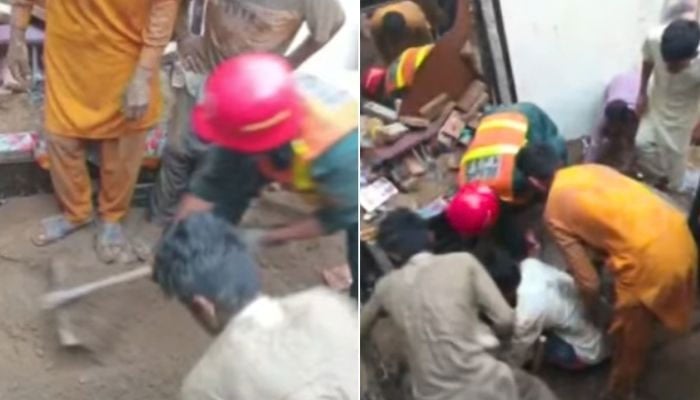
Bring to mind, while you read these words, the faces of the fourteen children who died in Lahore on Tuesday in that ‘tuition centre’ tragedy. You should have seen their pictures in the media and in this and other newspapers.
Now, if you have children or grandchildren of that age bracket, you may have deciphered some resemblance in those charming faces. They looked so endearing. On an emotional level, we are all touched by this heartbreaking loss of innocent lives. It is hard to imagine the pain that the parents and other relatives will have to bear for a long time. Actually, the death of a child makes no sense – though it happens all too frequently.
What had happened was that the roof of a room in which more than 20 children were supposed to be studying suddenly collapsed in the Kahna area of Lahore. Reports said that 14 children had died when the debris was removed and a number of others were seriously injured. The female tutor and eight students were taken to the hospital.
There are details about this incident that I am not concerned with in this column, such as the arrest of the contractor and the owners of the tuition centre housed in a poorly built structure. What I find incomprehensible is that a ‘tuition centre’ of this kind had existed in reality.
They were there, children aged about four to about twelve, all crammed into a room and taught by one female teacher who, it was reported, was the homemaker. We have no information about the nature of the education being provided.
Also relevant is the locality in which this ‘tuition centre’ is – or was – situated. An extensive coverage in the news channels and social media depicted a low-income community seemingly deprived of proper civic facilities. We don’t know whether there are any government primary schools in the vicinity or whether the children who sat under the roof that collapsed were also enrolled in any of them.
By the way, it is the government’s constitutional responsibility to provide primary education to all children. This is what Article 25-A states, after the 18th Amendment to the constitution, passed in 2010: “The state shall provide free and compulsory education to all children of five to sixteen years of age in such manner as may be determined by law”.
Ah, but what about that oft-repeated finding by international agencies that around 26 million children are out of school in Pakistan, constituting over a third of the country’s school-age population?
There are so many other thoughts that are triggered in my mind by the Lahore tragedy. If you look beyond the headlines, this story offers many insights into Pakistan’s present reality. If education is a fundamental and legally enforceable right for all children, it should also mean that all children across all sections of society have an equal opportunity to advance. How else would education be an equaliser?
But education in Pakistan is effectively a measure of our social inequality. Let the scene change to any of the private schools for children of the privileged class. One month’s fee in these schools is generally more than Rs50,000. I know there are private schools at all levels because even lower-middle-class parents have rejected public schools. Then, language is another barrier that leaves the majority of students out of the loop of opportunity.
As I said, my mind wanders. The loss of 14 little boys and girls has disrupted my thoughts in a manner that I am unable to make sense of what we are doing to our children and what future can be perceived in the mirror of their present that is manifest in our schools and on playing fields and in the streets and homes where they live their lives.
Children, obviously, are everywhere. At least in Pakistan. You see them playing in the dust in the slums of Karachi, for instance. You know that around 40 per cent of them were stunted in their infancy, and it shows. There are other children who live in another world, in the lap of affluence – and “never the twain shall meet”.
What relevance is there for Pakistan to the famous quotation of Wordsworth that “the child is the father of man”? Because it means that we are shaped by our childhood. I am reminded of another quotation – of Tagore: “Every child comes with the message that God is not yet discouraged of man”. So, do we still have hope that these children we have now will make a better world?
Thinking about the promise that children represent for our future, I recall a personal observation during my first visit to China in 1982. At that time, the one-child family plan had just been enforced, and there were families on the streets with little children. The general scene was not very lively.
But I noticed that the children looked healthier than their parents and were better dressed. There was more colour in their attire. I thought this to be a remarkable indication of how the children were being pampered. I was in China on a journalistic visit and had shared my understanding with several people. To me, it seemed something important.
I do not know if what I had observed had any significance in the context of how and why China became a great country. How children are educated and brought up may have some bearing on a country’s progress, but this is a very complex issue.
Anyhow, let me conclude with some statistics I checked on Google. In 1982, China’s per capita income was about $203 in nominal terms. In 1982, Pakistan’s per capita income was approximately $350.
As of 2026, China’s per capita gross domestic product (GDP) is roughly $14,870. Pakistan’s nominal per capita income stands at $1,901 for FY2026, according to the official Pakistan Economic Survey.
The writer is a senior journalist. He can be reached at: [email protected]