_updates.jpg)
The body of Ayatollah Ali Khamenei lay in state in a vast hall in Tehran as clerics, officials, foreign dignitaries and other mourners paid their respects to Iran's late Supreme Leader, slain by US and Israeli bombs.
Iran is staging a week of mass funeral processions for Khamenei, whose 37-year reign was brought to an end in February by the first airstrike of the war, in a show of public devotion to the Islamic Republic's theocratic state and revolutionary zeal.
Khamenei's body was expected to be taken to Qom, Najaf and Kerbala, the great Shi'ite centres of Iran and Iraq, before being laid to rest on Thursday in Mashhad, home to the country's holiest pilgrim shrine.
On Friday the coffin — and those of family members killed with him — was laid in state in the great prayer hall built to honour his predecessor, Ayatollah Ruhollah Khomeini.
The funeral is taking place at a critical moment for Iran, where the clerical rulers backed by the Islamic Revolutionary Guard Corps are riding high from surviving what they saw as an existential war against their greatest and most powerful foes.
Authorities aim to mobilise millions of people for the big processions over the coming days, offering transport, food and lodging to buoy the numbers.
But nearly five decades after the 1979 revolution, and for all the official proclamations of national unity in the run-up to Khamenei's funeral, the Islamic Republic has rarely been so internally fractured.
Support for the clerical leadership is paper thin, analysts say, and the new Supreme Leader, Khamenei's son Mojtaba Khamenei, has not been seen in any new image since being wounded in the strike that killed his father.
Years of crippling sanctions have paralysed the economy as accelerating bouts of mass nationwide protests have been put down by security forces with increasing force — culminating in the killing of thousands of demonstrators in January.
Those deep problems have been brushed aside this week, with the authorities mounting a display of state power and mass support.
Tehran streets were tightly controlled, with military and police vehicles lining the major roads and police and members of the black-shirted volunteer Basij paramilitary force patrolling on motorbikes. Iran warned the United States and Israel against any attacks during the funeral.
After the coffins arrived on Friday, borne high across the upraised hands of a waiting crowd, they were laid in the prayer hall on a white, stepped dais before a high, intricately tiled, arched recess, flanked by national and black mourning flags.
A black turban, worn by clerics claiming descent from Islam's Prophet Mohammed, lay on the coffin on a folded chequered scarf, a symbol in Iran of militant revolutionary ideals and solidarity with Palestinians.
Former Russian President Dmitry Medvedev, Chinese National People's Congress deputy head He Wei, Pakistani Prime Minister Shehbaz Sharif and Iraqi President Nizar Amedi were among the foreign leaders and officials attending.
Families of Hezbollah leader Hassan Nasrallah and senior commander Imad Mughniyeh, close Lebanese allies of Iran killed in Israeli strikes, attended the ceremony.
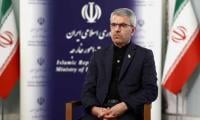
Iran's own political leaders — the president, parliament speaker, foreign minister and others — filed in to weep and pray on Friday morning. A group of generals stood saluting in front of the coffin. Among them was the new Revolutionary Guards head Ahmad Vahidi, having not appeared in public since his appointment for fear of assassination.