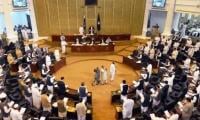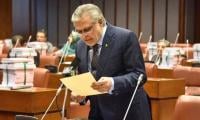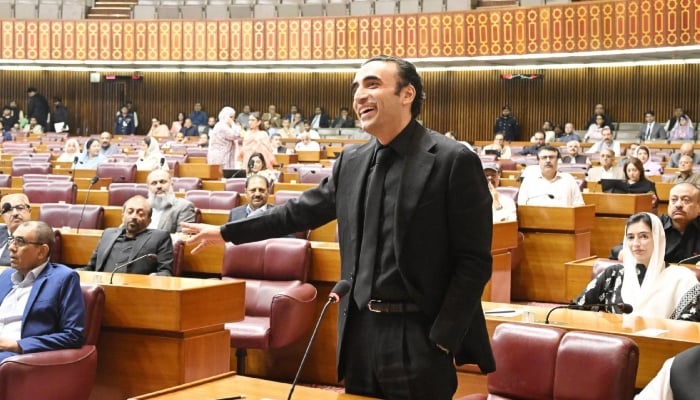
ISLAMABAD: Pakistan Peoples Party (PPP) Chairman Bilawal Bhutto Zardari on Wednesday took a strong exception to the remarks of Defence Minister Khawaja Asif on the identity of the people of Rawalakot, saying that certain ministers in the current government were creating obstacles for Prime Minister Shehbaz Sharif rather than assisting him.
“The prime minister must have the mandate and authority to control his team,” he said while addressing the National Assembly on Wednesday. “If ministers keep making contradictory statements that do not align with the prime minister’s policy, it will create further hurdles.”
He questioned the presence in the federal cabinet of a minister who had reportedly said that the people of Rawalakot were not Kashmiris. “How can we tolerate such remarks coming not only from a senior politician but also from the country’s defence minister?” Bilawal asked.
The PPP chairman said he had voted twice for Prime Minister Shehbaz Sharif, noting that the premier had consistently sought constructive engagement with allies and the opposition. He stressed that given the geopolitical situation, all political parties should unite to address national challenges and create opportunities for the public, but said inconsistent statements by some ministers undermined this effort.
He also referred to a statement by a federal minister regarding elections in Kashmir, in which it was claimed that “12 seats are in our pocket”. He said such remarks fuel unrest and give justification to those seeking to destabilise the region. “How, then, can we justify such statements when they come from a federal minister?” he asked.
While criticism of statements made during protests was justified, he noted that those making such remarks did not hold public office or parliamentary positions.
Bilawal said he respected Rana Sana and acknowledged Nawaz Sharif’s connection with Kashmir. He added that the issue could not be addressed by the federal government alone, and although mistakes may have been made during the PPP’s brief tenure, the current situation required a political rather than confrontational approach.
Earlier, Jamiat Ulema-e-Islam-Fazl (JUIF) chief Maulana Fazlur Rehman called for a meaningful dialogue between the government and Joint Awami Action Committee (JAAC) in the AJK, urging authorities to address the protesters’ demands and avoid any actions that could further inflame tensions.
Speaking during a National Assembly session, the JUIF chief said the JAAC had contacted him and formally submitted a letter outlining its concerns and demands. “I forwarded it to the government. However, no response has been received so far,” he told the House.
Maulana Fazl noted that a large number of people had gathered in Rawalakot and stressed the need for negotiations rather than confrontation. “There should be dialogue. The charter of demands should be examined seriously, and no action should be taken against protesters merely on the basis of speeches delivered during demonstrations,” he said.
He welcomed the JAAC’s decision to postpone its planned march towards Muzaffarabad, describing the move as a positive step that could create space for negotiations. The JUIF chief also criticised the remarks by Defence Minister Khawaja Asif, saying “Such remarks should not have come from a defence minister. You have entrusted conflict to Khawaja Asif and reconciliation to Ishaq Dar. Statements of this nature will only increase tensions,” he remarked.
Warning the government against underestimating the opposition, Fazl said, “Do not compel the opposition to take a harder stance. We recently held a gathering of hundreds of thousands in Charsadda. The ruling party should demonstrate that it can organise a similar public meeting.” Calling for patience and restraint, the JUIF leader said, “A great deal of emotional rhetoric has been witnessed in this House. This is a time for tolerance and wisdom.”
Responding to Fazlur Rehman’s remarks in the National Assembly, Prime Minister’s Adviser Rana Sanaullah rejected the impression that the government had failed to engage with the Jammu Kashmir Joint Awami Action Committee (JAAC) through dialogue. He said the government would welcome any mediation efforts by the JUI-F chief.
He said the JAAC had initially raised two key demands during last year’s protests: electricity at Mangla Dam production cost and continuation of wheat subsidy. He added that Prime Minister Shehbaz Sharif approved electricity at a subsidised rate of Rs3 per unit and ensured continuation of wheat subsidy, while progress was also made on 38 development-related demands, including infrastructure and health facilities.
Sanaullah said differences arose when the Jammu Kashmir Joint Awami Action Committee (JAAC) demanded abolition of refugee seats in the AJK Legislative Assembly. He said the government maintained the issue was constitutional and could only be decided by an elected legislature, a position supported by political parties, the APC, Legislative Assembly and the Supreme Court. A six-member committee was formed, but the JAAC boycotted the process from October 2025.
He said that despite the July 2026 election schedule, the JAAC announced a long march in March. During talks in Muzaffarabad on May 30, officials reviewed all the 38 demands in the presence of AJK prime minister and chief secretary. He said the government offered three options to resolve the dispute, but the JAAC rejected them and later boycotted the APC process. Sanaullah said the committee later raised eight additional demands, including removal of declaration in nomination papers supporting Kashmir’s eventual accession to Pakistan. He reiterated that abolishing the 12 refugee seats was unconstitutional and could only be decided by the AJK Legislative Assembly, not any “armed group”.
Rejecting claims of government inaction, he said 177 cases against JAAC activists were withdrawn and several demands were accepted. He accused the committee of using “mob pressure and violent agitation”, while maintaining that law enforcement agencies were acting within their mandate.
Separately, he addressed reports on possible constitutional amendments related to Article 140-A and local government reforms, saying no amendment would be introduced without broad political consensus. He added that a committee had already been formed to examine the matter. He also said personnel from all the four provinces, as well as Gilgit-Baltistan and AJK, were serving on the Line of Control (LoC) to safeguard the country’s borders and defend the Kashmir cause.
Responding to points raised by former prime minister Raja Pervaiz Ashraf, Khawaja Asif said Pakistan had rendered immense sacrifices for the Kashmir cause and fought five wars against India over the longstanding dispute, stressing that anti-Pakistan statements and disrespect towards national institutions and martyrs were a matter of serious concern.
Earlier, speaking in the National Assembly, former prime minister Raja Pervaiz Ashraf said the hearts of Kashmiris beat with Pakistan and stressed the need for responsible rhetoric to ease tensions around the Kashmir issue. He cautioned political leaders against making remarks without careful consideration, saying describing any area as “not Kashmiri” was contrary to the vision of Pakistan’s founder Muhammad Ali Jinnah.
Speaking on a point of order, PTI Chairman Barrister Gohar Ali Khan said Pakistan needed unity, stability and political harmony, stressing that strengthening parliament and state institutions required the rule of law. On Kashmir, he reiterated PTI’s position that it was Pakistan’s “jugular vein” and said the JAAC had emerged due to public grievances, urging the government to address its demands.
Meanwhile, MQM-P MNA Dr Farooq Sattar called for a national agenda and greater self-accountability to resolve the country’s issues. He said his party had also put forward four key proposals for consideration.