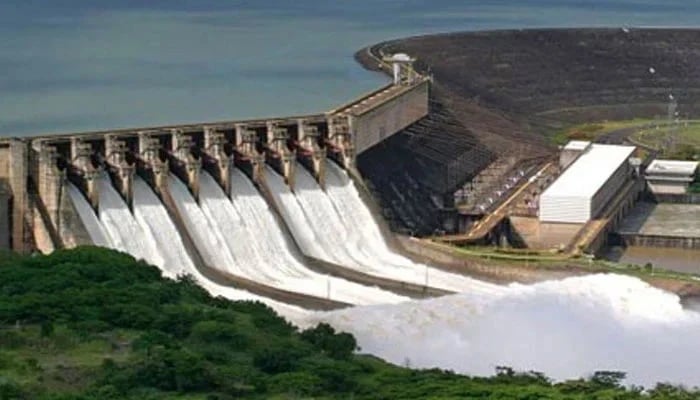
LAHORE: Just a year after navigating massive summer floods, the Indus Basin is staring at an ‘artificial’ water scarcity crisis driven by an inability to optimise storage and integrated system dynamics.
The Mangla Dam has been heavily drawn down to a live storage of 2.465 million acre feet (MAF) on Wednesday against its maximum storage capacity of 7.3 MAF, leaving it depleted at just 33.3 per cent of its maximum capacity and sitting at a staggering 74.35 feet below its Maximum Conservation Level (MCL) of 1,242 feet.
Year-on-year comparative data reveals that while total national live storage has shrunk from 4.413 MAF last year to a precarious 3.167 MAF — a real reduction of 1.246 MAF or a 28.2 per cent drop — Mangla is being aggressively emptied to counter broader systemic failures across the basin, including operational constraints relating to Tarbela Dam.
The primary factor trigger forcing Mangla into a crisis is a stark year-on-year supply imbalance. While direct inflows into the Jhelum River remained sluggish at 27,800 cusecs, outflows from the dam surged to an unprecedented 65,000 cusecs, up from 15,000 cusecs on the same day last year. This represents a real absolute outflow spike of 50,000 cusecs, or an astronomical 333 per cent escalation. This massive drawdown means Mangla is bleeding 37,200 cusecs per day more than it receives, creating an operational depletion trajectory that makes filling the dam to its peak capacity highly unlikely before the seasonal deadline unless the monsoon performs extraordinarily well.
Compounding this strain is a severe shortfall at the Marala rim station on the Chenab River. Historically a major contributor to the canal networks, Chenab’s current inflow has collapsed to 27,200 cusecs compared to 61,900 cusecs last year — a real deficit of 34,700 cusecs, meaning the river is flowing at 56.1 per cent less than its previous annual benchmark.
Commenting on the drawdown of Mangla Dam, the Indus River System Authority (IRSA) explains that this stress at Mangla storage cannot be looked at in isolation; the entire basin must be viewed as an integrated entity. Initially, Irsa routed 3.0 MAF of water from the western rivers via Link Canals to support the eastern Trimmu and Panjnad canal systems. However, a parallel multi-day temperature dip at the glaciated headworks caused Tarbela’s inflows to drop from 226,300 cusecs on June 24 last year to just 113,800 cusecs on Wednesday — a real contraction of nearly 50 per cent. This extreme drop in inflows of Indus River forced Irsa and Punjab Irrigation Department to shift the burden entirely onto the Mangla Dam as an interim mechanism.
This ongoing emergency highlights a structural paradox: Pakistan continues to suffer completely avoidable severe intra-seasonal water shortages less than twelve months after witnessing massive flood surpluses, solely because the country lacks the required reservoir capacity to capture and hold water over extended cycles.
To meet demand through Indus River, water managers are now entirely dependent on an impending temperature spike in the upper catchment — where maximum temperatures currently hover below 30°C, a critical mark where ice melt accelerates — to revive the Indus and Kabul flows. Until those temperatures rise to trigger glacier melt, the Mangla Dam remains the sole, over-exploited shock absorber for the country’s agricultural heartland, highlighting the urgent need for expanded storage capacity.