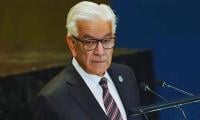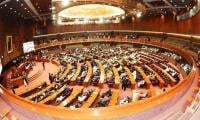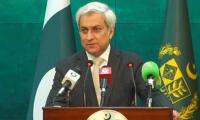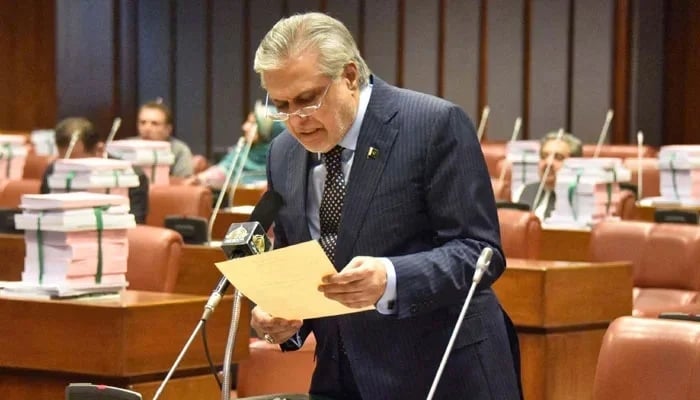
ISLAMABAD: Deputy Prime Minister/Foreign Minister Senator Ishaq Dar informed the National Assembly on Wednesday that as an honest and sincere facilitator and mediator, Pakistan kept the details of correspondence between the US and Iran close to its chest and did not share them even with friendly countries.
Speaking in the National Assembly, he said Pakistan was now being recognised as a peacemaker and net security provider for the region due to its US-Iran mediation efforts, saving hundreds of thousands of lives. “At an international forum where global diplomacy is discussed, the US charge d’affaires acknowledged that Pakistan by its role has become the net security provider in the region,” he said.
Dar also placed on record the copies of ‘Islamabad Memorandum of Understanding’ which was electronically signed by the US and Iranian presidents and the prime minister of Pakistan, and the joint statement which was signed in Switzerland on June 22. He said Pakistan, Iran, US and Qatar participated in the parleys held in Switzerland on June 21 and 22.
The Islamabad MoU is a three-page document with every page signed by the presidents of the US and Iran and Prime Minister Shehbaz Sharif. He said Pakistan ensured that no details of correspondence or documents between the US and Iran were made public.
He said Pakistan played its role as mediator and facilitator with honesty and sincerity and did not share documents even with Saudi Arabia and Egypt who somehow were also involved. “When they asked for the document, we told them that Pakistan can do this only when the US and Iran permit,” he said.
Dar said prior to the signing of MoU, Pakistan went through multiple rounds of shuttling between the United States and Iran. “Iran used to send its draft via Pakistan to the US who would amend the same. In phase one, it was mentioned in the Islamabad MoU that Hormuz Strait would be opened. In the second phase, it was mentioned that technical discussion would take place on nuclear issues, sanctions on Iran and frozen assets and Lebanon. Lebanon is a real problem because the Israeli attack on Lebanon delayed talks for two days, which were held on June 21 and 22,” he said.
The deputy prime minister said it was on record that Pakistan was the only Muslim country which pro-actively condemned the US attack on Iran on February 28. Dar said he was in Saudi Arabia to attend an OIC meeting soon after the attack on Iran, called his Iranian counterpart and requested restrain and de-escalation. “But somehow, Iran also attacked US bases in GCC countries. We also condemned those attacks on the similar principles,” he said.
Dar said Prime Minister Shehbaz Sharif remained in contact with the heads of states and he himself called his counterparts, while Field Marshal Asim Munir also engaged both parties actively. “It were our efforts for de-escalation and after two weeks a ceasefire was agreed for two days and more dialogues took place. Later, high-level delegations from the US and Iran with mediation of Pakistan were engaged in talks in Islamabad in six sessions for 21 hours on April 11 and 12.”
He said the leaders of two countries agreed to sit on the negotiation table in Islamabad after 47 years provided that Pakistan acted as mediator. For the next few weeks, no further development took place. “But I want to appreciate the efforts of the prime minister, our Foreign Office and Field Marshal Asim Munir that they did not give up”, he said.
He said the resort in Switzerland where talks on June 21 was owned by Qatar Investment Authority and it was selected as venue on suggestion of the US and Qatar. He said another forum — comprising Saudi Arabia, Pakistan, Turkey and Egypt — was engaged and the same held multiple meetings at different venues. He said Pakistan’s growing diplomatic profile was evident from its increasing participation in high-level global forums and its role in hosting or co-chairing international events, including the upcoming OIC women-related conferences and SCO meetings.