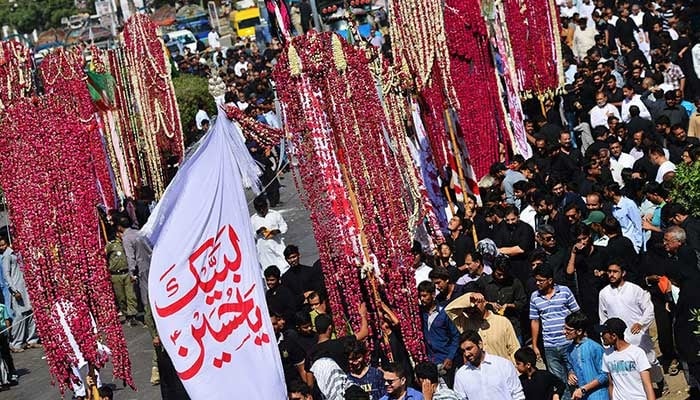
As Muslims worldwide remember the day of the martyrdom of Imam Hussain (a.s) and 72 of his followers on the 10th of Muharram in Karbala, southern Iraq, events from the night before delivered a memorable message. Together, events before and after Ashura have preserved the legacy of that monumental tragedy for times to come.
Just before sunset on the 9th of Muharram, almost 1400 years ago, the army of Yazeed ibn Muawiya, estimated to number between 30,000 and 70,000, began advancing for a final attack on Imam Hussain’s camp, where women, children and loyalists who travelled to Karbala were assembled.
As martyrdom looked imminent, Imam Hussain (a.s) asked his younger brother Hazrat Abbas (a.s) to seek a delay in the enemy’s attack till the next morning. Historians have widely recorded three equally significant reasons for the delay.
First, Imam Hussain (a.s) sought to spend another night in prayer as preparations for the martyrdom in Karbala began. The record of the prayers of Imam Hussain (a.s) on that tragic night still offers grounds to Muslims worldwide to relive the events of the final hours. It was an example that encourages those trapped in tragedies in contemporary times, notably in Gaza, Lebanon and Iran, to keep up their hope irrespective of the scale of the ordeals they face.
Second, Imam Hussain (a.s) assembled all of his companions under complete darkness. There, he granted permission to anyone seeking to depart under the cover of darkness rather than sacrifice their lives. Historical records show that no one left. It was an act to renew loyalty from the followers of Imam Hussain (a.s) who were carefully chosen by him.
Finally, Imam Hussain (a.s) chose to present himself and his followers in battle in the full glare of the day, to ensure a full record of their final encounter rather than meet their end in darkness. As explained in a private gathering by the late eminent Pakistani scholar Allama Talib Jauhari, the daytime battle was a conscious choice by Imam Hussain (a.s), to preserve the fine details of his martyrdom and that of his companions for historical record. In brief, “it was a strategic choice”, he noted.
Together, the choices made by Imam Hussain (a.s) that delayed the martyrdoms of Karbala by another night, highlighted his determination to ensure the remembrance of his legacy for the indefinite future. It is a legacy that is widely remembered almost fourteen centuries later.
Throughout the day of ‘Ashura’, historical accounts suggest a continuation of the martyrdoms one after another. Even the afternoon ‘zuhr’ prayers, according to historical accounts, saw some of the followers of Imam Hussain (a.s) embrace martyrdom while protecting the prayer congregation he led.
And just before the late afternoon martyrdom of Imam Hussain (a.s) came his last sacrifice of the day. As he carried Hazrat Ali Asghar (a.s.), his six-month-old infant son, to face the enemy soldiers, Imam Hussain (a.s.) sought water for the visibly starved baby. The event followed the contingent of Imam Hussain (a.s) being deprived of water for three days from 7th Muharram onwards.
Sensing an immediate anxiety among his troops, Umar ibn Sa’ad, the commander of the army of Yazeed ibn Muawiya, ordered his lead archer, Hurmula, to aim for the baby’s jugular. Left unaddressed, Umar ibn Sa’ad feared a rebellion among his troops, notably after earlier that day when Hazrat Hur ibn Yazeed al-Riyahi, another commander from Yazeed’s army, defected with his son to fight alongside Imam Hussain (a.s).
To this day, visitors to Karbala first pay their homage at the shrines of Imam Hussain (a.s) and Hazrat Abbas (a.s) before venturing on to visit locations including the shrine of Hazrat Hur ibn Yazeed al-Riyahi. His remarkable choice on the day of the battle has repeatedly highlighted the transformation in the fate of Hazrat Hur ibn Yazeed al-Riyahi from a follower of evil to one who gained salvation.
Any discussion on events in Karbala will remain incomplete without a detailed mention of the fate of the women and children left behind after the martyrdoms. Accounts of their agony are multifaceted. Their tragic journey from Karbala to Kufa to the court of the regional governor Ubaidullah Ibn Ziyad and onwards to Damascus to the court of Yazeed ibn Muawiya began the day after the massacre. During the previous night, their tents were burnt and their few worldly belongings snatched by the soldiers of Yazeed’s army.
One of the many heartbreaking accounts of their journey to Damascus rests upon the failure of historical accounts to reliably report the number of underage children who left Karbala versus the number who finally arrived at their destination. Along the way, numerous accounts report cases of underaged children who fell off the camels upon which they were tied, together with their mothers.
Even caught in the gravest moment surrounding the survivors, the courage shown by Sayyeda Zainab binte Hazrat Ali (a,s), the younger sister of Imam Hussain (a.s) is preserved in history as an exemplary show of defiance. Facing Yazeed ibn Muawiya in his Damascus court, she rebuked him and said, “By the grace of God, you will never erase our name or remove our revelation. This stain of shame will never be removed from you. Your stand is hollow, your days numbered and your gathered forces will soon be shattered”. The empire of Yazeed ibn Muawiya collapsed after he died within three years of the battle of Karbala.
The words of Sayyeda Zainab (a.s.) came true, leaving behind not only a powerful lesson but also a legacy well preserved in history. Her words must encourage all those struggling today to keep up their hope, notably if they follow a just cause, for justice to be delivered sooner or later.
The writer is an Islamabad-based journalist who writes on political and economic affairs. He can be reached at: [email protected]