Right now, the Pacific Ocean is quiet. We are in a neutral phase of the El Niño cycle, that vast natural warming of the Pacific that flips every few years with its cooler twin, La Nina. But our Met Department and the regional climate forum are warning that El Nino is likely to develop during this very monsoon season, bringing hotter-than-normal temperatures across South Asia.
When most people hear the words climate disaster in Pakistan, they picture 2022, when a third of the country went under water. But that is the end of the story, not the beginning. For Pakistan, El Niño does not arrive with floods. It arrives first with heat, then with drought, and only then, when the country is already exhausted, with the water.
Here is what makes this so dangerous. El Nnño is natural, it has always happened, but it now lands on a fundamentally hotter world. The last El Nino helped make 2023 the second-hottest year ever recorded, and 2024 the hottest in human history. Every cycle now runs hotter than the last because the baseline keeps rising.
The first blow is heat. From April to June, the pre-monsoon spike pushes temperatures in Sindh, southern Punjab and Balochistan towards 52 degrees. Agriculture is nearly a quarter of our GDP and around 40 per cent of our jobs, and temperatures above 40 degrees cut wheat yields, stunt rice before it can flower and kill livestock left without shade or water. The power squeeze follows close behind because low reservoir levels mean less hydropower at the exact moment cities run their fans and air conditioning around the clock. Loadshedding stretches to 14-16 hours a day. Factories fall idle, export orders slip and cold storage fails.
And then labour itself stops. You cannot work a field, a building site, or a brick kiln at 50 degrees. The daily wage economy, which is the economy most Pakistanis actually live in, has no sick pay, no insurance and no savings buffer. A labourer who loses three weeks of work to the heat in June does not earn that money back in July. The hospitals fill long before any flood arrives, with heatstroke patients coming in waves, dengue spreading as mosquito season lengthens, and intensive care units losing power in the same loadshedding that hits everyone else.
Only after all of this does the flood arrive, and this is the point we keep missing. The flood does not land in a healthy country. It lands on one already on its knees, its crops gone, its reservoirs empty, its grid failing and its hospitals full. A sudden cloudburst or a glacial flood then destroys whatever the drought had already weakened. That is the difference between an emergency and a collapse. It is not the size of the flood, it is the state of the system the flood lands on. In 2022, the floods submerged a third of the country and erased close to 10 per cent of our GDP. These are not background events; they are among the most destructive disasters in our history.
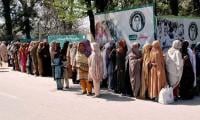
But even the flood is not the lasting wound. The lasting wound is displacement. In 2022 alone, around 33 million people were uprooted, and here is the truth we rarely say out loud: these people do not go home. The water recedes, the cameras leave, and they remain displaced. Every single month, in their hundreds and often their thousands, climate-displaced families make their way to Karachi and the other big cities, and they do not arrive in homes; they arrive in slums.
The coast is being swallowed, with over 1.2 million people displaced from the Indus delta in two decades, and Karachi is projected to absorb 2.3 million climate migrants by 2050. In Quetta, the water table is dropping two to five metres every year, pushing families towards Sindh and Punjab. In the north, glacial floods destroy homes for good, and those families flow into the cities as well.
This is where our failure becomes a scandal. A person forced from their home by climate, yet still inside their own country, has no binding protection. So the fastest growing category of displaced person in the country is also the most invisible, with no legal status, no entitlements and no plan. They are quietly reshaping our cities – and we are governing as though we cannot see them.
None of this, in the end, is really a weather problem. It is a governance problem. We have built almost everything around relief, the tents, the rations, the helicopter shots over the water and almost nothing around prevention. The money and the attention arrive only once the disaster has already happened. Worse, we work in silos. The disaster authority handles the flood, health handles heatstroke, agriculture handles crop losses, the climate ministry handles policy – and nobody owns the chain connecting them all.
It does not have to be this way, and the proof is right next door. Bangladesh, a poorer country than many assume, turned the deadliest cyclones on earth into survivable events through early warning systems, a vast network of shelters, and a volunteer force that is half women. When Cyclone Mocha struck in 2023, it moved 700,000 people to safety before landfall, a feat of preparation, not of relief. We can do the same. We can scale early warning systems nationwide, send cash to families before the flood rather than months after and treat the relocation of the delta and the drought belt as a managed right rather than a desperate scramble.
We cannot stop El Nino but we can absolutely stop turning every flood into a humanitarian collapse. This is a choice we have to make before the flood, not after.
The writer is an environmentalist.