Read the FY2026-27 federal budget closely and a pattern surfaces. The state has become very good at raising money in the name of the climate. It has not become good at spending it.
‘Budget in Brief 2026-27’ projects roughly Rs2 trillion from climate- and green-linked levies next year. Petroleum Levy alone accounts for Rs1.68 trillion. Add a new Climate Support Levy of Rs50 billion, an EV Adoption Levy of Rs22.5 billion, the Gas Development Surcharge at Rs70.8 billion and oil and gas royalties of Rs140.5 billion. Against all of that, the same document tags Rs214 billion for direct climate spending, excluding subsidies. The state collects roughly ten rupees in green revenue for every rupee it commits to climate action (on paper). The rest funds the treasury.
The composition is the tell. Adaptation, the money that prevents damage, fell 17.5 per cent to Rs70.5 billion. Mitigation collapsed by almost 80 per cent. Disaster spending went the other way, rising 132 per cent to Rs116 billion, with a reconstruction line that did not exist last year. The budget is now better funded to clean up after a flood than to mitigate one. Prevention is invisible when it works. Reconstruction photographs well and briefs even better in a negotiation room. Think about that for a moment.
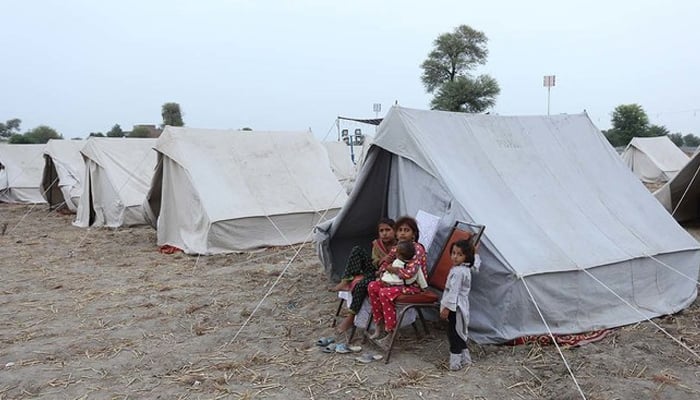
This is where the numbers turn into talking points. The 2022 floods produced figures that travelled the world with the then climate minister and other leadership. Over $30 billion in damage and losses, $16.3 billion in reconstruction needs, 33 million people affected, more than 1,730 dead, a lake formed in the middle of the country, 100 kilometres wide. These numbers made Pakistan’s case at COP27 and made it a pathfinder for the Loss and Damage Fund. The danger is that the country starts to treat its disasters as an asset class, reciting the death toll abroad more fluently than it funds the embankments at home.
The gap has become a credibility problem. Pakistan tells the world it needs $40-50 billion a year to adapt. The World Bank puts the wider climate investment bill at $348 billion by 2030. The adaptation Pakistan funded itself this year is about $0.25 billion. When a finance minister asks Bonn or Belem for more, the obvious question follows him into the room: what happened to the Rs2 trillion you raised?
Then there is solar, where the contradiction is sharpest and least understood. Pakistan has imported roughly 45 gigawatts of panels in five years, close to the entire installed capacity of the national grid. Rooftop solar now lets the highest-paying customers walk away. By the government’s own count, net-metered users had shifted Rs159 billion in costs onto everyone else by end-2024, a figure projected to reach Rs4.24 trillion by 2034 if left untouched (hence the shift to net billing). As they exit, the bill for idle thermal plants lands on those who cannot afford to leave.
This is why the energy policy and the climate policy are pulling against each other. One hand runs the Off-the-Grid-Levy, an IMF benchmark that pushes industry off captive gas generation and back onto the grid, climbing to 20 per cent by August 2026. The IMF has tied relief on that levy to a single condition: grid demand must not fall. The other hand watches solar do exactly what the levy is built to prevent, which is to drain the grid. The budget floated a 18 per cent (an 8.0 per cent increase) levy on solar, then retreated to 10 per cent under public pressure.
The whiplash, 10 to 18 to 10, is its own confession. The government wants the green-energy-transition its NDC promises, and it wants the grid revenue solar erodes. It cannot have both.
None of this is hidden. It is printed in the budget tables, in the levy notifications, in Pakistan’s own flood assessment. The honest reading is that climate has become a line of revenue and a line of argument, and only rarely a line of defence. The monsoon does not read budget documents. It will arrive on schedule, test what was built and leave behind a fresh set of numbers.
The question worth settling before then is whether we mean to spend on resilience, all the way down to the district level, or simply to bill for it.
The writer is a partner at Tabadlab and runs their climate portfolio. He can be reached at: [email protected]