Originally from 7th-century Arabia, the ghazal spread to Persia in the mid-8th century and subsequently to Europe and the Subcontinent. Its transformation from a literary to a musical form in the 12th-century Subcontinent and its proliferation across diverse languages such as Urdu, Hindi, Telugu, Tamil, Gujarati, Punjabi, Bengali, Spanish, Hebrew, English and German speak to its ability to permeate national, ethnic, and linguistic domains.
The ghazal’s role in courtly settings, performed by courtesans in Mughal-era mehfils and kothas, situates it within the socio-political landscape of South Asia, initially reserved for elites before its spread in the 18th and 19th centuries. This socio-economic shift was catalysed by urban centres like Lucknow and Delhi and by the contributions of artists such as Begum Akhtar, and poets such as Mirza Ghalib and Mir Taqi Mir, mirroring the broader distinctions of class and social exclusivity in South Asia. The advent of print media, gramophone recordings, cassettes and record players in the late 19th and 20th centuries further enabled the ghazal to traverse these class boundaries.
Similar in structure to the Petrarchan Sonnet – rhyming couplets with independent contexts, unified by ‘radifs’, portrays the structural versatility of the ghazal, which encapsulates its adaptability to shifting purposes and audiences. The ghazal’s performance modes: Taranum in mushairas, qawwali and so on highlight its ability to encode and traverse religious, philosophical, and emotional meanings, transforming according to ritual context. The art song tradition, especially as performed by courtesans during the Mughal era, highlights the ghazal’s interpretive openness and its capacity to foster interpersonal and collective experiences.
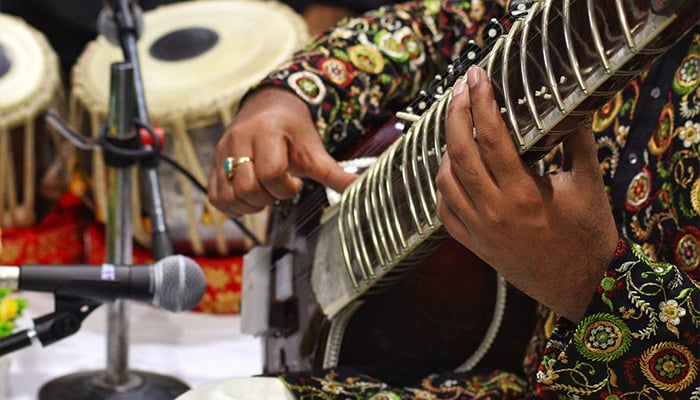
This interplay between the soloist, sarangi, tabla, and harmonium not only serves musical aesthetics but also reflects the social dynamics that mark the performance. Thus, the ghazal emerges as an evolving, dynamic poetic form whose traversal of social and contextual boundaries is shaped by audience, intent, and content, thus making it a suitable means for analysing the socio-political landscape of identity and technological change.
One ghazal I want to address is ‘Hum Dekhaingay’ meaning “We shall witness,” originally written by Faiz Ahmed Faiz and later performed by Iqbal Bano in a revolutionary artistic expression in 1986 Pakistan as an act of resistance against General Ziaul Haq’s oppressive Islamisation regime, which curtailed freedom of speech and imposed regressive laws on women.
Bano, the solo vocalist dressed in a white sari, is accompanied by three male instrumentalists: tabla, harmonium and sarangi. Faiz uses intense religious imagery and promises an inversion of socio-political roles in which the oppressed will be crowned and seated on high cushions while oppressive authorities will be held accountable for their tyranny.
The poem begins with three repetitions of the phrase ‘we too shall witness’, and the instruments follow the song’s flow. Bano then phonetically extends the verses, evoking agonising longing and yearning and emphasising the anticipation of the Day of Judgment, when this promised justice will be meted out. The sarangi creates a deeply melancholic sound that echoes the yearning in Faiz’s verses and the political context of the time.
In its traditional context, the ghazal expresses longing and yearning for a romantic lover. Faiz’s ghazal, however, expresses yearning for an idealistic, utopian, politically just society in which institutions like democracy are strong enough to destabilise oppressive and fascist regimes.
Another notable contemporary rendition of the ghazal form is Arooj Aftab’s ‘Mohabat’, originally written by Hafeez Hoshiarpuri in the 1920s. Aftab’s Grammy-winning, jazz-inspired version is deeply poignant and evokes the classical sentiment of longing and separation from the beloved. Her arrangement is distinct from traditional ghazal renditions: she strips the song to minimal instrumentation and relies heavily on the melancholic quality of her voice to convey unresolved longing and desire. The song includes long silences in which the instruments continue to play while she stops singing, creating an illusory and temporal suspension of time. Unlike the classical ghazal, where the lover is identified as an object of desire and longing, ‘Mohabat’ departs from that context, presenting love and longing as existential states rather than emotions associated with a person.
The ghazal’s narrative offers a broader philosophical interpretation of love, as Aftaab compares the pain of her personal separation from the loved one to that of society and conveys that, regardless of her personal separation, society’s grievances and suffering will not end, and that, irrespective of her own loss, lovers will always be reborn.
Both Bano and Aftab’s ghazals, although disparate in context and narrative, capture the ghazal’s central purpose: to express separation, longing and loss within socio-political contexts, whether that context is a person, a state of being, or a political revolution. I found the two ghazals echoing our discussions on the Buddhist concepts of karma and relational selfhood. In Iqbal’s ghazal, death becomes a day of reflection and a day of promised justice for societal moral wrongs; the actions and decisions made in this lifetime reverberate in society, and a person’s life is not merely individual but has larger consequences.
Political dissent and unjust fascist regimes, such as the one Bano opposes in Faiz’s ghazal ‘Hum Dekhaingay’, capture the power of moral and relational selfhood and its ability to effect change by entering the collective consciousness of the masses. The self is formed in relation to others, and without a social context, or in the case of absence and separation, the self is at risk of loss. Thus, the thematic and sonic poignancy of the ghazal aptly conveys the broader socio-political contexts of South Asia, its notions of relational selfhood, and the detrimental impact of the rupture of the socio-political order.
The writer is a student at the University of California, Berkeley.