Last Friday morning saw SpaceX listed on the NASDAQ. At an initial valuation of $1.75 trillion, it was the largest Initial Public Offering in history.
When the market closed, it ended the day up valued at $2.1 trillion, thereby creating the world’s first trillionaire. That is more than five times larger than Pakistan’s GDP of $411 billion and two-and-a-half times the estimated size of the economy, including the informal sector, of approximately $850 billion.
Meanwhile, nine time zones to the east in Islamabad, the finance minister was presenting the $67 billion federal budget proposal for FY27, and I could not help but think what a massive contrast of numbers.
Like every year, many people will be dissecting the budget. I am going to focus on the education sector and review the Pakistan Economic Survey (PES) 2025-26, which covers ‘accomplishments’ presented for FY26, as well as the federal budget, which is an indicator of true priorities for the coming FY27. Let’s begin with the PES. My overall impression of the report is that it: 1) makes substantial claims completely unsupported by evidence and in some cases even contradictory to its own reporting elsewhere; 2) focuses on expenditure versus outcomes and impact; 3) the government is just not serious about prioritizing education in its budgetary spending, period; and 4) claims superficial achievements. Let me break it down.
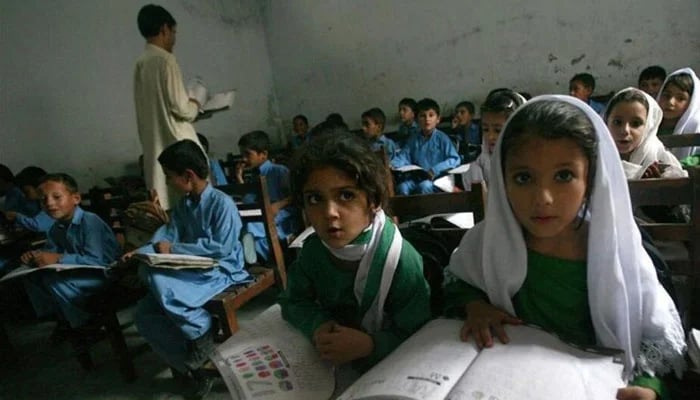
One of the most basic yet vital statistics, out-of-school-children (OOSC), has become contested or uncertain over the past year. In February 2026, a report released by the Ministry of Federal Education and Professional Training (MoFEPT) put the number at 26.2 million, up from the long-quoted 25 million. Yet, the PES claims that the percentage of children out of schools has gone down from 38 per cent in 2023 to 28 per cent in 2025. Take your pick to suit your narrative. That 10 per cent reduction translates to almost seven million children out of 25 million. This is a huge assertion, with no evidence to back it up. It even contradicts some of the other reported numbers in the PES 2025-26. As a reader, I can be forgiven for not believing this claim.
On the higher education side, major achievements claimed in the PES include things like a raft of scholarship programs (ten of them), a research funding program, establishment of Business Incubation Centers (BICs) and Offices of Research, Innovation and Commercialisation (ORICs), organising some professional development programs, distributing laptops to university students, and a number of minor items. The year-round rhetoric about impact does not align with the year-end expenditure reporting.
If I had to describe the Higher Education Commission (HEC) based on what it considers its achievements in the PES, I would call it a mechanism for the disbursement of funds and goodies, anything but a regulator charged with tracking or enhancing the quality of higher education. The lack of commitment to make efforts to achieve substantial improvements in school and higher education is seen in two indicators.
First, everyone, including politicians, bureaucrats, parents and students, knows what the outcomes of a good education are: school students who are literate and numerate, understand the world they inhabit, can reason, express themselves, and solve original problems and challenges.
For university graduates, whose next step is often to start their working lives, the expectation is that a university education will make them hireable or enable them to pursue an entrepreneurial path. Metrics that track success after graduation include the unemployment rate a year after graduation and average starting salaries. If you want to know how a university is doing, if you want to know how well a programme prepares students for working life, if you want to decide whether a university programme is worth the time, cost and effort, these are the (measurable) metrics we care about. And as I said in my previous op-ed, you cannot improve outcomes you do not measure or track.
For 11 months of the year, we instinctively know these things. Then comes the end of the fiscal year, and in a blink, everyone in government turns into a moron who cannot think of the right questions to ask to hold the education bureaucracy accountable. Instead, the yardstick of performance changes to ‘how much money have you spent?’ That is why the accomplishments listed in the PES are meaningless for the mission of a regulator tasked with improving substantive outcomes of university degree programs.
Second, is the government’s expression of its priorities in its budget for the coming fiscal year. On the issue of education, next year looks a lot like the previous year. Spending on education as a percentage of GDP has been steadily declining from 1.9 per cent in 2019-2020 to just 0.8 per cent in 2024-25, a far cry from the 4-6 per cent of GDP recommended by Unesco and the commitment to allocate 4.0 per cent in every party’s pre-election manifesto.
The current expenditure for FY27 in the federal budget (excluding provincial spending) is proposed at Rs118 billion for all education, almost unchanged from the previous year’s initial allocation of Rs113 billion, but significantly down from the revised Rs169 billion. Development expenditure on education is proposed to be Rs76 billion, up from last year’s revised Rs53 billion.
These numbers include federal spending on higher education. Current expenditure of the HEC is Rs66 billion, virtually unchanged not only from last year, but since 2017. In the meantime, of course, inflation has risen significantly, the rupee-dollar parity has fallen from 1:107 to 1:280, enrolments have expanded, salaries and benefits have tried to catch up, and operational costs (eg, electricity, petrol, etc.) have multiplied. No wonder universities are going bankrupt.
While the development budget has edged up slightly from Rs39 billion last year to Rs46 billion, it has not risen above past highs, although the standard practice is to withhold releases, especially in the 3rd and 4th quarters, resulting in lower actual allocations during years in which the initial allocation is higher than past trends. It is a curious fact that every government, regardless of its provenance, is equally indifferent, if not outright hostile, towards education.
To my fourth observation, school enrollment numbers are marginally up for primary, middle, high, higher-secondary schools, degree colleges, vocational institutions and universities, but are down for pre-primary – not a positive sign in a country with a healthy population growth rate. The number of educational institutions has also increased marginally across most levels, except for primary and middle schools. School attendance rates for males, females, urban and rural areas are all up from 2018-19. Over the same period, primary school completion rates have gone up across provinces.
It reports availability rates of essential facilities (electricity, drinking water, toilets and boundary walls) in primary, middle, high and higher-secondary schools for all provinces (based on data from 2023-24). Notably, Punjab reports availability rates of all facilities at all levels of schools between 99 and 100 per cent - all great news if that is indeed accurate.
Yet the national literacy rate, the key, if somewhat crude, performance indicator for education, remains stubbornly stuck at 63 per cent, smack in the middle of the 60 to 65 per cent range that is usually quoted. Translation: There are fluctuations in numbers here and there, but the broad reality of school-level education remains unchanged.
They say that there are some things which, try as you might, you cannot polish to a shine. Until we demand accountability for the metrics that actually matter, our education sector will remain one of them.
The writer (she/her) has a PhD in Education.