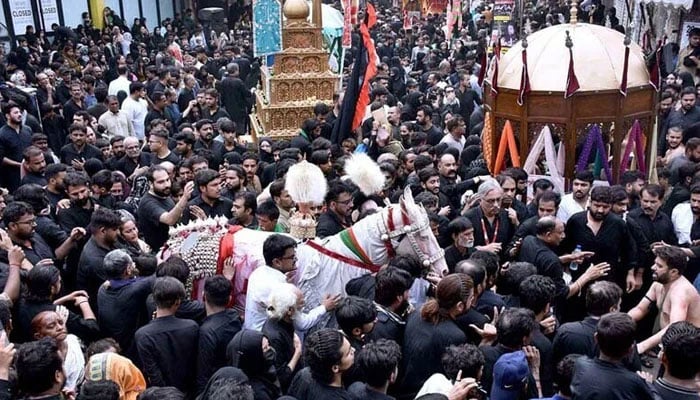
The annual remembrance of the epic battle between Imam Hussain (a.s) and 72 of his followers versus the army of Yazeed ibn Muawiya began worldwide this week with the arrival of Muharram, the first month of the Islamic calendar. The occasion marks an important milestone to renew the spirit of sacrifice and powerfully reaffirm the message of the prevalence of good over evil.
The remembrance received a significant boost because Imam Hussain (a.s) was the grandson of the Prophet Muhammad (pbuh). His martyrdom, therefore, is widely remembered as a forceful display of defiance by the household of the Prophet Muhammad (pbuh).
This Muharram has arrived at a time of widespread use of oppression across the world, notably the Israeli onslaught in Gaza and Lebanon and the US-Israeli war on Iran. The stand taken by Imam Hussain (a.s) in Karbala also serves lessons for Muslims and non-Muslims alike worldwide. It is hardly surprising that the memory of events in Karbala has been honored by Muslims and non-Muslims alike, in works of poetry and celebrations of its history.
From the outset at Karbala, the odds were stacked against Imam Hussain (a.s) and his followers. Yet the moral high ground he took won him and his followers a permanent place in the history of the universe. It was on the 10th day of Muharram, widely known as ‘Ashura’, when Imam Hussain (a.s) and his followers, ranging from the elderly to the middle-aged, the young and even a six-month-old infant, were brutally slaughtered in Karbala, southern Iraq. The event is remembered as the worst massacre in a single such incident in global history.
Despite the passage of almost 1400 years since that terrible tragedy, its annual remembrance has inspired an increasing number of followers to join the crowds of mourners worldwide. Reliving the memory of Karbala with each passing year promises to inspire generations to come, notably those fighting against tyranny around the world.
After the massacre, the family members of the martyrs including women, children and a lone adult male, Imam Zainul Abideen (a.s), the only surviving son of Imam Hussain (a.s) were captured and taken in cruel conditions to Kufa and Damascus.
Unlike many other conflicts in history whose memory has faded over time, the clash in the desert of Karbala gains fresh, broader appeal every year. The history of Karbala itself highlights a powerful transition from a remote locality built upon sandy dunes to a thriving urban centre. Karbala serves as a magnet for millions of worshippers who visit the city throughout the year to pay homage to Imam Hussain (a.s) and his followers. Every step of this journey serves as a vital stop in the events of ‘Ashura’. The congregations peak in the days just before ‘Ashura’ and subsequently on ‘Arbaeen’, the 40th day after the martyrdom of Imam Hussain (a.s) and his followers.
Traditions such as ‘mishi’ – a walk from the city of Najaf, the final resting place of Hazrat Ali (a.s), to Karbala covering a stretch of just over 100 kilometres – have become increasingly popular among pilgrims. Upon reaching Karbala, locations such as ‘Tila-e-Zainabiya’ – the vantage point from where Bibi Sayyeda Zainab (a.s), the younger sister of Imam Hussain (a.s) watched her brother’s last stand till his martyrdom and the severance of his head, stands as a powerful reminder of the sacrifice made by women from the household of Prophet Mohammad (pbuh).
Not too far stand ‘Maqamat e Kaff al-Abbas’, the two shrines nearby where the two arms of Hazrat Abbas (a.s), the younger brother of Imam Hussain (a.s) were severed. These shrines precede visits to the mausoleum of Hazrat Abbas (a.s).
Accounts from the tradition of pilgrimage at the final resting place of Hazrat Abbas (a.s) serve to reinforce the profile of the brother of Imam Hussain (a.s). Below lies the actual burial place of Hazrat Abbas (a.s), which is remembered with accounts of a stream of water in its surroundings that continues to flow without interruption. To this day, researchers have failed to discover the source of that water, thus reinforcing its status as a living miracle. Within a short walking distance from here lies the spot where Hazrat Ali Akbar (a.s), an adult son of Imam Hussain (a.s), was brutally martyred. His final resting place, visited by scores of pilgrims, lies within the compound of the final resting place of Imam Hussain (a.s).
An especially heartbreaking spot remains the location of the martyrdom of Hazrat Ali Asghar (a.s), the six-month infant son of Imam Hussain (a.s). Just before his own martyrdom, historical accounts report Imam Hussain (a.s) carrying the infant in his arms to face the army of Yazid ibn Muawiya. And when Imam Hussain (a.s) sought water for the baby who, like the rest of the members of his clan, was deprived of water for three days, Hazrat Ali Asghar (a.s) was martyred by Hurmula, an expert archer in the army of Yazeed ibn Muawiya, using a three-pronged arrow typically reserved for targeting of horses in battle.
Once the battle ended, it was the turn of the survivors of Karbala to face the wrath. Their tents were burnt in the evening after the massacre. The next day, the survivors were rounded up and taken to Kufa, to the court of Ubaidullah ibn Ziyad, the regional governor of Yazeed, and then to Damascus, to the court of Yazeed ibn Muawiya, to be presented as spoils from the battle.
In the aftermath of that massacre, Yazeed ibn Muawiya and his successors went out of their way to erase the memory of events at Karbala. But the remembrance of Imam Hussain (a.s) and his followers, almost 1400 years later, serves to reinforce the righteousness of their mission and their duty in Islam.
The writer is an Islamabad-based journalist who writes on political and economic affairs. He can be reached at: [email protected]