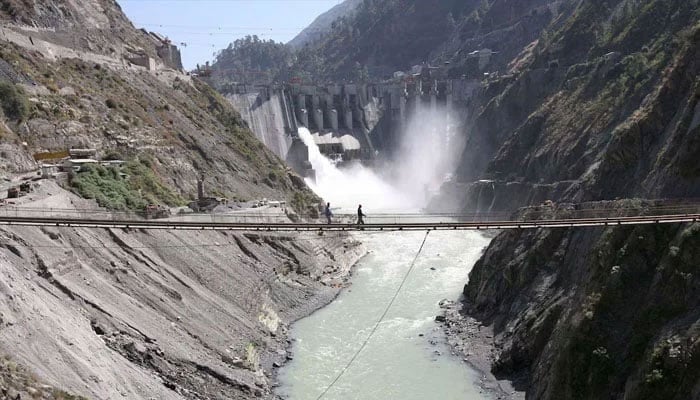
The next war in South Asia will be over water and it looks like as if the Modi government has already made up its mind to go that way. By walking away illegally from the World Bank brokered Indus Waters Treaty, India has made its intentions clear.
The unilateral holding of the IWT in abeyance was preceded by the usual wolfish accusations by a prevaricating upper riparian that started by accusing the lower riparian of terrorism and then, without waiting for a response, went ahead and choked its water supply.
Pakistan is fully entitled to the water flowing from the three Western rivers under the IWT, having forfeited its share of the three eastern rivers – Ravi, Beas, and Sutlej. Now India has started slowly and steadily encroaching on the flow of the western rivers, whose waters, under the IWT, were guaranteed solely to Pakistan. According to Article III (2), “India shall be under an obligation to let flow all the waters of the western rivers, and shall not permit any interference with these waters.” The only exception to the above is the use of water under specific conditions, as enshrined in Annex C of the treaty, for domestic, non-consumptive, agricultural and hydroelectric projects, without altering the overall flow of the rivers.
Indians have constructed the most dams and reservoirs on the eastern rivers since the 1960s, thereby gaining the capacity to choke the entire flow of these rivers in Pakistan, leaving nothing even for the minimum environmental flow. The major dams on the eastern rivers include Bhakra, Nangal, Koldam, Karcham Wangto, Nathpa Jhakri (on Sutlej), Pratap Sagar and Pandoh (on Beas) and Ranjit Sagar, Madhopur Headworks, Shahpur Kandi, Chamera I, II, III dams (on Ravi).
The lack of minimum environmental flow in Pakistan is causing the death of aquatic ecosystems and depleting aquifers around water-stressed cities like Lahore. Incendiary statements by Indian politicians are also indicative of an ideologically driven mindset that uses communal hatred as a business model to win elections. The externalisation of the same policy in foreign relations with neighbours is reflected in India’s behaviour vis-a-vis Pakistan on all contentious issues. In a time of climate-induced water scarcity, when joint watershed management and environmental cooperation should be the norm, India is rattling the water sabre.
The latest caper is the plan to divert water from River Chenab to River Beas. Recently, India’s government-owned National Hydroelectric Power Corporation has issued a tender notice for a proposed 8.7-km-long tunnel project that would transfer water from the Chenab River to the Beas Basin. India is also planning to remove sediments from the Salal Dam to enhance water storage capacity.
At present, India does not have the capacity to divert flows from the western rivers, except by withholding water release timings. This new announcement of a tunnel to divert the water from River Chenab to the Beas, however, has the potential to alter the volume of the flow too.
The work, however, on the controversial project cannot start before mid-2027 and would take around five years to complete, provided all engineering and topographical challenges are surmounted. Indians would definitely encounter engineering and resource challenges, but where such kind of ideology drives policies, anything is possible.
The project has the potential to initiate a war between India and Pakistan, as Pakistan regards such an act as an act of war. India brought the two nuclear states to the brink of war last year, on a spurious terrorism accusation and with this Link 3 tunnel project for water diversion, it is again crossing the restraint Rubicon of Pakistan.
Indians are terming this water diversion as the removal of the ‘surplus flow’ of the River Chenab through a 19-meter-high barrage at Lahaul-Spiti in Himachal Pradesh, to divert 1.9 million maf of water to the Beas, and from there onward to a network of canals in the arid regions of Rajasthan, Punjab, Haryana and Delhi.
Since there is no legal definition of ‘surplus capacity’ in the IWT, Pakistan is well within its rights to claim that the Indian act violates international law. In engineering terms, surplus water is the water flow from glacial melt or the precipitation in the river in the peak flow period, which is in excess of the storage or power generation requirements downstream. Since the water is exclusively allocated to Pakistan for agricultural and other uses, India has no legal right to divert the river’s flow.
The tender for the project was issued on May 20, 2026 and cancelled on May 23, but stayed on the active list with the Himachal governor, who endorsed it. No environmental, forest, tribal or Garam Saba clearances have been sought, while the locals of the area are also opposing it. Pakistan needs to lodge a formal demarche invoking the Permanent Indus Commission process, while demanding design data and bringing the Link-3 tunnel project within the Court of Arbitration proceedings.
Pakistan also needs to engage the World Bank as a treaty broker and appointing authority. Pakistan should immediately compile a list of all contracting companies that submitted tenders as competing entities for the controversial project, and then serve legal notices to each individually for violating the law.
The above legal actions would be a concrete and tangible manifestation of Pakistan’s resolve and the will to employ all options to safeguard its water security. The writer is a security and defence analyst. He can be reached at:[email protected]