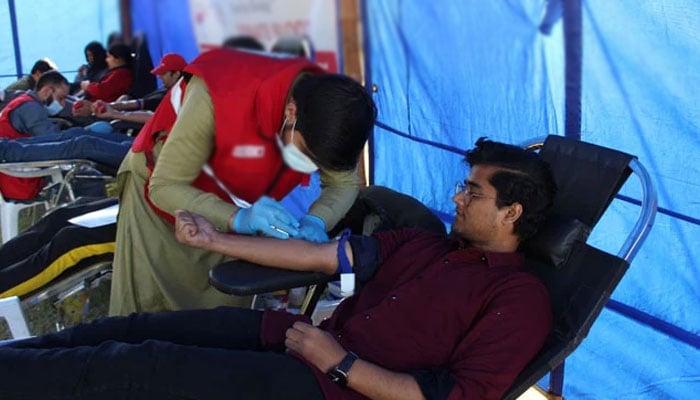
ISLAMABAD: Less than eight per cent of blood donations collected in Pakistan come from voluntary donors, compared with more than 85 per cent worldwide, leaving the country heavily dependent on patients’ relatives and friends for life-saving blood transfusions.
Pakistan collected 1.59 million blood donations in 2023, but only 126,172 were made by voluntary unpaid donors, accounting for just 7.9 per cent of the total. In contrast, 878,189 donations, or 55 per cent, came from family or replacement donors, while another 590,887 donations were reported under other donor categories.
The figures are contained in the World Health Organisation’s Global Status Report on Blood Safety and Availability 2025, which assesses blood collection, safety and transfusion services in 168 countries representing 97 per cent of the world’s population.
The report estimates that more than 120.4 million blood donations were collected worldwide in 2023, with 85.4 per cent of all donations coming from voluntary unpaid donors. Family or replacement donations accounted for 13.5 per cent globally, highlighting how far Pakistan remains from international norms.
Health experts regard regular voluntary donors as the safest and most reliable source of blood because they donate repeatedly, undergo routine screening and generally have lower rates of infections that can be transmitted through blood transfusion.
Pakistan’s continued dependence on replacement donors means patients often have to arrange blood through relatives and friends before undergoing surgery, cancer treatment, thalassaemia care, emergency trauma treatment or management of severe bleeding during childbirth.
The report notes that data submitted by Pakistan came from 272 blood establishments and covered around 84 per cent of the country’s blood collection system.
The WHO findings also highlight the burden of blood-borne infections among people presenting to donate blood.
Of 1,555,462 blood donations screened in Pakistan during 2023, 31,325 tested positive for hepatitis C, 20,668 for hepatitis B and 2,423 for HIV. Another 18,514 donations were reactive for syphilis and 1,781 for malaria.
Together, the screening process identified more than 74,700 reactive test results for the five infections, representing nearly five per cent of all donations screened, although some donations may have been reactive for more than one infection marker.
Hepatitis C was the most frequently detected infection, found in 2.01 per cent of screened donations, followed by hepatitis B at 1.33 per cent, syphilis at 1.19 per cent, HIV at 0.16 per cent and malaria at 0.11 per cent. All reactive blood units are discarded and are not used for transfusion.
The report also points to the increasing use of blood component therapy in Pakistan. During 2023, blood centres prepared 839,354 units of red blood cells, 388,864 units of fresh frozen plasma, 237,500 platelet units and 92,122 units of cryoprecipitate for patients requiring specialised treatment. Pakistan also reported collecting 7,670 platelet units, 1,000 plasma units and 500 red blood cell units through apheresis procedures.
Globally, access to blood remains highly unequal. High-income countries, home to just 15 per cent of the world’s population, accounted for 36 per cent of all blood donations collected worldwide, while low-income countries, where around eight per cent of the global population lives, collected only two per cent of donations.
The median blood donation rate was 28.9 donations per 1,000 population in high-income countries, compared with only 4.5 donations per 1,000 population in low-income countries, underscoring persistent disparities in access to safe blood.
WHO has warned that many low- and middle-income countries continue to face shortages of safe blood because of inadequate financing, weak regulation and insufficient donor recruitment programmes. The organisation said expanding voluntary blood donation remains one of the most effective ways to improve both the safety and availability of blood supplies and reduce dependence on replacement donors.