ISLAMABAD: Pakistan Tehreek-e-Insaf (PTI) on Sunday sounded alarm over the new federal budget, warning that it would unleash a tsunami of taxes and push millions of inflation-hit and poverty-stricken citizens further below the poverty line.
It was noted that the past four years since April 2022 had been among the worst economically in Pakistan’s history and that despite regional economies registering growth rates of around six percent, Pakistan had failed to achieve even four percent GDP growth.
Moreover, the party lamented that inflation had surged to unprecedented levels, severely eroding the purchasing power of ordinary citizens and pushing millions into economic distress.
The party also made it clear in response to Prime Minister Shehbaz Sharif’s offer of talks and signing any accord and said that the premier should not expect PTI to enter into a Charter of Democracy similar to the one signed between the PPP and PMLN.
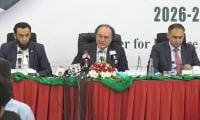
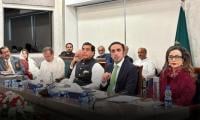
Speaking to a news conference here alongside PTI senior leader Taimur Khan Jhagra, MNA Mobeen Arif Jutt, and MNA Rana Atif, PTI senior leader and MNA Sardar Latif Khosa said the IMF-driven and elite-centric budget would further aggravate public hardship.
He said the proposed budget offered no meaningful relief to ordinary citizens and had been presented by an unelected Form-47 government, fearing the anti-people budget would not only deepen the suffering of the masses but also negatively impact the national economy.
Khosa questioned the government’s fiscal strategy, pointing to the ambitious tax collection target of Rs15.264 trillion set for FBR for FY2026-27, which represents a 17.6 percent increase over the revised target of Rs12.983 trillion for the previous year.
He asked how the government intended to achieve this target after failing to meet earlier benchmarks, warning that additional taxation would add further to the burden of taxpayers and potentially push millions of lower and middle income families below the poverty line.
Referring to the PM’s offer of a CoD with the opposition, Khosa questioned the outcome of the earlier CoD signed between martyred Benazir Bhutto and Nawaz Sharif in 2006, adding that not a single commitment of the accord was honoured.
He claimed that subsequent governments acted contrary to its spirit by weakening democratic norms and constitutional supremacy, eroding judicial independence, manipulating electoral processes, and restricting political freedoms, curtailing freedom of expression, reducing political space, and damaging the overall democratic framework.
Khosa claimed PMLN formed the government despite securing only 17 seats, while PTI was denied power despite winning over 180 seats in February 8 elections. He added that even PM’s authority had been reduced to the extent that routine political facilitation, such as arranging meetings with PTI founder Imran Khan, required special permission.
The PTI leader contended that his party workers and leaders had been subjected to political victimisation, with hundreds of cases registered against ex-PM Imran Khan, his spouse and associates, including Dr Yasmin Rashid, a cancer survivor.
He noted that instead of strengthening institutions and accountability, the government had reversed democratic gains, weakened the rule of law, and presented an anti-people budget that would further burden ordinary Pakistanis.
Speaking on the occasion, Jhagra, who is ex-finance minister of Khyber Pakhtunkhwa, slammed the government for increasing the petroleum levy to as much as Rs100 per litre, arguing that the move would have a cascading impact across all segments of the society.
He said that the elephant in the room was the ever-rising cost of running the state, arguing that if the government was serious about putting Pakistan on the path to prosperity, it would need to demonstrate the courage to slash extravagant expenditures. He stressed that without controlling state expenses, no meaningful economic relief could be delivered to the public.
Jhagra pointed out that salaries and administrative expenses of the federal government had surged to around Rs100 billion, and collectively with the provinces had crossed Rs1 trillion, while pension liabilities had also ballooned to nearly Rs1 trillion.
He insisted that Pakistan did not need such a budget, arguing that taking nearly Rs3,000 billion from the provinces while offering only minimal relief could not be considered a sound fiscal strategy. He said the government neither had a roadmap nor a coherent strategy to pull the country out of its economic difficulties.
Jhagra argued that instead of introducing reforms aimed at sustainable growth and public welfare, the government had continued to rely on excessive taxation and short-term measures, further aggravating the hardships faced by the people.
He said Pakistan’s official poverty rate had risen to 28.9 percent in the 2024-25 fiscal year from 21.9 percent in 2019, with around 70 million people now living below the national poverty line. He noted that the government had set the poverty threshold at Rs8,483 per person per month, while the internationally recognised benchmark of four dollars a day equated to nearly Rs33,000 per month.
Rejecting the government’s claims of economic recovery, he said exports had declined by six percent and investment by 26.5 percent, as most economic targets had been missed across key sectors.
Jhagra termed the budget a complete failure, saying the finance minister had offered only minor tax relief for the salaried class without presenting any roadmap for economic recovery. He added that despite presenting five budgets, the government had failed to introduce meaningful reforms.
He charged that the current arrangement, imposed to fix the economy, had instead deepened the crisis, adding that marginal tax relief was merely an excuse to delay structural reforms. He also questioned how provinces could fund education and healthcare if their fiscal share continued to shrink, and termed the budget “anti-people,” describing it as “a budget for the state, by the state, and from the people”.
Speaking on the occasion, PTI legislator Mubeen Arif Jutt said the government had failed to present any clear strategy for broadening the tax base or bringing new taxpayers into the net. He noted that the ruling coalition was presenting its fifth budget, yet had not delivered any meaningful relief to the public over the past five years.
He criticised the government’s decision to extend tax exemptions on solar vehicles for another year, questioning how such measures would benefit ordinary citizens. At the same time, he said, the authorities had imposed additional Federal Excise Duty to offset the revenue loss, arguing that this reflected the absence of any genuine relief-oriented approach in the budget.
Jutt said PTI supported faceless tax assessments and collections as a means to reduce corruption and discretionary powers. However, he expressed concern that the proposed legislation lacked safeguards for taxpayer privacy and accountability. Instead, he stated that it merely concealed the identities of tax officials conducting audits, limiting transparency to the extent that even courts would have restricted visibility over audit processes.
He questioned how such measures could ensure justice, arguing that the government appeared more focused on protecting officials than reforming the taxation system.
He said the economic situation had become so severe that every Pakistani, whether rich or poor, was facing mounting financial pressure. “In such circumstances, lofty claims of saving Pakistan from default ring hollow when the people themselves are already overwhelmed by economic distress,” he added.
On the occasion, another party lawmaker Rana Atif questioned the government’s claims of economic stabilisation, arguing that the ruling coalition had imposed unprecedented taxes over the past five years while failing to implement meaningful structural reforms. Criticising the sharp increase in sales tax, he said the government had failed to advance long-promised power sector reforms.
He claimed that circular debt, which was temporarily reduced through heavy bank borrowing, had again surged alarmingly, whereas exports declined by nearly $2 billion, while they had increased by $8 billion under PTI, ruling out economic stability without political stability.