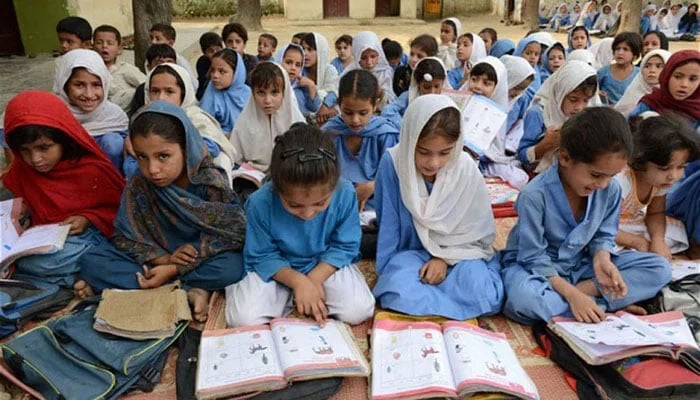
Let us begin with two numbers from Pakistan’s Economic Survey 2025-26, released a day before the federal budget. Public spending on education: 0.8 per cent of GDP. Public spending on health: 0.8 per cent of GDP. Together, the two sectors most critical to human development, productivity and long-term prosperity account for just 1.6 per cent of national income.
Pakistan’s Vision 2025 envisaged education spending of 4.0 per cent of GDP. Unesco recommends a similar benchmark. Most emerging economies spend more on education alone than Pakistan spends on education and health combined.
These are not merely low numbers. They are declining numbers. Education spending has fallen sharply in recent years. Health spending has stagnated. Yet this is before the full impact of the FY2026-27 budget is felt.
This year’s budget requires provinces to generate approximately Rs1.9 trillion in fiscal surpluses while also contributing nearly Rs1 trillion towards federal fiscal objectives. Since education, health, water, sanitation, local infrastructure and much of social protection are provincial responsibilities, the practical consequence is obvious: less fiscal space for human development.
Pakistan is not merely underinvesting in its people. It is actively disinvesting in them and calling this fiscal discipline. The FY2026-27 budget has been presented as a success story of economic management. Inflation has fallen dramatically from crisis levels. Foreign exchange reserves have improved. The fiscal deficit is narrowing. The current account has stabilised. Pakistan remains on track under the IMF programme. These achievements are real.
But before celebrating them, we should ask a simple question: If repeated IMF programmes and repeated rounds of fiscal adjustment are succeeding, why is Pakistan becoming progressively poorer, less productive, less competitive and more dependent on external support?
Pakistan has followed a familiar pattern for decades. A balance-of-payments crisis erupts. Foreign reserves collapse. The IMF arrives. Taxes rise. Spending is compressed. Macroeconomic indicators improve. Policymakers declare success. Then growth weakens. Investment stagnates. Exports disappoint. Poverty rises. Human development deteriorates. Another crisis emerges. Another IMF programme follows. Pakistan has entered IMF programmes more than two dozen times since 1958.
The problem is therefore not that Pakistan cannot achieve stability. The problem is that stability has repeatedly been achieved without transformation. The FY27 budget risks repeating precisely this pattern. Its central achievement is fiscal discipline. Its central weakness is the absence of a credible strategy to improve the productivity, capabilities and competitiveness of Pakistan’s people.
The Economic Survey reveals the consequences of this approach. National poverty has risen significantly over recent years. Nearly four out of every ten Pakistani children under five suffer from stunting, causing irreversible physical and cognitive damage. Pakistan ranks near the bottom of global human development indicators. Learning outcomes remain weak. Public health indicators continue to lag regional peers.
These are not simply social challenges. These are the country’s most serious economic challenges. A malnourished child becomes a less productive worker. A poorly educated student becomes a lower-skilled employee. A lower-skilled workforce produces lower-value goods and services. Lower productivity translates into lower exports, lower incomes and weaker economic growth. Human development is not separate from economic development. It is the foundation of economic development. Yet the budget treats it as a residual expenditure rather than a strategic investment.
The most consequential fiscal measure of this budget was not announced in the finance minister’s speech. It is the fiscal arrangement reached with provinces. Under the 7th NFC Award, provinces are constitutionally entitled to 57.5 per cent of the divisible pool because they carry primary responsibility for education, healthcare and most social services. Yet under the new fiscal framework, provinces are expected to generate around Rs1.9 trillion in surpluses while simultaneously transferring nearly Rs1 trillion to support federal fiscal objectives.
In economic substance, this amounts to a significant reallocation of resources from the delivery tier of government to the federal tier. Whether one views it as cooperative federalism or fiscal necessity, its practical effect is clear. Resources that could have financed schools, hospitals, nutrition programmes, local infrastructure and social services are being redirected to support fiscal consolidation.
More importantly, it is difficult to believe this arrangement will remain limited to a single year. Once incorporated into IMF programme design and fiscal planning, such mechanisms tend to become embedded features of the fiscal framework. What is being presented as a temporary adjustment increasingly resembles a de facto alteration of the resource-sharing architecture established under the NFC Award.
The state’s balance sheet improves. Society’s balance sheet deteriorates. The contradiction becomes even more striking when viewed alongside the government’s emphasis on AI, startups, digitisation and innovation.
The budget contains several initiatives in these areas. Most are welcome. But they are largely symbolic. An allocation of around Rs1 billion for AI and startup-related initiatives in a budget approaching Rs19 trillion is economically immaterial. It may finance conferences, pilot projects, policy papers and publicity campaigns. It will not materially alter Pakistan’s innovation ecosystem.
Innovation economies are not built through token allocations. They are built through sustained investment in education, research, universities, skills, competition and risk capital.
Artificial intelligence and technology adoption require skills. Startups require talent. Innovation requires scientists, engineers, researchers, entrepreneurs and institutions. Knowledge economies emerge when countries systematically invest in knowledge. Pakistan increasingly talks about becoming a digital economy while spending less than one per cent of its GDP on education. It talks about innovation while universities remain underfunded and poorly governed. It talks about startups while millions of children remain outside quality schooling. It talks about the future while underinvesting in the very people who must build that future.
The deeper concern is that the budget contains little evidence of a national productivity strategy, which is the country’s biggest challenge.
The productivity crisis is much bigger than the fiscal crisis. Agricultural yields remain significantly below international benchmarks. Industrial productivity continues to lag regional competitors. Exports remain concentrated in relatively low-value products. Research and development spending is negligible. Skills shortages are widespread. Learning outcomes continue to deteriorate.
Yet the budget contains no ambitious programme to reverse these trends. There is no national productivity agenda. No large-scale skills revolution. No major effort to convert universities into engines of innovation and research. No roadmap to integrate Pakistani firms into global value chains. No serious attempt to address the country’s deepening learning crisis. Most importantly, there is little evidence of the creative destruction that drives successful economies, the willingness to replace inefficient systems, obsolete regulations and unproductive structures with better alternatives.
Instead, the budget appears to assume that macroeconomic stability will somehow translate into prosperity. History suggests otherwise. Countries do not become prosperous because inflation falls. They do not become competitive because fiscal deficits narrow. And they do not become innovative because governments announce notional startup funds.
Countries become prosperous when their people become more productive. South Korea did not become rich through fiscal adjustment. Singapore did not become competitive through expenditure compression. China did not become a manufacturing powerhouse through underinvestment in human capital. Each invested relentlessly in education, skills, health and productivity.
Pakistan appears to be moving in the opposite direction. To be fair, policymakers face difficult constraints. Debt servicing absorbs more than Rs8 trillion annually. Defence requirements have increased. IMF commitments limit fiscal flexibility.
But budgets ultimately reveal priorities. The FY27 budget successfully protects debt servicing, meets IMF targets and achieves fiscal consolidation. Whether it adequately protects Pakistan’s future is a different question.
A country can balance its books and still weaken its foundations. It can satisfy creditors while disappointing citizens. It can achieve fiscal discipline while eroding the human capital upon which future prosperity depends. The real concern is not that Pakistan is balancing its books. The real concern is how it is balancing them.
By extracting resources from education, healthcare, skills and human development, the country is effectively financing fiscal discipline at the expense of the future productive capacity of its people. That may improve today’s fiscal indicators. It may satisfy programme reviews. It may reassure lenders and markets. But it will not make Pakistan more productive, more competitive or more prosperous.
The question raised by this budget is therefore not whether the numbers add up today but whether the country can afford the cost tomorrow. Because balancing the books is not an achievement when the cost is a generation.
The writer is a former managing partner of a leading professional services firm and has done extensive work on governance in the public and private sectors. He tweets/posts @Asad_Ashah